

Why Do Some F1 Drivers Start From The Pit Lane?
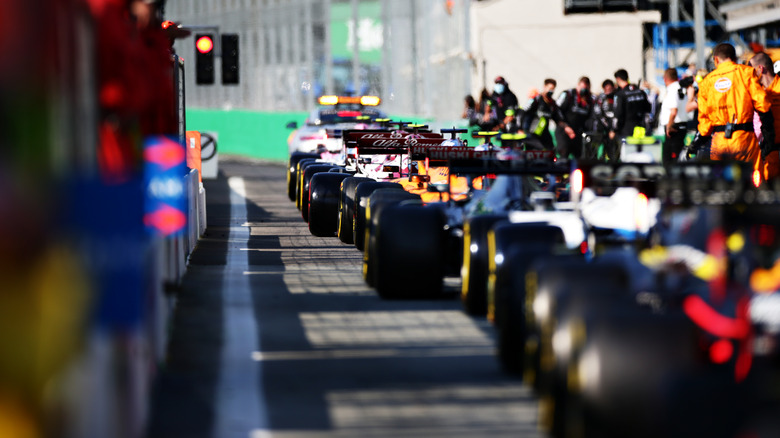
F1 cars are technological tours de force that leave many people scratching their heads about how everything works. Sometimes, though, the Formula 1 rules and regulations themselves cause confusion, given the myriad laws that govern the sport. One group of rules that newer fans may not know cover why some F1 cars start the race from the pit lane instead of the start grid, and how they have to line up there.
Drivers starting from the pits may have been told to do so due to them violating certain rules and regulations, while some choose to do it to gain an advantage if they've qualified poorly. Still, while a handful of drivers have won races after starting from the back of the grid, no one has ever won from the pit lane. The most notable performance came from Sebastian Vettel at the 2012 Abu Dhabi Grand Prix, when he started from the pit lane and finished third, the same season he won his third drivers' championship.
What are a few reasons for F1 drivers starting from the pit lane? Let's have a look.
Parc fermé rules
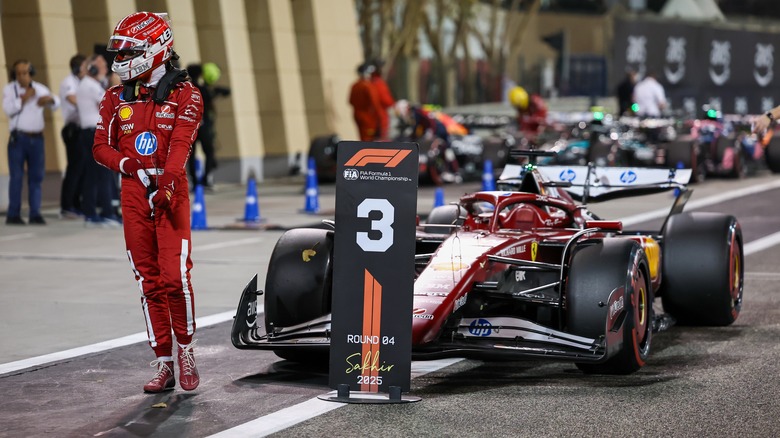
F1 cars will automatically be sent to start from the pit lane if they violate the "parc fermé" rules. The term is French for "closed park," the parking area where cars must be left after qualifying, and these rules are enforced as soon as the car drives out for the first qualifying session. The teams can't make changes or replace major components on the car for the rest of the race weekend.
Once qualifying ends, the cars will be scrutineered by race officials. When the car is parc fermé, it doesn't mean that the mechanics won't be allowed to work on the car after the qualifying session to prepare it for the race. Teams are allowed to inspect and repair the car for 3½ hours after qualifying, as well as five hours before the formation lap on race day.
As per Article 40.6 of the F1 Sporting Regulations, under parc fermé rules brakes can be bled and cleaned, the front wing can be adjusted, the car can be cleaned, and bodywork that has been damaged can be repaired without altering its geometry. In addition, fluids can be changed, the engine started, and wheels removed and tire pressures adjusted. Teams are also allowed to make small changes to aid driver comfort. If the race director deems that there has been a change in the "climatic conditions," teams may alter their cooling systems.
Teams opt to start from the pit
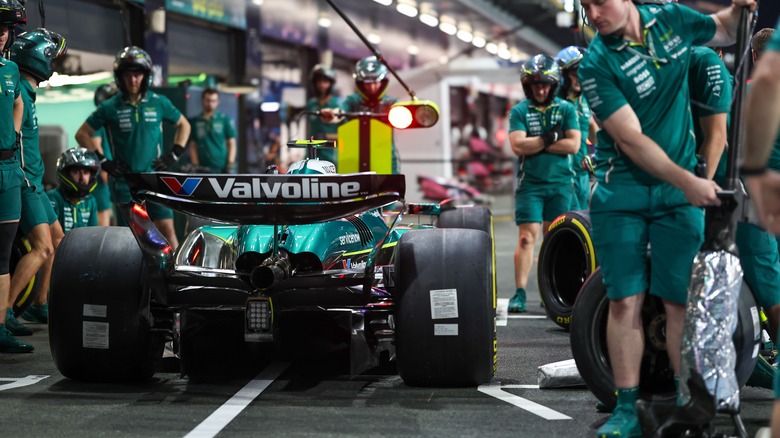
Each F1 driver has a fixed number of power unit elements it can use each season, a rule instituted to save costs. F1 drivers are allowed four engines, four motor generator units-heat, four motor generator units-kinetic, four turbochargers, two energy stores, two control electronics, eight exhaust-system elements, and five gearboxes per season. In case they exceed the number of engine elements, they will receive a 10-place penalty, and a second offense will lead to an additional five-place penalty.
The gearbox consists of two component groups — one comprising the gearbox case and cassette, and the other comprising the gearbox driveline, gear-change components, and auxiliary components. Each driver has an allocation of five of each per season, and exceeding the allocation in either group incurs a five-place grid penalty. Replacing both at once results in a 10-place grid drop.
Due to the restrictions on the number of engines and gearboxes a driver can use, some teams and drivers strategically take engine and gearbox penalties to get fresh components and extract maximum performance from their cars, even if it means starting from the pit lane. This lets them work on the cars after breaching parc fermé rules, enabling adjustments to suit track conditions and fuel load.
Violation of grid start regulations
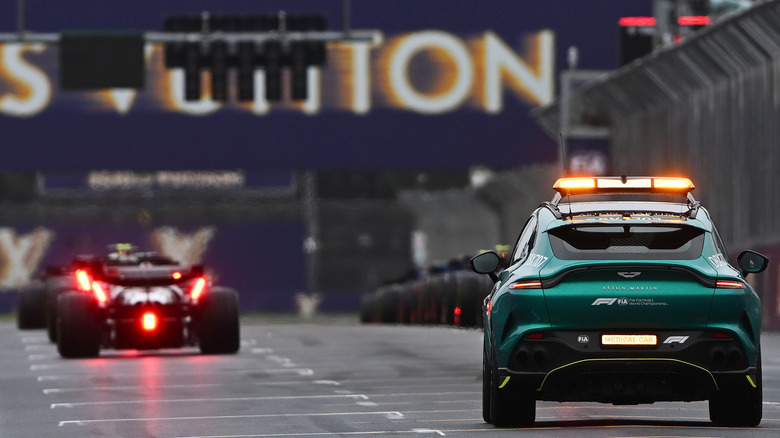
F1's sporting regulations (44.1) state that qualified cars must arrive at the grid using their own power — that is, they must drive out of the pit lane and can't be pushed to the grid slot. They must also leave the pit lane 30 minutes before the start of the formation lap. Cars must start from the pit lane if either of these rules is breached. F1 also has strict rules on the number of personnel that can work on the car on the grid, as well as when they have to disperse and stop working on the cars.
Team personnel must start the engine when the one-minute warning is given by the race director, and they may not work on the car once the 15-second warning is issued. Even a single mechanic touching the car at that point will result in the driver being forced to start the race from the pits (44.6). If the driver has an issue with the car, he must signal to the rest by raising his hand, and the race marshals will then wheel the car into the pit lane once the rest leave the grid. The team can work on the car, but the driver cannot rejoin the grid and must start from the pit lane (44.6 b).
Drivers who have lost their place during the formation lap due to a technical issue, or say, a spin, and are unable to gain it back before the first safety car line, will also be told to start the race from the pits (44.9).
What happens if many start from the pits?
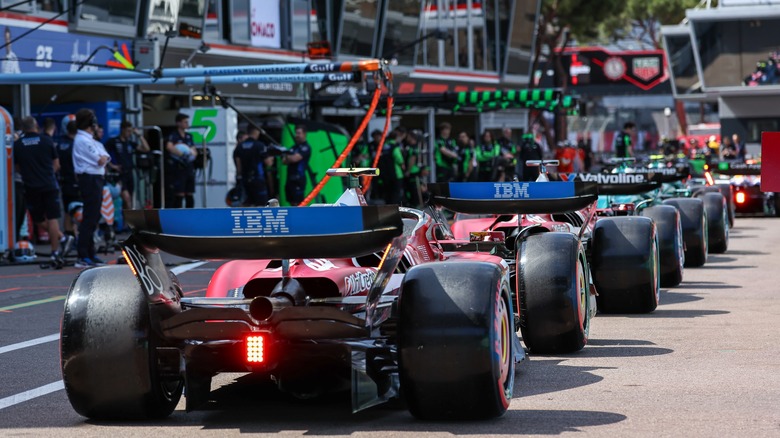
There's always the possibility of more than one driver starting from the pit lane during an F1 race, which can cause some confusion. How is it determined who gets to be at the head of the queue in such a situation?
Cars starting from the pit lane with 15 or fewer grid penalties are assigned a temporary position based on their qualifying result and the penalties they've received, known as their cumulative grid position. If two drivers have the same cumulative grid position, their qualifying order decides who goes ahead. Drivers with more than 15 grid penalties start behind them (Sporting Regulation 42.3).
Drivers starting from the pit lane may only leave once the last car on the grid has passed the pit exit and the green light is shown in the pit lane. For the 2025 season, F1 introduced a new rule requiring cars starting from the pit lane to complete the formation lap with the rest of the grid before re-entering the pit lane for the start.