

How Reliable Are Tire Pressure Monitoring Systems? Here's What AAA Says
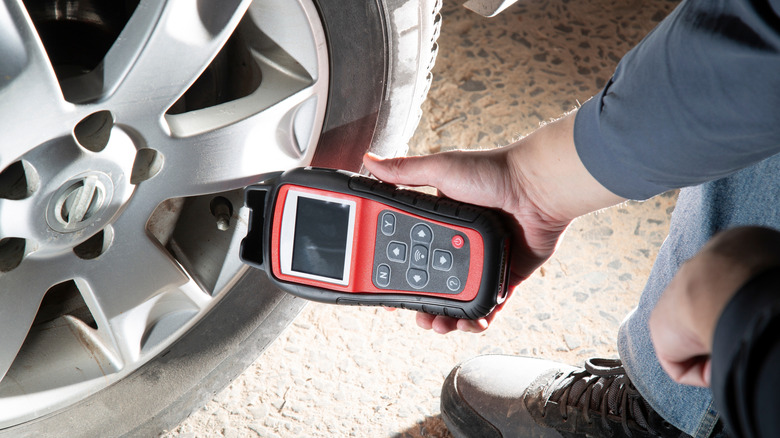
The tire pressure monitoring system (TPMS) is perhaps one of the most underappreciated safety features in modern cars, as it can save you from a gnarly crash or keep you from getting stranded on a deserted stretch of road. A 2012 NHTSA survey revealed that the presence of a TPMS has reduced the likelihood of under-inflated tires by 55.6 % (via Schrader).
In 2023, AAA tested 11 cars and their TPMS to verify accuracy. Testers parked the cars in the shade before inflating the tires to the manufacturer's recommended pressure. AAA then drove the vehicles under different conditions, checking the tire pressure afterward and comparing it to what the instrument cluster displayed. The tested models came from brands such as Ford, Tesla, BMW, Cadillac, Toyota, and Hyundai, among others, from model years 2022 to 2024.
The Tesla Model 3 was the best performer, showing no deviation between the displayed and actual pressure, while most others deviated by no more than ±1 PSI. The Cadillac Escalade and Ford F-250 were the least accurate, with the former showing a deviation of 1.2 PSI in one tire and the latter deviating by up to 2 PSI.
Your TPMS is probably reliable but shouldn't replace manual tools
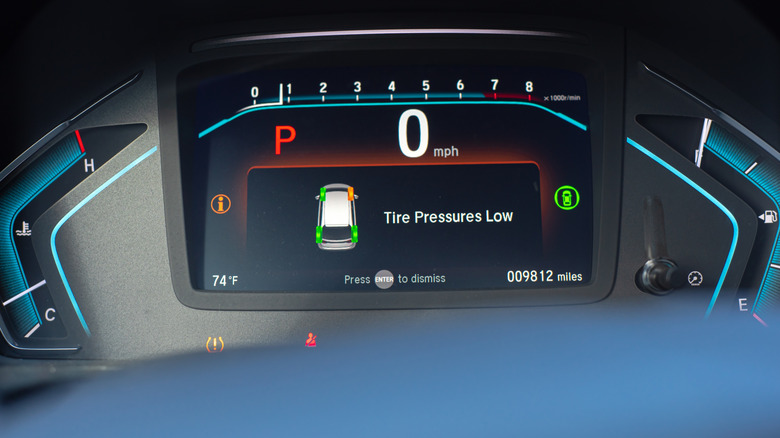
In its 2023 test, AAA also checked the vehicles' TPMS warning lights, which should display when a tire falls below 75% of its recommended pressure. Five vehicles on the list — 2023 BMW i760x, 2022 Ford F-150 Lightning, 2023 Ford Maverick, 2023 Lexus RZ450e, and 2023 Tesla Model 3 (which, along with Tesla's Cybertruck, was recalled in 2024 for TPMS issues) — warned the driver when tire pressure fell below 75%. The 2022 Ford F-250 was the only vehicle that didn't show any warning.
In its report, AAA wrote that it was "encouraged" by the findings, as the tire pressures displayed on screen closely matched those measured with an air pressure gauge, with only a 1.2% to 1.5% deviation. The exception was the Ford F-250, whose warning light didn't light up even when tire pressure fell to 65% of the manufacturer's standard.
AAA recommends that owners periodically use a handheld gauge to ensure their TPMS is providing accurate readings (this can also help you get the most miles out of your tires). The company also advised that drivers physically inspect their tires for wear, tread damage, or sidewall issues, and that drivers monitor individual tire pressures on the instrument cluster, since the warning light only activates when a tire's pressure falls below 75% of the manufacturer's recommendation.