

Is Lane Splitting Legal In Colorado In 2025?
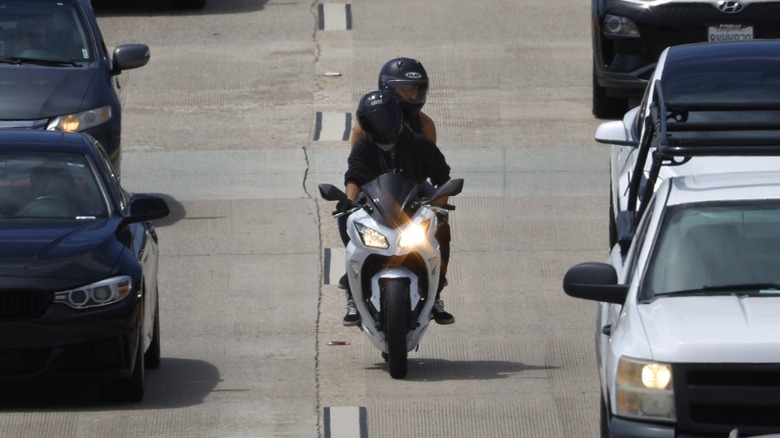
On August 7, 2024, a new law came into effect in Colorado that allows motorcyclists to pass or overtake stopped cars in the same lane. Riding between cars or sharing lanes had been expressly illegal up to that point, a restriction that was enforceable by fines and points. With the new law, however, Colorado joins California, Arizona, Montana, Utah, and Minnesota in making some form of lane splitting legal. Other states, like Texas and Connecticut, have recently considered laws introduced that would allow it, the practice remains illegal in most areas of the U.S.
Lane splitting, or riding between moving vehicles, has long been practiced by motorcyclists. It's a convenient way for a motorcycle to overtake slow-moving vehicles when traffic makes it impossible to use the next lane over to pass. It can also help prevent a rider from getting rear-ended by other vehicles. So does this new law make lane splitting legal in Colorado? Nope — lane splitting is still prohibited. What the new law describes is actually lane filtering which is similar but distinct in some important ways.
Lane splitting versus lane filtering
So what, exactly, is the difference between lane splitting and lane filtering? Lane splitting is when a motorcyclist rides between moving vehicles, and this is still illegal in Colorado. In fact, the only state where it is completely legal is California. True lane splitting remains illegal everywhere else in the U.S., which means that states like Colorado, Minnesota, Montana, and Utah have all legalized some version of lane filtering.
Lane filtering is when a motorcyclist passes or overtakes stopped or slow-moving cars in the same lane. The new Colorado law specifies that cars must be stopped when a motorcyclist passes them in the same lane. This is commonly done at stop lights, when a motorcycle rider will pass a line of stopped cars and pull up next to the front car without leaving the lane. Once traffic starts moving, the rider must stop filtering through the lane. The new law also specifies that the rider may not exceed 15 miles per hour when doing this and may not pass on the right.
Is lane splitting safe?

It's obvious from the many conflicting laws among various states that there is a difference of opinion on whether lane splitting or lane filtering is safe. However, Colorado Senate Bill 24-079 – which amended the law on lane splitting to allow for filtering — cites several safety studies to justify the decision.
The research listed includes a 2009 study by the European Association of Motorcycle Manufacturers which found that "motorcyclists were seven times more likely to be hit while stopped compared to crashing while lane splitting". It also cited two studies in California that concluded that motorcyclists are 43 percent less likely to be rear-ended when they split lanes.
The data on lane splitting isn't completely cut-and-dry, however. Consumer Reports shared a 2012 survey of motorcyclists conducted by the California Office of Traffic Safety which found that 14.9 percent of respondents had been in an accident while lane splitting. Beyond that, a French report released in 2021 found that lane splitting led to motorcycle accidents going up by 12 percent in areas under study.
Ultimately, riders and drivers alike need to drive defensively, be aware of their surroundings, and follow the local laws — even if those laws are changing soon.