

How The Subaru BRAT Got Its Name (And How It Helped Dodge Taxes)
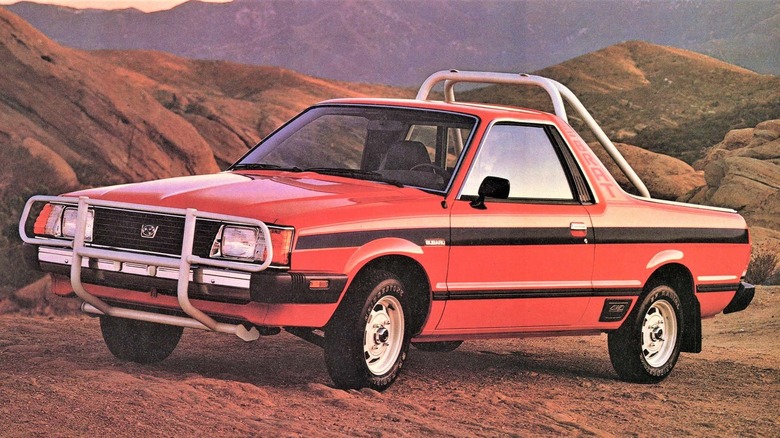
During the 1970s energy crisis, Americans began to embrace smaller, more fuel-efficient vehicles, as opposed to manufacturers' previously bragging about portliness. Even the hallowed pickup truck wasn't exempt from the right-size movement. Japanese automakers were well positioned to fill this mini-truck void because such vehicles already existed en masse owing to space constraints in Japan. By the latter part of the disco decade, Subaru decided to carve out a piece of import truck sales alongside Toyota, Mazda, and others. To expedite this endeavor, Subaru opted to remove the rear portion of its Leone station wagon and mount a cargo bed instead.
Whether you call them coupé utility vehicles, utes, or whatever, Subaru's little truck joined the likes of the Chevrolet El Camino and Ford Ranchero in 1978. Like the automotive equivalent of a mullet haircut, it's business in the front and party in the back. Subaru chose the name BRAT for its creation, short for Bi-Drive Recreational All-Terrain Transporter. That first bit is in reference to the BRAT's part-time selectable all-wheel drive system. The BRAT was never sold in its home country of Japan, but it was sold in other world markets besides the United States under a myriad of different names. Some of the more interesting BRAT alter egos include Brumby, Shifter, and Targa.
Playing a game of chicken
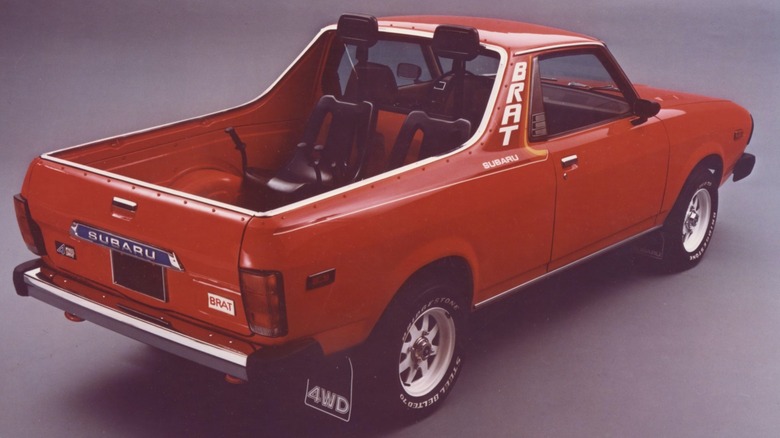
Besides its funky styling and playful name, what many enthusiasts remember about the BRAT is the two rearward-facing seats mounted in the cargo bed. This strange but clever workaround was designed to avoid paying a 25% tax levied on imported pickup trucks. Because this tax was originally intended as retribution for European tariffs on American poultry, it's known as the "chicken tax." Initially, the chicken tax was targeted at Volkswagen trucks and vans from Germany, but before long, Japanese truck manufacturers were caught in the trap.
Incredibly, the chicken tax still exists today, but Subaru was able to sidestep it by classifying the BRAT and its extra seats as a passenger car, subject to only a 2.5% tariff. In the last few years of the BRAT's production run, the bed-mounted seats were absent after being declared patently unsafe by safety authorities, which meant that quirky tax loophole was also shut.
BRAT sales in the U.S. ceased in 1987, although it soldiered on in other parts of the globe until 1994. If you're pining for a BRAT of your own, perhaps as the perfect summer project, know that you're in good company. Former President Ronald Reagan owned a brand-new 1978 BRAT on his ranch until it was donated to charity in 1998.