

2025 Porsche 911 Carrera Might Be The Best Base Model Money Can Buy
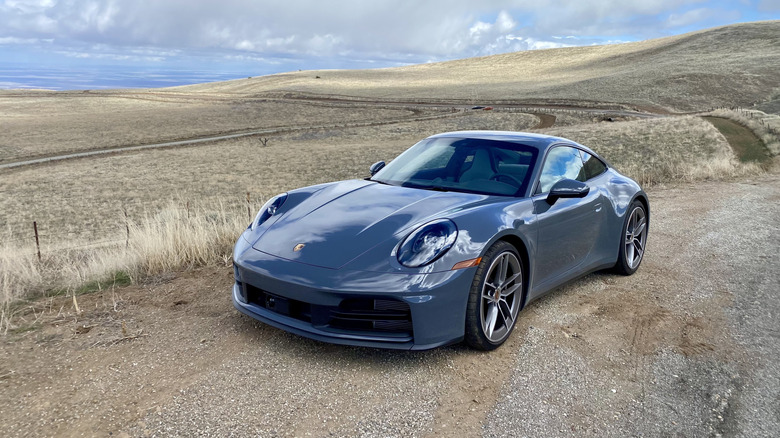
I was a durability test driver for Porsche and Audi earlier in my career, which sounds really cool but it just meant that I drove hundreds of miles on traffic-filled public roads every day. The last (and only) time I drove a 911 was a 991.2 GT3 RS, one of the most hardcore models in the lineup, so I was eager to get behind the wheel of the rear-wheel-drive base model Carrera version of the updated 992.2 and reacquaint myself with the rear-engine legend. I was skeptical that the 2025 Porsche 911 Carrera would live up to all the praise the 911 receives every time it's reviewed. Spoiler alert: It is just as good as everyone says. Almost annoyingly so.
Full disclosure: Porsche gave me a 2025 Porsche 911 Carrera for a week, and what a wonderful week it turned out to be. I used it as a daily driver through the tight and chaotic streets of Los Angeles, a long distance drive down to a drive program near San Diego, and even did a sizable Costco haul with it and it never once felt out of place. Thanks for lending me your excellent car, Porsche!
There's one big reason to avoid the base Carrera
The 992-generation Porsche 911 was introduced way back in 2020, and its facelift debuted earlier this year. As is tradition with the vaunted 911, the mid-cycle changes for 2025 are relatively discreet, but the 911 is such an overall good car that new generations typically don't really need more than occasional minor tweaks.
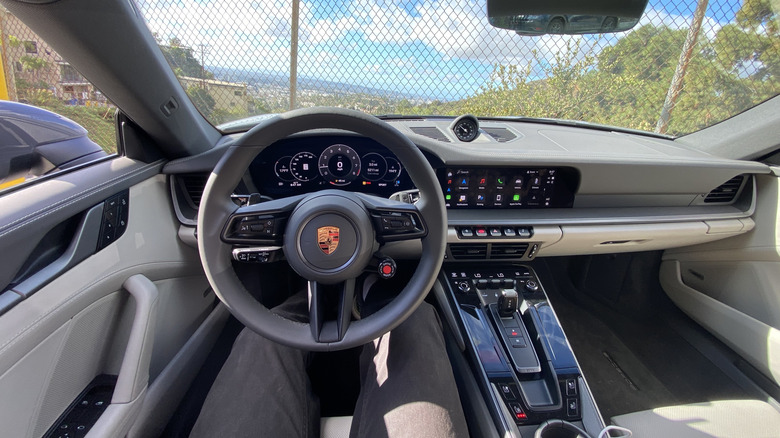
The 911 lost two traditional features of the model for 2025, and the base Carrera continues without one very important feature which will have purists looking elsewhere. No longer on the 911 with the new 992.2 generation are of course the analog tachometer and the left-mounted twistable starter, while the feature that remains absent from the Carrera's spec sheet is a manual transmission. As long as you aren't allergic to technology, you won't mind the way these traditional features are replaced; the new digital gauge cluster is exceptional, the still-left-mounted start button is a no-brainer, and the eight-speed automatic PDK transmission is about as good as an automatic can get. If you really want a manual, you'll have to go for the Carrera T, or step up to a GT3 model. As it stands, though, the standard rear-wheel-drive base model Carrera offers more than enough performance for the vast majority of drivers while remaining a viable comfortable daily driver.
2025 updates are minor
Power outputs of the 992.2 Carrera are almost the same as the outgoing car despite receiving the previous-gen GTS' larger turbos and the larger intercooler from the 911 Turbo. The rear-mounted twin-turbo 3.0-liter flat-6 now produces 388 horsepower, up 9 hp, and the same 331 pound-feet of torque as last year. Don't despair, though. I assure you even with the base powertrain, the Carrera's power never feels lacking.
Purists may decry the omission of the 911's traditional center-mounted analog tachometer, but I found the new fully digital gauge cluster to be quite nice. The graphics are incredibly sharp, and it opens up the space for a full map display or an array of other views in the gauge cluster. Does it make the 911 any better to drive? Not really, but it does feel like it modernizes the user interface. Another nice update for tech fans is the 2025 Carrera's standard Matrix Design LED headlights; HD-Matrix Design LED lights are optional.
 Logan K. Carter/ Jalopnik
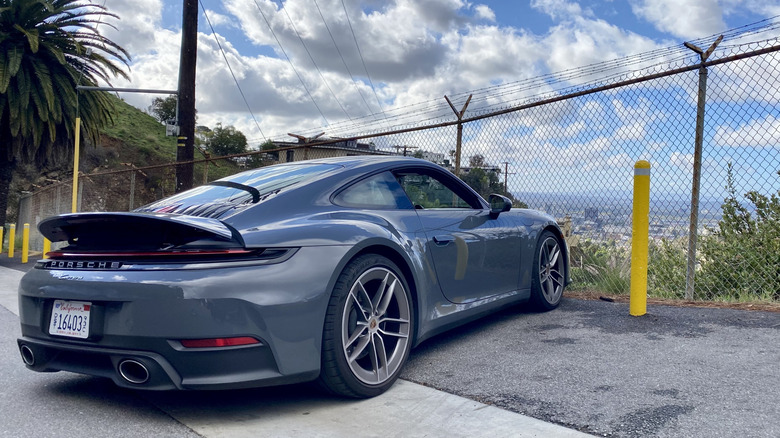
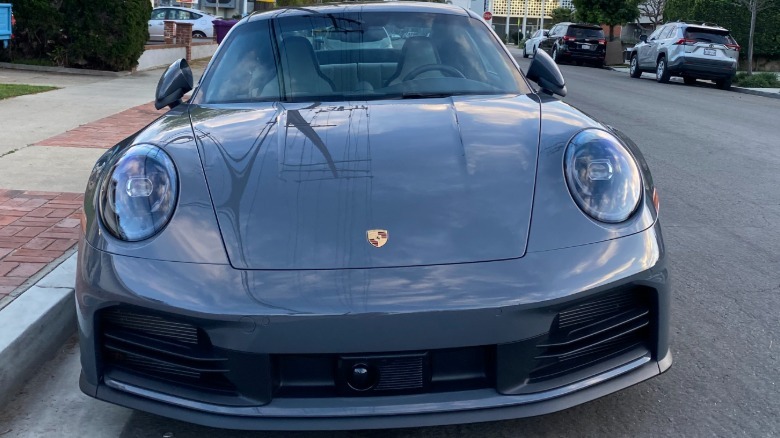
On the exterior, it takes a keen eye to identify a 992.2 from a 992.1, but it's easiest to discern from behind. 992.2 models receive a new taillight bar and a reworked lower section of the rear bumper, which moves the license plate up higher, addressing what I felt was the 992's least flattering angle. Up front, the lower air intakes have been reworked, visually widening the front of the car and making it look that little bit more aggressive.
Enough boring stuff, what's it like to drive?
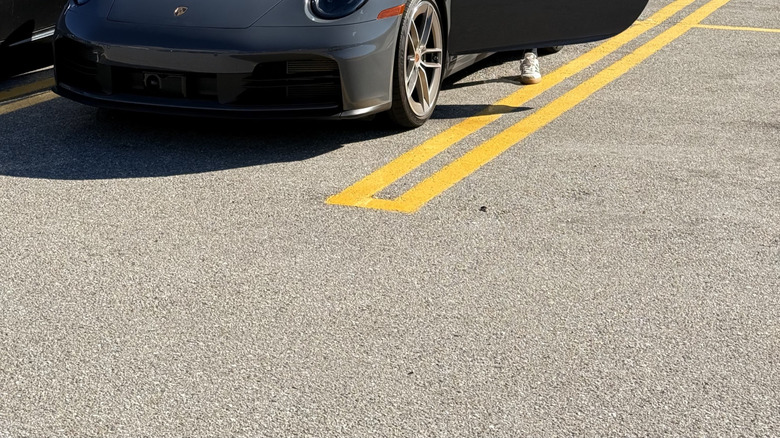
The Carrera's power increase may be limited to a modest 9-hp bump over last year's model, but it still results in faster acceleration times. Base Carrera coupes now complete the 0-to-60-mph run in 3.9 seconds, or 3.7 seconds when equipped with the $2,400 Sport Chrono Package. Both of those figures are 0.1 second faster than the outgoing model, and both are obscenely impressive for a base model car. If you prefer your Carrera in tasty Cabriolet form, the extra 183 pounds added to the coupe's 3,342-pound curb weight adds 0.2 seconds to the droptop's 0-to-60 times. If 4-ish second 0-to-60 times aren't quick enough to satisfy you then cough up the extra dough to go for a more powerful 911, but honestly my Sport Chrono–equipped Carrera coupe press car still made me giggle on launches and scared the crap out of my passengers.
Conveniently, my car friends decided to plan a group drive on the weekend that I had this Carrera, so I got to wring it out on one of my favorite driving roads, and much to my chagrin it was just as brilliant as everyone said it would be. Even in its base form, the rear-engine, rear-wheel-drive Porsche 911 Carrera is mind-bogglingly capable with astounding grip levels that feel like you're defying the laws of physics. Every aspect of its driving dynamics feels like it has been fine-tuned and optimized to the fullest extent possible; I never felt like it needed a power boost or even more downforce, so do not turn your nose up to the Carrera just because it's technically the base model.
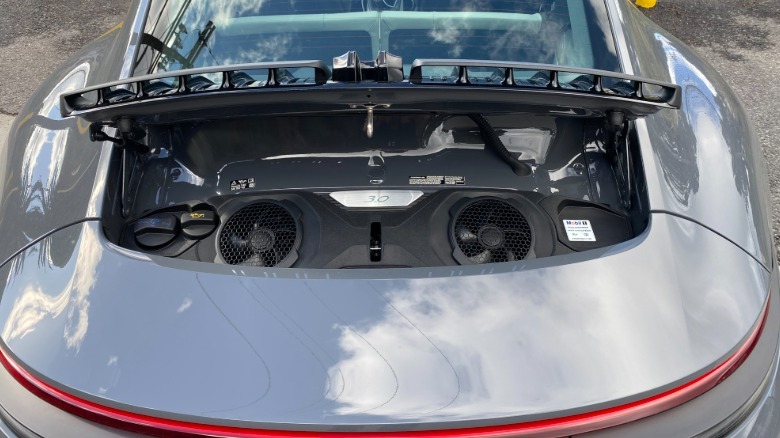 Logan K. Carter/ Jalopnik
The steering in the 911 is like talking with your best friend, it feels easy, honest, and enjoyable. It's one of those steering racks that feels like all you have to do is spot the apex of a corner and the next thing you know you hit it masterfully and you're ready to do it all over again. The steering wheel itself is thinner than I've encountered in a new car before, and while it does provide some feedback, I know Porsche is capable of making it feel even more communicative.
That's the thing about the Carrera — it does everything so technically well, and with such brain surgeon-like precision, that it feels somewhat clinical. I know I sound crazy saying that it's too good for its own good, but I prefer cars with quirks and character over the most technically capable and precise option, even if that means having more flaws. The Carrera made me laugh in disbelief at its grip levels and performance abilities, but not necessarily because I was having a blast, more so because I was acutely aware that I might not survive if that prodigious grip suddenly lost its battle with the laws of physics. This is a mighty capable and impressive machine, but not one with a great sense of humor. Would you rather take a pragmatist to bed, or a romantic? There's no wrong answer, but I would go for the romantic.
Daily driving a legend
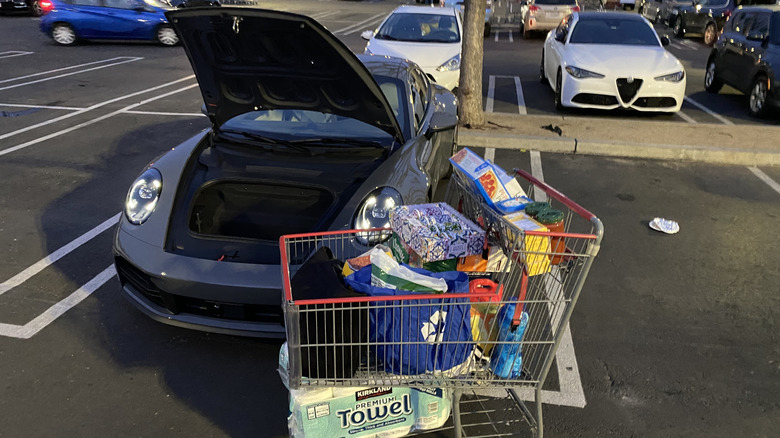
In daily driving the 911 doesn't feel cumbersome or frail like some of its more exotic competitors. I averaged an impressive 27 mpg on a two-hour drive from Los Angeles down to Carlsbad, and it handled a sizable Costco run better than I expected. But the engine, while being plenty powerful, doesn't light up unless you're wringing its neck.
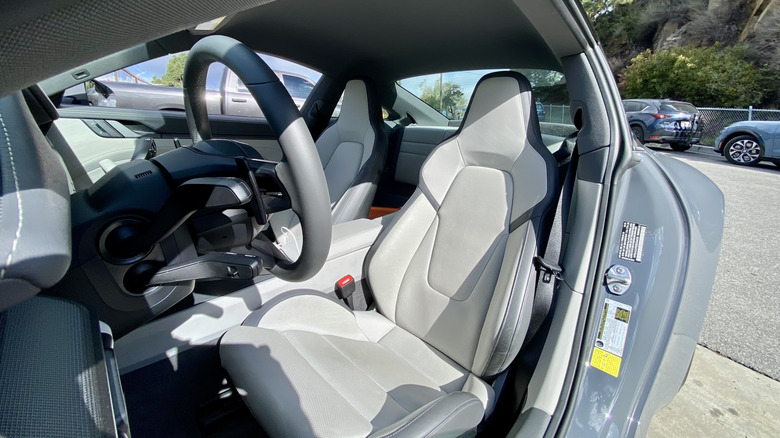
Historically, one of the 911's biggest appeals, though, is how well it handles the day-to-day despite its mind-bending performance abilities, and that doesn't change here. It's quite a tame car to daily drive, and its compact size is a boon around town. Unlike many sports cars, the 911 doesn't scrape its chin on every bump and dip that's larger than a slice of bread, and its interior is spacious for a sports car of this caliber, too; all 6-foot-8 of me fit comfortably behind the wheel, with headroom to spare, in fact. Once you've got the $3,470 18-way adjustable Adaptive Sport Seats perfectly positioned for your posterior, you'll be delighted to find that all the important vehicle controls are laid out logically, and with a reasonable amount of easy-to-use physical toggles and switches. And should you need it, you can always press that big red Sport Response Button on the steering wheel dial and you instantly have access to all of the nearly 400 horsepower that were quietly hiding out back.
The twin-turbo flat-6 is quite mild-mannered until about 5,500 rpm, when it suddenly starts sounding like a lion whose tail just got stomped on by an elephant. The engine note changes and for all intents and purposes enters god mode for the brief, glorious moment it takes to reach its 7,500-rpm redline. Those upper 2,000 revs raised the hair on the back of my neck and made me say, "ohhhh I get it now." It feels quite naturally aspirated, and rewards you greatly for running it out to redline.
It's just hard to access that upper rev territory in day-to-day driving. Prior to receiving this 911 I had a 2025 Mini Cooper S 4-Door press car, and I had more fun chucking the Mini around in day-to-day driving than I did the 911, all while remaining (relatively) close to the posted speed limit.
On the plus side, as someone who is of the poor and for the poor, I drove the 2025 Porsche 911 Carrera S a week after I had the base Carrera and I am happy to report that upgrading to the Carrera S nets incredibly minute benefits. That means you don't have to worry about what you're missing out on by going for the Carrera and not the Carrera S, you can save your money.
Other minor annoyances
I'm a big fan of adaptive cruise control, but in this 911 the standard adaptive cruise control system required frequent driver intervention in situations that didn't warrant any confusion. The issues ranged from intermittently staying unreasonably far away from the lead vehicle, to more severe issues like following phantom lanes and getting me uncomfortably close to semi trucks and k-rails under freeway overpasses. These problems weren't frequent but they were concerning, and serve as a reminder that the driver needs to pay attention to the road whether ACC is active or not.
Other than a minor complaint that the seat ventilation fans were weirdly loud, my other big gripe is with the wireless phone charger that happens to live under the center armrest. It might as well be marketed as an in-car air fryer the way it heats your phone up instantly — it overheated my phone a couple of times, and to top it off it's way too easy to forget your phone inside the arm rest since it's out of sight and out of mind.
If you can afford a 911, just buy one
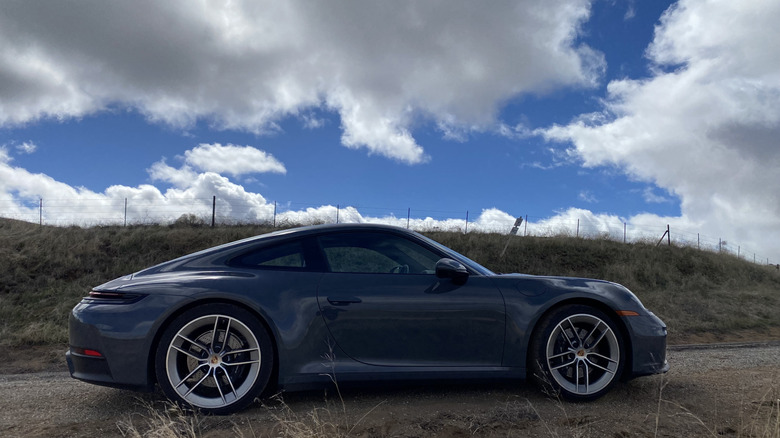
911s are expensive cars. The cheapest 911 Carrera you can buy costs $120,100 (including $1,995 for destination), and my press car totalled $148,155. The optional extras included the $2,980 Slate Gray Neo paint, $4,960 Slate Grey/ Chalk leather interior, a $230 extended range fuel tank, the $2,960 Sports Exhaust System, $3,820 for the gorgeous 20/21-inch wheels, $2,400 for the Sport Chrono Package, $3,470 for the 18-way Adaptive Sport Seats Plus, and the $5,200 Premium package that includes surround-view cameras with automated parking, ventilated front seats, Lane Change Assist, an ionizer and a passenger footwell storage net. Of those options, I'd probably forego everything except the Sport Exhaust, endlessly adjustable seats, and Sport Chrono Package.
If you're one of the people who has saved up their whole life to finally get a taste of Stuttgart's finest, you'll be happy to learn that you aren't missing out on anything by going for the least-expensive version of the Porsche 911. Unless you are a thoroughly experienced performance driver or you plan to take your 911 to the race track frequently, the 911 Carrera is more than enough car for you.
The 911's limits are pretty mind-bending, but if you're a poor kid reading this fantasizing about driving a 911 like I was 10 years ago, know that its magic comes from its composure, refinement, and stability. Other cars are more exciting, visceral, rowdy, and boisterous, but the Carrera has so many fans because it's so easy to get along with. Thrashing one on your favorite road is impressive and you're able to attack it at speeds you may not have thought possible, but its biggest selling point is being a comfortable, capable, drama-free, and obscenely rapid car.
 Garret Donahue