

7 British Sports Cars That Simplified And Added Lightness, Ranked Smallest To Largest
The late, great Colin Chapman coined the phrase "simplify, then add lightness," but it's a saying that modern performance cars seldom understand. Where minimalism was once the catalyst for speed, nowadays, manufacturers instead turn to turbocharged engines, heavy use of technology, and increasingly complicated shapes to improve high-speed efficiency. This means performance cars have grown substantially in size over the decades, to the point where something weighing over a ton-and-a-half is now considered light. Alas, we go back to Chapman's famous words. Instead of chasing pure power with displacement, the founder of Lotus proved that losing dead weight was a more effective method of finding speed compared to adding displacement: You can get the same power per pound, but you can also get on the gas sooner, brake later, and corner with more ferocity.
It was an ethos that not just Chapman lived by, but a number of British manufacturers too. Caterham is perhaps the most extreme example of this, and it does still actually build small, lightweight cars. Ginetta is another, and it draws on years of experience in motorsport, effectively distilling its learnings from the track onto the road. In short, Britain has a lot of companies that have taken Chapman's approach and added their own bit of seasoning on top. And in celebration of those manufacturers and the resulting products, we're counting down seven of the smallest, lightest sports cars to emerge from the British Isles and ranking them by length.
Caterham Seven 170 (125.2 Inches)
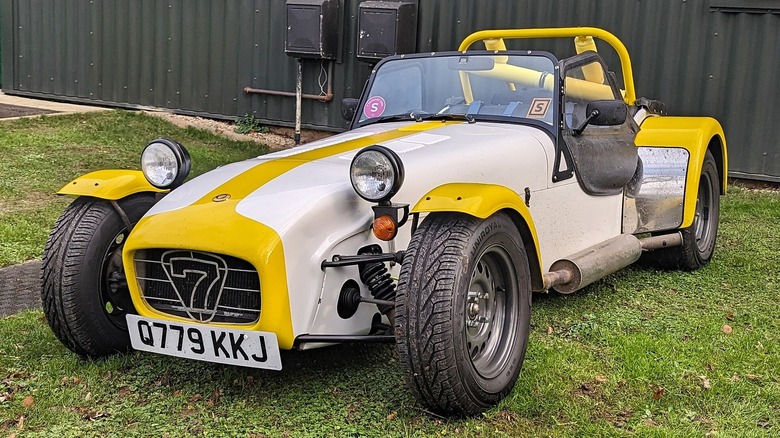
Perhaps the one modern car that encapsulates Chapman's philosophy best is the Caterham Seven 170 — the smallest and lightest production car Caterham has ever made. It measures in at just 125.2 inches long and 57.9 inches wide, which almost sounds impossible in today's world, but it does exist. In fact, the 170's diminutive size even qualifies it for Japan's Kei-car regulations. It also has a dry weight of just 970 pounds, which is about a third of what a regular hatchback, like a Honda Civic, weighs. Crazy, right?
Hold on, it gets better. To keep weight as low as possible, Caterham's powertrain of choice is a teeny tiny 660cc turbocharged three-cylinder Suzuki engine. It may only produce a mere 84 hp and 86 lb-ft of torque, but since the 170 has the same mass as a ball of wool, its power-to-weight ratio shoots up to 170 hp per metric ton (hence the name). That power is sent to the rear wheels through a back-to-basics five-speed manual gearbox, with 0 to 62 mph complete in 6.9 seconds. Caterham will also sell you an "R" version of the 170, which gains race seats, a carbon-fiber dashboard, and four-point racing harnesses. It's basically just an engine, two seats, and a bit of scaffolding holding the whole lot together — just as it should be. In fact, the Caterham is so good, it can take you from stalls to slides in a single day of drift school.
Lotus Elan Series 1 (145.2 Inches)
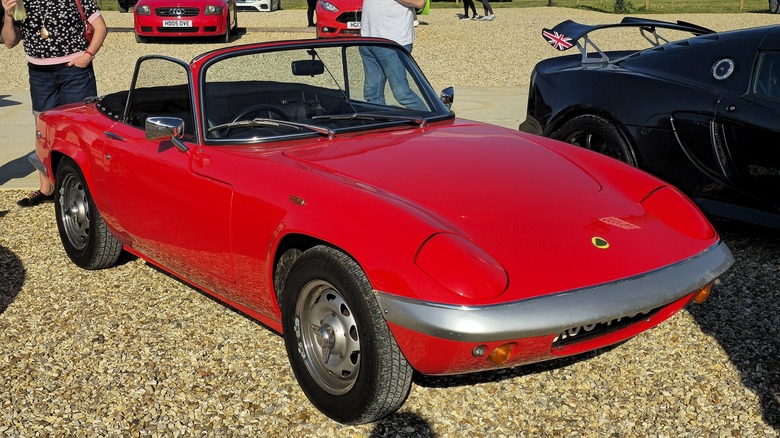
The Mazda MX-5 Miata may be the familiar two-seat, two-door, minimalist sports car of today, but the first-generation Lotus Elan perfected Chapman's blueprint for lightweight roadsters decades prior in 1962. Measuring in at just 145.2 inches long and 56 inches wide, it was, and probably still is, the perfect car to hustle down a narrow country road. More supporting evidence comes from a curb weight of around 1,200 pounds, achieved thanks to the use of an innovative steel backbone chassis and a fiberglass body shell.
Meanwhile, providing power is an extremely lively 1.6-liter Lotus-Ford twin-cam inline-4 producing up to an estimated 108 hp. That was directed to the rear wheels via a four-speed stick, and if you got your changes spot on, it's possible to hit 60 mph in around nine seconds. That may not sound supersonic by today's standards, but remember: This car is the same age as Jim Carrey. And more important than outright speed is how the Elan cornered. Thanks to independent four-wheel suspension and proper disc brakes at each corner, this thing is a showstopper when things get twisty.
Lotus Elise Series 1 (146.7 Inches)
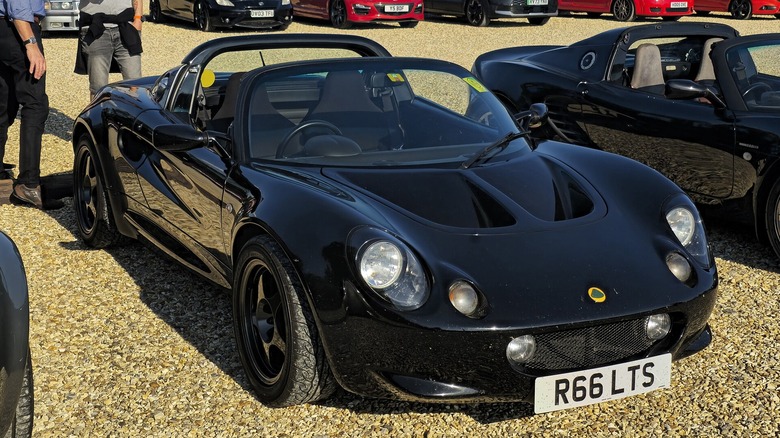
After Chapman died in 1982, Lotus started to hit serious financial troubles that wouldn't really be solved until the first-generation Elise was launched in 1995. It saved the company, with sales far exceeding what was being projected, and even today, it's easy to understand the appeal. Its tiny dimensions of 146.7 inches long and 67 inches wide meant the Elise was barely any bigger than a regular hatchback. Yet its frame was built using a bonded, extruded-aluminum tub held together with aerospace-grade resin. It weighed just 150 pounds and formed the basis for some truly incredible builds such as this Integra Type R-swapped left-hand-drive Series 1 Lotus Elise.
The entire car tipped the scales at just under 1,600 pounds, so it didn't need a big, heavy engine to deliver some kicks. Lotus decided on a naturally aspirated Rover K-Series inline-4 for the base engine, mounted just behind the two-seat cabin and good for 120 hp and 122 lb-ft of torque. Zero to 62 mph could be done in as little as 5.9 seconds if you're showing good form with the five-speed manual, while top speed was capped at roughly 126 mph. Like the Elan, though, the Elise's party trick was the way it blitzed through corners: Unassisted rack-and-pinion steering, no power brake, and double-wishbone suspension all round mean the Elise remains one of the great handlers ever.
Ginetta G40R (147.6 Inches)
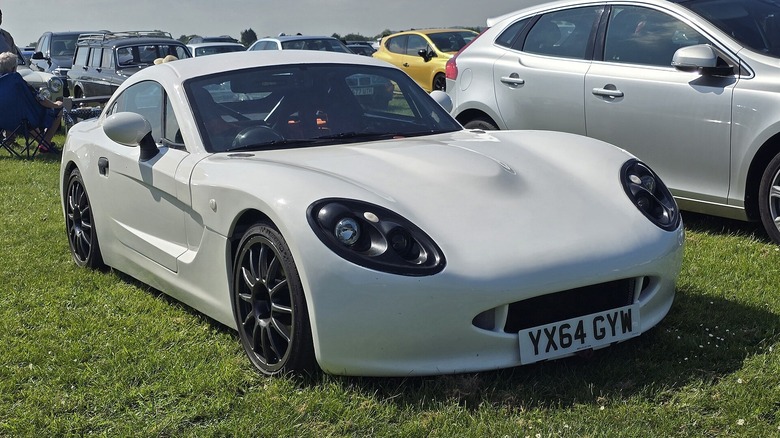
For more than six decades now, Northern England-based Ginetta has been a gateway into motorsport for many would-be racers. It has had similar success with road cars, and we have to give a big shout-out to its G40R. Its formula is nothing short of fantastic. The two-door coupe tips the scales at just 1,874 pounds in its basic G40 form, and sheds more than 100 additional pounds in its road-legal G40R edition, which was introduced in 2010. What's more, every G40R comes with the same FIA-approved roll cage as Ginetta's Junior competition car, so it is quite literally a race car for the street.
The front-mid-mounted naturally aspirated four-banger delivers around 175 hp and 140 lb-ft of torque, sent through a six-speed manual transmission to the rear wheels. The result is 0 to 62 mph in just 5.8 seconds before it hits the limiter at 140 mph. It's quick on the straights, but the true magic lies in how this thing corners. There's plenty of grip, and it's easy to thread the front end of the G40R precisely where you want it to be. Its stiff, motorsport-derived chassis makes it agile, while the 11-inch, four-piston rear and two-piston front brake discs take the edge off the G40R's impressive pace.
Lotus Exige Series 1 (148 Inches)
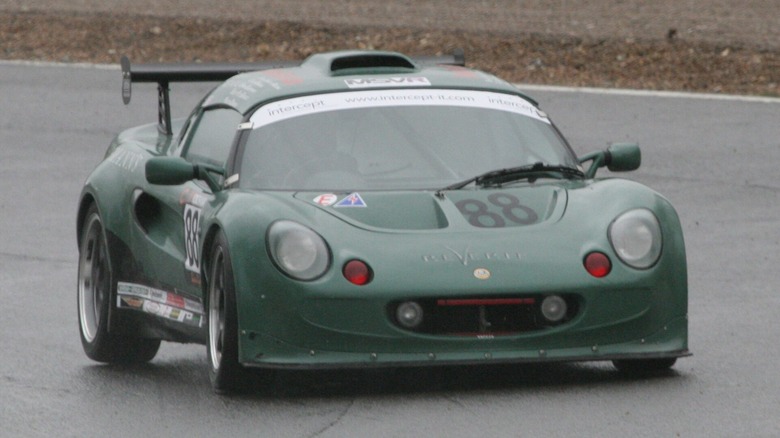
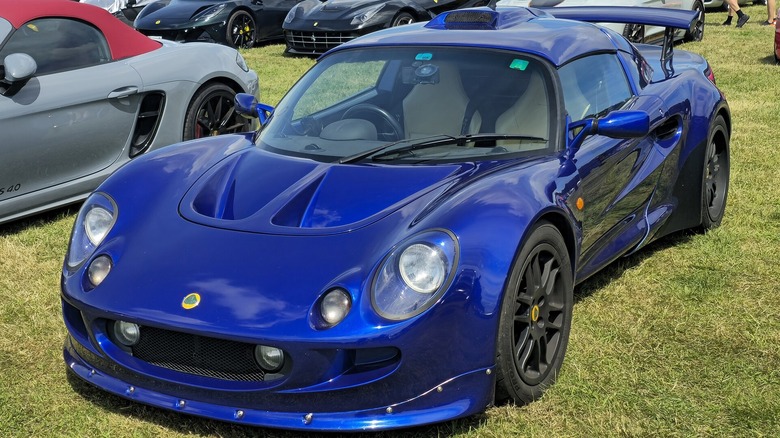
If the aforementioned Series 1 Elise was a surgical scalpel for carving up back roads, the Exige S1 it birthed is a full-bore hunter's scimitar meant to devour the world's race tracks with millimetric precision. It has a slightly longer and wider body than its roadster sibling at 148 inches long and 68 inches wide, but is peppered with several motorsport-inspired design cues, including a roof-mounted air scoop, thick fenders, a fixed rear wing, and, of course, a bulbous body kit. It takes the beautiful original shape and turns it into something all the more deviant — and useful, because Lotus claimed it helped the S1 produce around 220 pounds of downforce at 100 mph.
In spite of all these cosmetic changes, the Lotus managed to stand firmly with its lightweight ethos at 1,720 pounds, and slung behind the driver is a K-Series 1.8-liter four-cylinder engine that sends power to the rear wheels. Power is rated at around 177 hp with 127 lb-ft of torque (192 hp and 146 lb-ft in the optional track spec), which is enough to catapult this shoe-sized retro hero from 0 to 62 mph in roughly 4.7 seconds. It's raw, loud, and wonderfully simple, which makes the S1 Exige an exquisite tonic to today's sterilized EVs.
TVR Griffith 500 (153.2 inches)
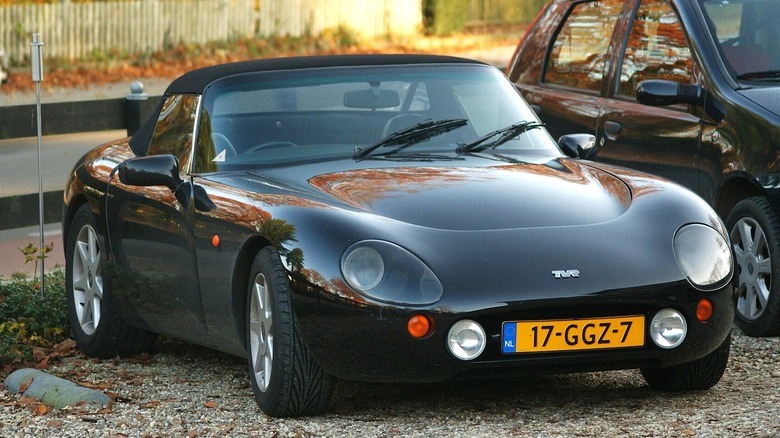
There is a bit of a jump in size between the Exige and the TVR Griffith 500, but that's wholly justified, considering most lightweight British sports cars use four-cylinder engines, while TVR threw in multiple variations of a thunderous V8 in the Griffith. In its most brutal 5.0-liter form, the Griffith's numbers were nothing short of remarkable: 340 hp, 350 lb-ft of torque, 0 to 60 mph in 4.1 seconds, and a claimed top speed of 169 mph. Considering the fastest cars in the world were things like the Ferrari F40 and RUF CTR Yellowbird, TVR was punching seriously hard with this thing when it launched it in 1993.
Supporting acts were provided by a trusty five-speed BorgWarner T5 gearbox (available after 1994), standard limited-slip differential, and eventually power-assisted steering -– something most of us take for granted these days. Yet all this goodness was packed into a hand-crafted fiberglass body that was just 153 inches long and weighed less than 2,340 pounds in total. In fact, the Griffith recipe was so tasty for attendees of the 1990 Birmingham Motor Show, where this car was launched, that TVR says an order was placed for one on average every eight minutes. We're still waiting on that all-electric Griffith TVR announced back in 2022, mind.
BAC Mono R (157.8 Inches)
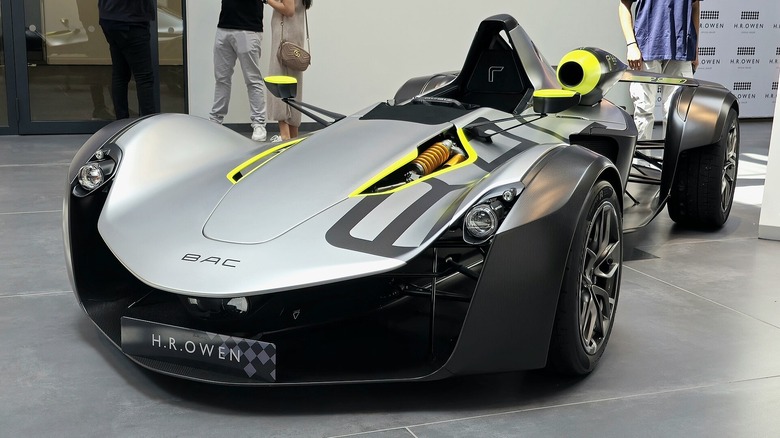
The BAC Mono R is just about the most unhinged street car you can buy. On design alone, it sits low to the ground and stretches just 157.8 inches long, while many of its core components, like the suspension, are left entirely exposed. It's a not-at-all subtle nod to the ferocity of this thing. The single-seater uses a 2.5-liter inline-4 co-developed by Mountune. If you're unfamiliar with the name, the small British firm is known for creating some seriously wild Ford race cars.
That powertrain revs to an eardrum-shattering 9,000 rpm and puts out 343 hp – enough to get the Mono R to 62 mph in just 2.5 seconds, before it tops out at 170 mph. That is no doubt helped along by the fact it weighs just 1,223 pounds, which translates to a frankly ridiculous output of 626 hp per metric ton.
The Mono R also has no doors or even a windshield, which shows the lengths BAC has gone to chase pure adrenaline thrills. Obviously, having a car like this will come with compromises. You can't, for example, imagine that it would be particularly comfortable on a long drive, nor will it be suitable for a trip to your local grocery store. But if all you like to do is strap in, start up, and cling on for dear life, very few machines get close to the BAC Mono R.