

The Disadvantages Hub Motors Have To Overcome For Widespread EV Adoption
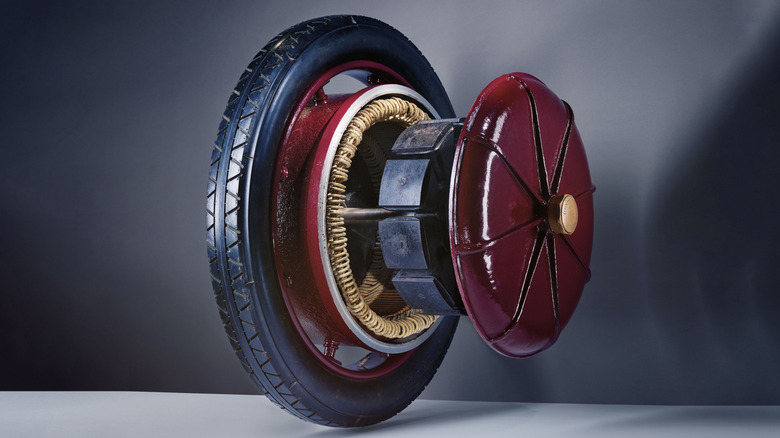
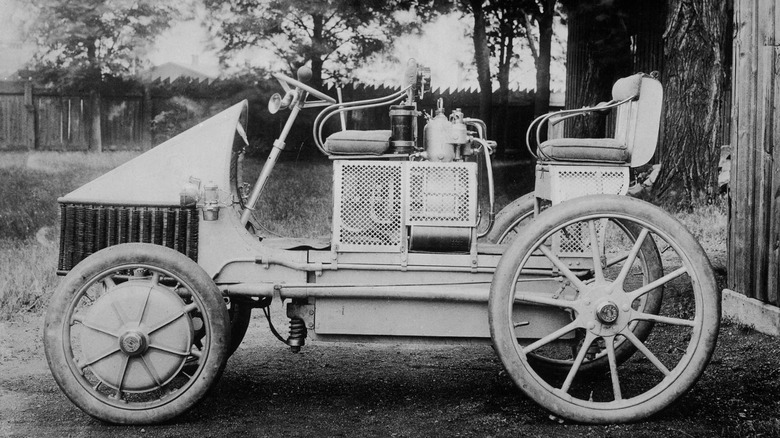
The idea behind the hub motor is nothing new. Seriously. An electric hub-wheeled vehicle was presented in 1900 at the Paris Exposition's Palace of Electricity. It was designed by none other than Ferdinand Porsche. Yes, that Ferdinand Porsche. Then the hub motor went to the moon. It's true. From Apollo 15 in 1971 through Apollo 17 in 1972, Lunar Roving Vehicles (LRVs) had a hub motor at each wheel. Despite these auspicious starts, hub motors haven't made it to the masses yet.
Hub motors have many advantages. Porsche designed them to eliminate the transmission. Who doesn't want more space? Additionally, hub motors promise to be more efficient, as less power is lost through the driveline, and the whole setup could be simpler than the complex motor-transmission-driveline-axle configuration we currently have.
But for all this promise, there are inherent downsides to the hub motor. By design, the motor weight that was on the chassis and supported by the suspension is now in the wheels, which leads to suspension and handling issues. The motors now have no suspension to protect them, so they are going to take incredible levels of abuse in the form of potholes, rain, dirt, and speed bumps. Then you've got to cool the damn things. But are these problems too big to overcome?
What's the hubbub?
Let's take a deeper dive into the issues before we look to the future. All that weight in the wheels is now unsprung mass — simply meaning weight not held up by the suspension. With this weight at the wheels and at least part of it spinning around, it's also now adding rotational mass. First, the added weight will affect how well the suspension controls the wheels. In the racing world, it is said that every pound of unsprung mass acts like seven pounds of sprung mass. This can impact ride quality and handling. The added rotational mass creates a gyroscopic effect. It's what helps keep a bike tire upright once it starts to spin. In the same way, a hub motor with more rotational mass wants to keep going straight. The impact of these forces depends on the vehicle's weight; a lighter vehicle would be more affected by them than a heavier one.
We touched on durability, but it bears repeating. Those motors are now exposed to whatever they are driving over. Even the smoothest pavement will send vibrations through them. Add in big hits from potholes or other obstacles, plus normal weather, and you'll really need to protect and seal these motors, which can make them harder to cool.
Let's look at efficiency. Current EV motors send power through reduction gears, to differentials, down drive shafts, and into some form of axle before the power gets to the wheel. Each step along the way adds friction and eats a little power. A more direct connection should help with that. But if we look at Lordstown Motors and its Endurance pickup, the efficiency wasn't there. Sample size of one, so YMMV.
The future of hub motors is now (well, soon)
On the plus side, a lot of these issues seem to be engineering problems, and they're being worked on. Companies such as Elaphe, Protean, and Donut Lab are working towards these goals. Elaphe was the motor provider behind the Lordstown Motors truck, which unfortunately never got to mass production. Donut Lab worked with Verge on its motorcycles, which use an in-wheel motor and what the company says is a solid-state battery. It's also working with start-up Longbow Motors on a potential future vehicle. We were also promised a beautiful hub-motor-powered vehicle from a Czech company in 2018, and we're still waiting.
Speaking of waiting, back in 2023, Hyundai Motor Company introduced an interesting hybrid approach to the hub motor with its Universal Wheel Drive System (Uni Wheel). Uni Wheel solves some of the issues listed above by mounting an electric motor on the chassis at each wheel, while the gearing lives in the hub. Connected through a trick planetary gearset, it splits the weight between the hub and the chassis, while protecting the motor.
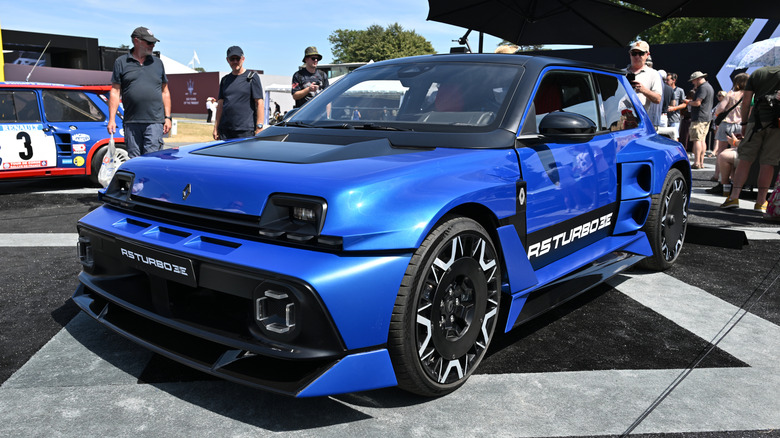
In the "holy cow, it's actually happening" category, we have Renault stepping up and putting hub motors into (limited) production. The rowdy Renault 5 Turbo 3E (pictured above) features two rear hub motors from Protean. It boasts some impressive numbers: 555 horsepower, 0 to 62 mph in 3.5 seconds, and a top speed of 167 mph. And it looks like it will eat up a track. It will not quite see mass production, as its run will be limited to 1,980 vehicles — a nod to the Renault 5 Turbo from 1980. Let's hope the Renault lives up to the hype so that we get to see some Porsche-derived, moon-tested hub motors here on Earth.