

The Legendary 1987 RUF CTR 'Yellowbird' Looks Like A Porsche, But It Isn't
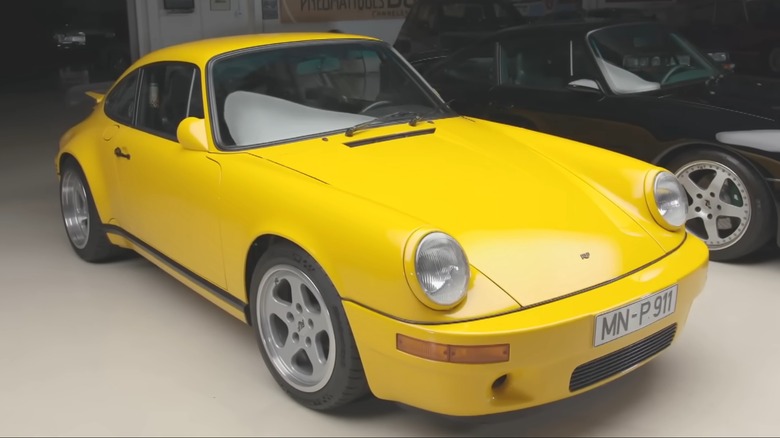
Take a quick look at that yellow beast in our top photo, with its bulging muscular fenders, curved profile, and massive whale tail spoiler. Now, you could easily be forgiven for thinking it was a Porsche — perhaps a late-1980s 911 Carrera 3.2. You'd be wrong, however. That machine is actually a Ruf CTR, which was nicknamed the Yellowbird for its striking exterior finish.
There are a couple of dead giveaways, too, including the fact that the Yellowbird could outrun any real production Porsches of the time. In fact, a Ruf CTR beat all challengers at a famed 1987 Road & Track comparison of the fastest cars in the world: Its 211-mph top speed was 10 mph faster than the second-place car, which was a modified Porsche, while entries like the AMG Hammer, Ferrari Testarossa, Lamborghini Countach, and Porsche 959 all failed to reach 200 mph. Unsurprisingly, the CTR was also named one of our readers' favorite yellow cars of all time.
Of course, peeking under the skin of the Yellowbird tells the tale. Keep in mind that Ruf is much more than just a tuning shop or an in-house performance brand, like Mercedes' AMG was and now is. Ruf uses so many proprietary components — and so few from production Porsche models — that it was certified as a full-on automaker back in 1981. Ruf cars even have different W09 VINs from Porsche's WP0 vehicle identification numbers. The genesis, though, actually does start with a Mercedes-Benz — well, that and a Porsche 356.
Raising the RUF
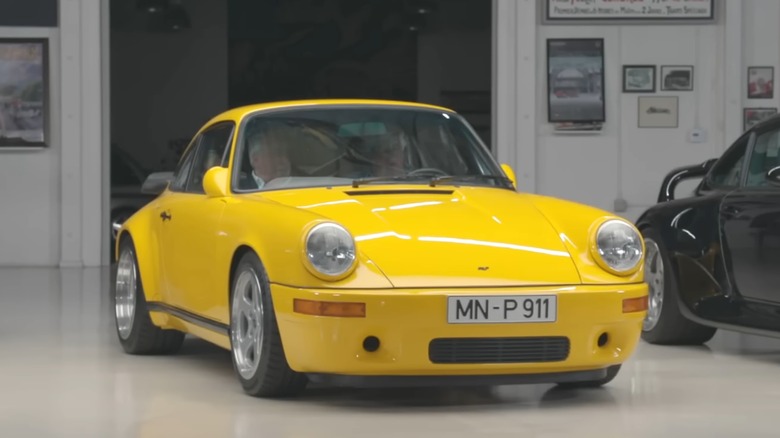
The company now known as Ruf — pronounced roof – began when Alois Ruf Sr. opened his first repair shop in Pfaffenhausen, Germany, in 1939. Ruf and the shop would both survive World War II, and in the 1950s, he expanded into building his own tour bus — on a chassis originally sourced from Mercedes-Benz.
It was in 1963, when Ruf was at the wheel of his bus, that he happened to see a driver lose control of his Porsche 356 and run off the road. Ruf then played a key role in bringing both back to health: He drove the Porsche's owner to the hospital and — after buying it off of the insurer — took the car itself back to his shop to fix. That began a lifelong romance between the Rufs and rear-engined Porsches, and one that carried over to the launch of the 911. Today, 911s like the Carrera GTS T-Hybrid are still out there making the haters look real dumb.
We're going to skip a lot of steps in a pretty fascinating story, but Alois Jr. took over for his father in 1974 after the latter died. Under Alois Jr.'s direction, and in response to rumors Porsche would kill off the 911 after introducing the front-engine 928, the company committed itself to supporting the 911 even if Porsche didn't. The first Ruf-tuned 911, the Turbo 3.3, premiered in 1977 with a Ruf-built 5-speed manual transmission. However, legal worries soon reared their ugly heads. Porsche, naturally, wasn't too keen on being liable for what Ruf did to its cars, so Ruf would go on to officially become an independent automaker in 1981.
The Yellowbird takes flight
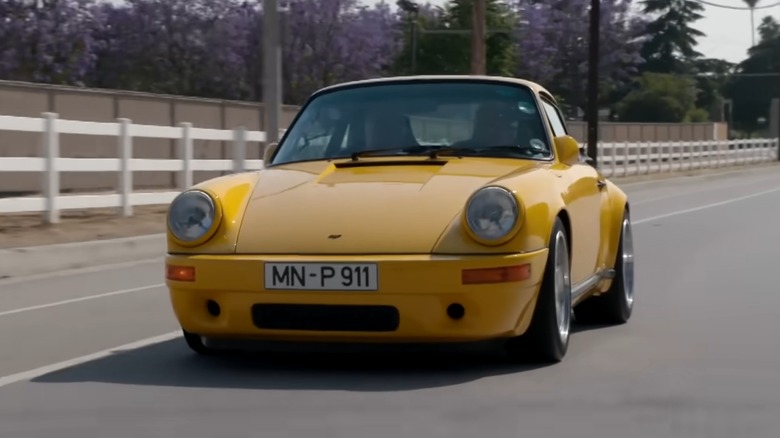
Yet, the car that really put Ruf on the map was the 1987 CTR, with a name derived from "Group C Turbo Ruf." The car started life as a 930-series 911 Carrera with a 3.2-liter flat-six engine, which was already one of the lightest models on the Porsche roster — it just wasn't light enough for Ruf. The company swapped out the production doors, engine cover, and bumpers to save more poundage. The car even has just one sideview mirror. The rear fenders also were reworked, with flares to handle its upsized tire/wheel package and NACA ducts for engine cooling.
Ruf increased the bore of the Carrera's donor engine as well, boosting displacement to 3.4 liters. Remember, bore and stroke are the two specs that decide an engine's power. Next up were twin-turbochargers custom made for the Yellowbird and Bosch fuel injectors to slake the motor's thirst. The result was 469 horsepower and 408 pound-feet of torque. The 1987 Porsche 959, for some perspective, came out with a twin-turbo 2.8-liter flat-six factory rated for 444 horsepower and 369 pound-feet of torque.
The differences were even more noticeable on the track, as mentioned above. We'll also add that while the 959 was a tenth quicker to 60, at 3.6 seconds, the CTR could keep on going to reach 100 mph in 7.3 seconds. That's 1.5 seconds quicker than the 959. But if you really want to get a feel for what the Yellowbird was all about, be sure to check out Weissach Group's video of Ruf driver Stefan Roser running one at Nürburgring in 1989. It's downright fascinating.