

Which Generation Of Hyundai Tucson Is Safest According To The IIHS
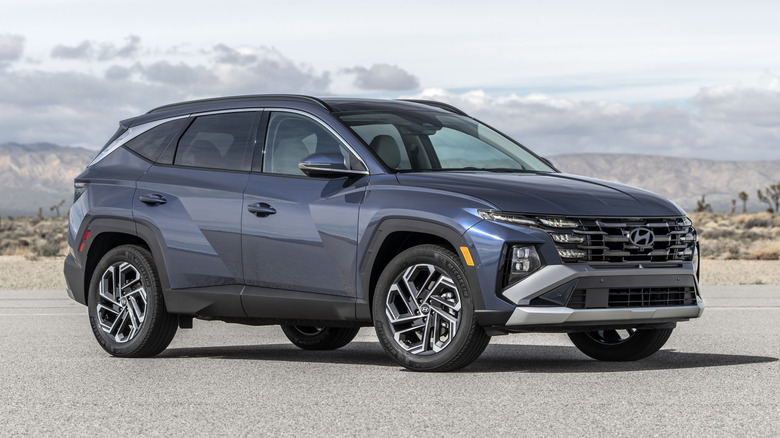
Car safety has come a long way since the days of yore. Ask the Insurance Institute for Highway Safety (IIHS). The organization's crash testing standards have evolved significantly over 30+ years as more new vehicles keep getting better at protecting their occupants. By now, we're pretty familiar with the IIHS Top Safety Pick awards. However, just because your second-gen 2011 Hyundai Tucson has the Top Safety Pick under its belt doesn't mean it's as safe as the third-gen 2021 model, which also happens to be a Top Safety Pick winner.
Although the IIHS rates the small SUV highly, understand that it also keeps updating the award's eligibility criteria as the years go by. For example, headlights were not even part of the Top Safety Pick criteria in 2010, nor were vehicle-to-vehicle or pedestrian crash-prevention features. And Top Safety Pick+ wasn't even a thing before 2013. In fact, looking at the many generations of the small SUV, it's fair to conclude that fourth-generation Tucsons (2022-2026) appear to be the safest, according to the IIHS. Not only have certain fourth-generation Tucsons gone through the organization's slew of updated testing standards, but they have consistently been part of the IIHS Top Safety Pick+ category between 2022 and 2026, unlike the third or prior generation models.
If you're looking for the safest model year within the fourth generation, the 2026 Tucson looks like the strongest candidate. While models built after March 2024 have fared really well in the updated tests, the eligibility criteria for Top Safety Pick+ have changed between 2024 and 2026, with the most recent update pushing automakers to improve their crash avoidance systems and protection for back seat passengers. Still, despite the tougher rules, the 2026 Tucson meets all the requirements for Top Safety Pick+.
The 2026 Hyundai Tucson is rated Poor for whiplash prevention
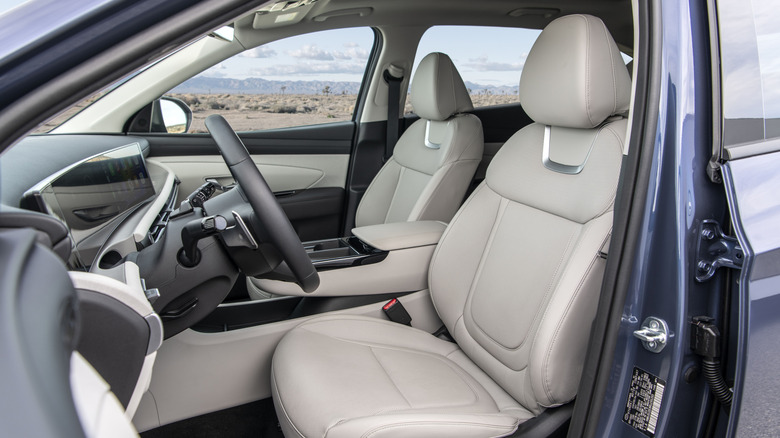
Although the 2026 Tucson won the Top Safety Pick+ award, it's worth noting that the small SUV performed poorly in the IIHS's latest whiplash prevention test. This replaces the original head restraint test that was discontinued in 2022. The new test evaluates three important aspects: "head and spine support, the interaction of the head with the head restraint, and how well the seat handles the energy transfer during impact."
If it means anything, only four out of the first 18 small SUVs tested scored really well and earned a Good rating, according to the IIHS. Although the Tucson isn't part of the group, that's not to say no Hyundai is — the Ioniq 5 was among the SUVs that scored a Good rating, as are the Subaru Forester, Toyota RAV4, and Audi Q3. Joining the Tucson with a poor whiplash prevention score are the Ford Bronco Sport and Mazda CX-50.
According to the IIHS, the Tucson's head restraint pushed the dummy's chin down toward the chest. While most of the vehicles tested were 2025 models, the IIHS says these ratings can apply to certain 2026 models as well. Something similar happened with the aforementioned second-generation Tucson as well. Although all model years except 2014 and 2015 were awarded the Top Safety Pick, they performed poorly in the driver's side small overlap test. IIHS noted that the side curtain airbags didn't deploy, the seatbelts allowed excessive movement, and the dummy's head barely contacted the front airbag. Third-gen and later Tucsons, however, performed considerably better in the test.
Notably, the fourth-gen Tucson received Good ratings in every other area except its LATCH ease of use and headlights (for trims other than Limited), where it received Acceptable ratings.