

Why Hypoid Differential Gear Oil Needs To Be Different From Engine Or Transmission Oil
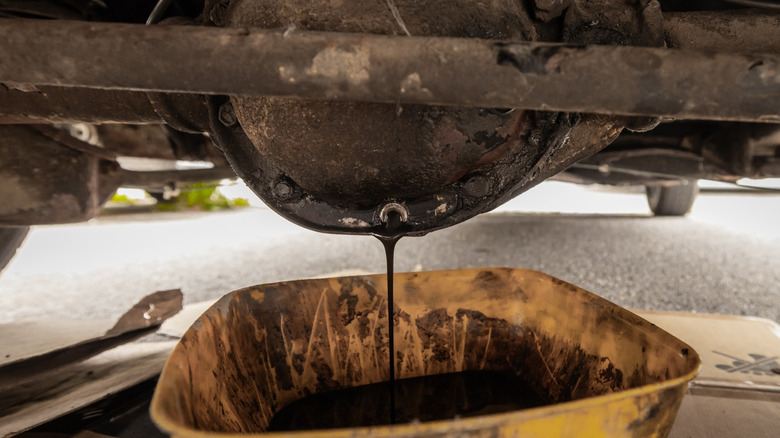
With all the fluids modern cars require, it's only natural to wonder whether one lubricant can handle multiple duties. Scratch hypoid gear oil off the list if you want the engine or most transmissions to keep functioning properly. We'll get to the reason shortly, but let's first explain how hypoid gearsets work. These gears, located in the differential between the rear (or sometimes front) wheels, are common on tow-oriented pickups and body-on-frame SUVs. Some all-wheel-drive vehicles also have a hypoid gear setup in the power transfer unit, which directs power back to the rear wheels.
Originally called a hyperboloidal gear, hypoid is the modernized term for a setup where the pinion gear meets the ring gear offset from the center. The driveshaft sits below, lowering the center of gravity and opening up more floor space. However, the gear teeth rub against each other in a sliding motion that squeezes the lubricant away from the teeth, leaving the metal surfaces without a full oil film between them (known as boundary lubrication). A specialized lubricant with EP (extreme pressure) additives inside the oil protects the exposed metal once the oil film between the gear teeth is squeezed out. This kind of gear oil meant for hypoid differentials typically carries the American Petroleum Institute (API) GL-5 designation. Let's look at how it's different.
Hypoid gear oil vs. engine oil
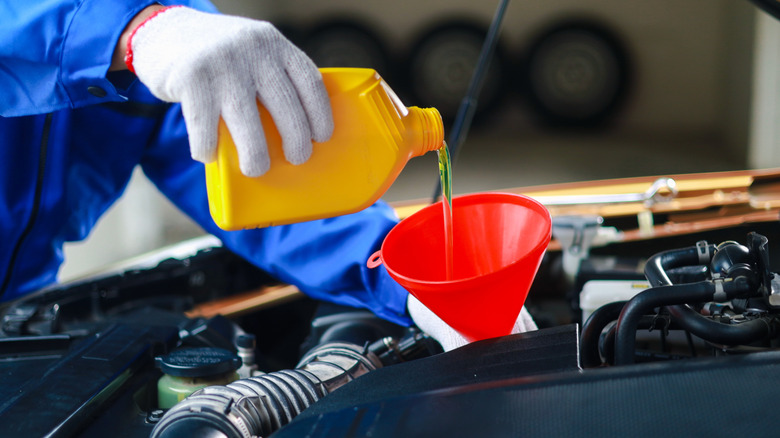
Two of the most important tasks of engine oil include lubricating the internal moving parts and managing the byproducts of the combustion process. Proper oil pressure maintains a full film on most moving parts, but some components, like the camshaft and lifters, may still have boundary conditions. Engine oil deals with these areas with milder anti-wear additives, such as ZDDP (zinc dialkyl dithiophosphate), instead of the heavy EP formulations found in gear oil. Simply put, the EP additives in gear oil aren't made for use inside an engine. These formulations start to become corrosive to some metals found inside the engine at about 200 degrees Fahrenheit. In addition, the use of phosphorus-based additives in engine oil is kept to a minimum to prevent catalytic converter damage.
Meanwhile, detergents and dispersants in engine oil control soot and sludge buildup inside the powerplant. Differentials don't have to deal with these contaminants. Instead, differential gear oil has to maintain a thin layer of lubrication between the gears, whether the vehicle is operating normally, driving under load, or pulling a heavy trailer. Engine oil lacks the necessary EP additives that support this. Oil thickness is also worth mentioning. Each fluid uses different SAE scales: J300 for engine oil and J306 for gear oil. So the numbers don't line up. For example, a 90 viscosity-grade gear oil falls in roughly the same thickness range as SAE 40 and 50 engine oils, not twice as thick. Nonetheless, modern engines are designed to use lighter-weight oils than much heavier gear oil.
Hypoid gear oil vs. transmission fluid
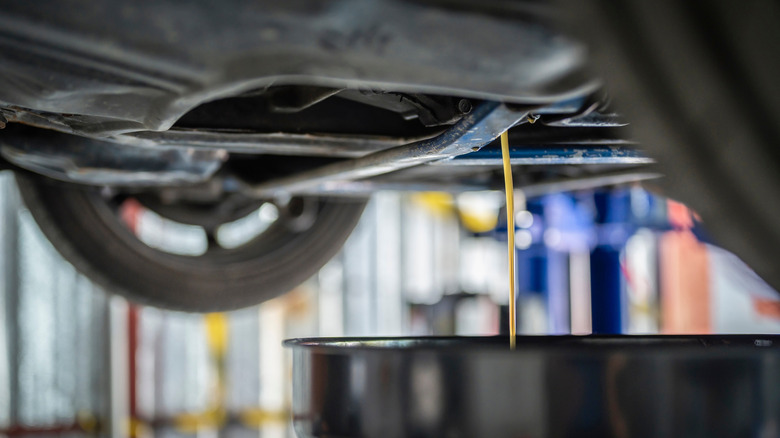
Swapping gear oil for transmission fluid, or vice versa, may seem possible, since hypoid differentials and manual transmissions are both complex collections of gears. However, shift-it-yourself gearboxes mostly use helical gears that have far less sliding than the hypoid gears used in most standalone differentials. You'll also find that many manual transmissions require a GL-4 lubricant, which has about half the EP additives of a GL-5 oil.
An EP-heavy GL-5 lubricant relies on sulfur-phosphorus additives to provide protection. Yet this formulation can corrode the brass synchronizers used in many manual transmissions, and the risk worsens at higher temperatures. Other brass and bronze (yellow metal) components can also be at risk with a GL-5 oil. Friction also comes into play, as synchronizers need grip before engaging a gear. Many differential oils are formulated to be slippery, which can cause poor shifting in manuals not designed to work with GL-5 oils.
Of course, nothing is always black and white in the car world. Some cars with manual gearboxes call for GL-5 transmission lubrication. Examples include certain Subaru models. Aftermarket suppliers also make GL-5 gear oil specifically for manual transmission applications. Keep in mind that manual and automatic transmission fluids aren't interchangeable.