

These 7 Sports Cars Were Designed To Tackle Off Road Adventures
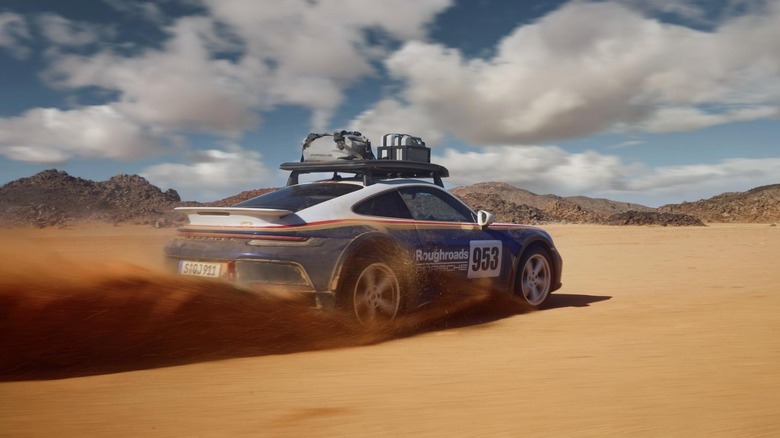
While it may seem sacrilegious for a manufacturer to jack up a low-slung sports car and give it knobby tires, the idea may not be all that wacky if you think about it — lots of horsepower and sporty dynamics, combined with the ability to hit the rough stuff. We're talking a bit of sand, snow, and gravel here, nothing too crazy — massive wheel articulation and extreme breakover angles are typically not their strong suit. But if you own a Jeep Wrangler kitted out to crawl over boulders, then an off-road-capable sports car would make a nice addition to your garage — if you have the means, that is.
Sure, they may not be as competitive off-road as some of the all-time greats, but the exercise does add a touch of practicality, taking away the usual sports-car compromises that stem from their low ground clearance. Plus, it's a unique proposition that few automakers are willing to bet on, except, of course, the names behind these seven off-road-ready sports cars. While Porsche and Lamborghini might've crossed your mind first, there are other names like Lancia, Singer, and a certain Gemballa. Here's a closer look.
Lancia Stratos
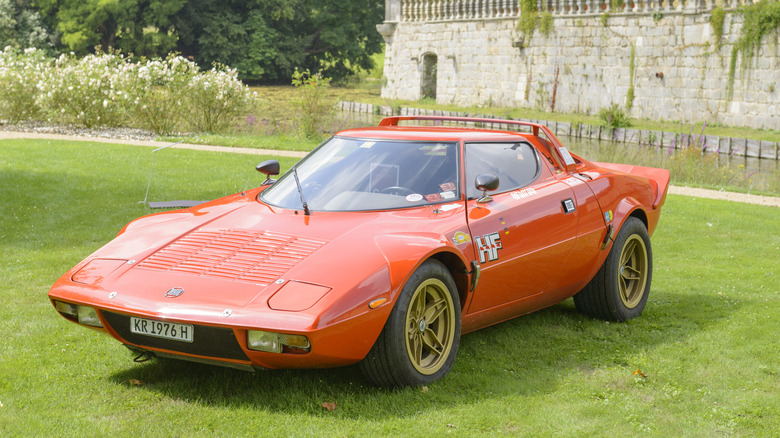
We begin the list with the OG. A legend in the rally scene, the Stratos, as you may know, is a homologation special, with the HF prototype (not the Zero concept) debuting at the 1971 Turin Auto Show. From Bertone and Gandini to the great Enzo Ferrari himself, the Lancia Stratos had quite the lineup of names behind its existence.
Powering the Stratos was a Ferrari-sourced 2.4-liter V6 (from the Dino), which made up to 320 hp in competition spec, while the Stradale (or street) version produced 190 hp. Both versions came with a five-speed manual transmission. Compared to the race-spec HF, the Stratos HF Stradale featured a full leather interior, softer suspension, carpeting and soundproofing, as well as a proper heater and additional instrumentation.
With a wheelbase over 5 inches shorter than that of a current-gen Miata, along with decent ground clearance and upturned front and rear overhangs, the Stratos proved agile and capable, more than willing to push its tail out when the opportunity arose. Its handling prowess allowed it to tackle snow, gravel, sand, and dirt with exceptional ease, making it a dominant force in the '70s WRC scene.
Although Group 4 rules required 500 production cars for homologation purposes, Top Gear puts the total production number at 492, making it even rarer than a Lamborghini Miura.
Porsche 959
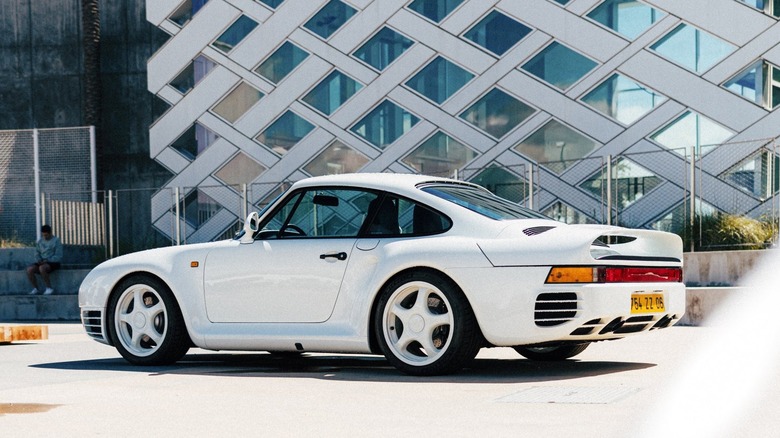
In all fairness, no one would dare go off-roading with a car as coveted and rare as the Porsche 959. After all, the company built only 292 examples. But bear in mind that the 959 was developed as a Group B rally car back in the early '80s and was the first series-production Porsche to feature all-wheel drive. Another first for the 959 was the introduction of electronic tire pressure monitoring, which, for a car built around the mid-'80s, was a pretty big deal.
Perhaps the most useful and innovative feature on the 959, should you ever decide to take it off-road, is its trick suspension, which can be raised a full 2 inches at the push of a button. If the speed-dependent self-leveling suspension isn't enough, the car also features four pre-selectable shock absorber programs as part of its active suspension setup.
Take a closer look at the six-speed manual gearbox, and you'll realize it's more of a five-speed with a low-range creeper gear. More specifically, the "G" on top of the shift knob stands for "Gelände," which is German for "terrain." For those wondering, it's there just so the adventurous among you don't get your 959 stuck in thick mud.
While the 959's twin-turbo flat-six is capable of 444 hp and 369 pound-feet of torque, helping it achieve a top speed of just under 200 miles per hour, there's an even faster and more powerful Sport version as well, of which only 29 examples were ever built.
Aixam Mega Track
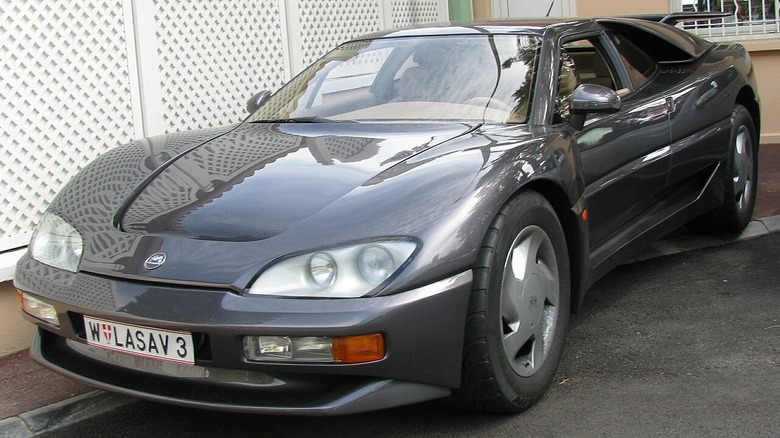
Known for building small city cars, Aixam, a French carmaker, decided to take on Ferrari and Lamborghini one fine day, though not in the way you might think. What came of the ambitious endeavor was the Mega Track — a wedge-shaped supercar with air suspension and a 390-hp 6.0-liter V12 at the back. The crazy part? You could raise its ground clearance to around 13 inches with the push of a button.
It's worth pointing out that the Mercedes-sourced V12 had a lot of work to do, considering the car weighed about 5,000 pounds. Despite its heft and a four-speed automatic transmission, the supercar could manage a top speed of 155 mph and a 0 to 62 mph dash in just under 6 seconds. The Mega Track also measured nearly 17 feet long and was roughly an inch wider than a Hummer H1.
Depending on who you ask, somewhere between five and 10 were built – rare, even for a mid-'90s off-road supercar. The Mega Track was also reportedly supposed to arrive with four-wheel drive, although budget constraints forced it to remain rear-wheel drive.
Lamborghini Huracan Sterrato
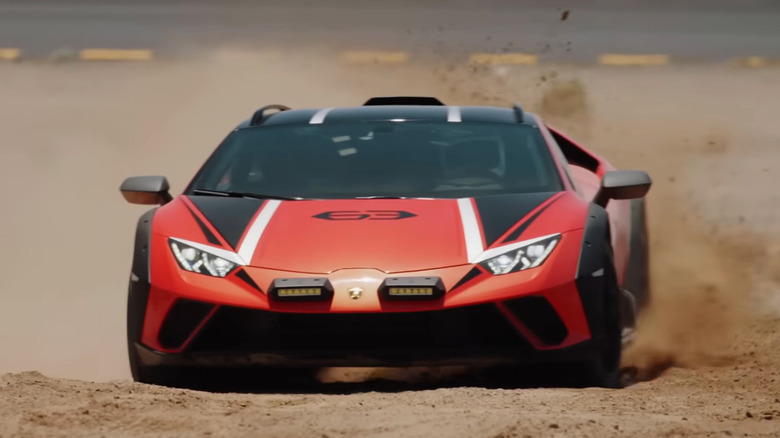
Limited to 1,499 units, the Lamborghini Huracan Sterrato is essentially a jacked-up Huracan with all-terrain tires, auxiliary lights, and underbody protection. While Lamborghini debuted the Sterrato concept in 2019, it took a few more years for the company to launch its final production version. If you're wondering about the name, Sterrato is Italian for "dirt road."
As for the specifics, the off-road-ready Lambo sits 1.73 inches higher than a Huracan EVO, gets Bridgestone Dueler All-Terrain AT002 tires and bits of wheel-arch cladding, all adding to its overall rugged appeal. A funky snorkel sits atop the roof, feeding air to the 5.2-liter naturally aspirated V10, which puts out 602 hp and 413 lb-ft of torque.
Lamborghini also gave the Sterrato a Rally mode to tackle low-grip conditions. While the revised damping programs, softer springs, and anti-roll bars all enhance the Huracan's off-road abilities, the Sterrato exercise does add a few tenths to the baby Lambo's 0 to 60 time – 2.8 seconds versus the Huracan EVO's 2.5. The use of all-terrain tires also meant the Sterrato's top speed was limited to 161 mph, as opposed to the EVO's 202 mph.
Porsche 911 Dakar
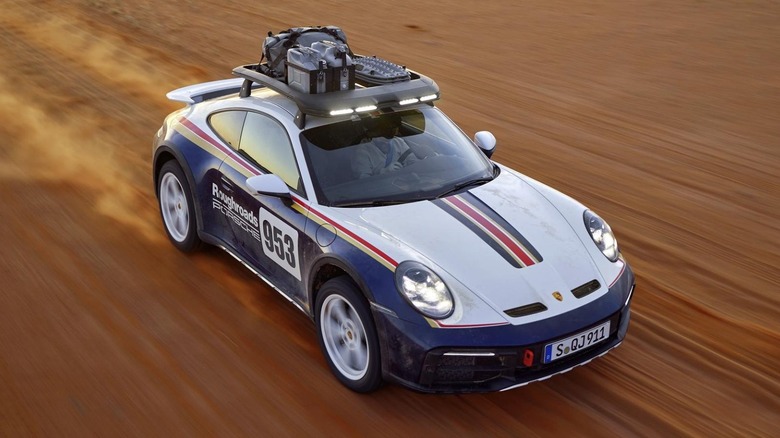
Perhaps as popular as the Sterrato among modern jacked-up sports cars is the Porsche 911 Dakar. Announced at the 2022 Los Angeles Auto Show and limited to just 2,500 units, the 911 Dakar is a special kind of 911 that pays homage to Porsche's win at the 1984 Paris-Dakar Rally.
Much like the Sterrato, the Dakar is based on a series-production car, specifically a 911 Carrera 4 GTS. So the 473-hp twin-turbo flat-six is shared, as is the eight-speed PDK transmission. In addition to all-terrain tires, this 911 also gets two new driving modes — Rallye and Offroad — along with widened wheel wells and protective elements on the front, rear, and sides of the car.
Compared with a 911 Carrera with sports suspension, the Dakar sits 1.9 inches higher, which can be further increased by 1.2 inches with the hydraulic lift system, taking the maximum available clearance to 7.5 inches. For context, a RAV4 GR Sport has about the same ground clearance. Similarly, the Dakar's maximum breakover angle of 19 degrees may not sound all that impressive until you realize it's comparable to that of a Cayenne or Macan.
Marc Philipp Gemballa Marsien

This is an adventure sports car envisioned by Marc Philipp Gemballa, son of Uwe Gemballa — the man famous for building some of the wildest Porsches from the '80s and '90s. But mind you, this is Marc's standalone business and has nothing to do with the Gemballa brand that you may be familiar with. The Marsien (a riff on "Martien," the French word for "Martian") was his first project, which the company started working on back in 2019 — years before the 911 Dakar came into the picture.
As you may have noticed, the design is very 959-esque. What you have is a heavily modified 992 Porsche 911 Turbo S with all-carbon bodywork, all-terrain tires, and height-adjustable suspension. The KW-supplied electrohydraulic setup unlocks a maximum ground clearance of 9.8 inches, though a fixed ride height option is also available. An onboard compressor is provided should you need help with inflating or deflating those all-terrain tires.
A RUF-tuned 740-hp engine is standard, but you can also opt for a version that outputs north of 800 hp. Only 40 units of the Marsien are being built, and yes, all of them have been sold. However, if you're after something more road-focused and even rarer, Marc Philipp has the Marsien GT, which the company recently unveiled with production limited to just 30 units.
Porsche 911 Reimagined by Singer – All-terrain Competition Study
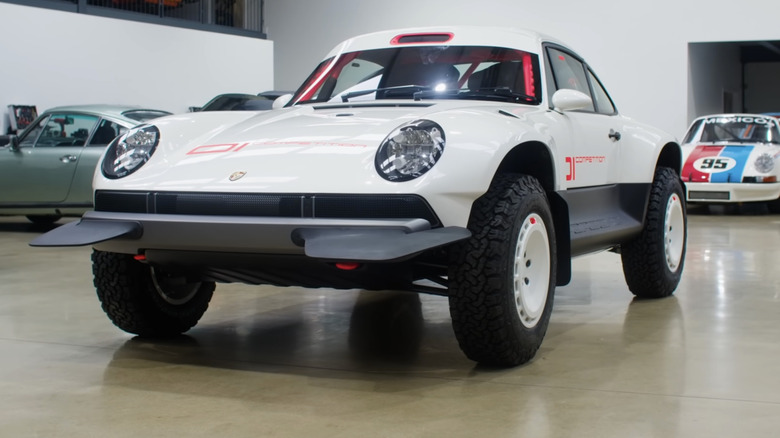
Rounding off the list is this banger of a restomod. Singer collaborated with Richard Tuthill to arrive at the All-terrain Competition Study (ACS), which was created for a long-term client who wanted an air-cooled 911 capable of off-road racing and extensive all-terrain exploration.
Based on a 964 chassis, the car is kitted out with BFGoodrich off-road tires, 16-inch forged aluminum wheels, full-time four-wheel drive, and two five-way adjustable dampers at each corner. The long-travel suspension does give it off-road appeal, as do the wide wheel arches and those mudguards at the front. While there is a full FIA-spec roll cage inside, Singer made sure to use all-carbon bodywork to keep the weight as low as possible.
At the business end, you'll find a 3.6-liter twin-turbo flat-six thumping out circa 450 hp, though it can be tuned. A five-speed sequential gearbox is part of the package, as are two full-size spare wheels and a long-range fuel tank. Apparently, the client commissioned two, one finished in Parallax White and the other in Corsica Red, making it the most exclusive car on this list.