

The Patient Zero Of Coupe SUVs Was Likely This Lifted 4WD AMC
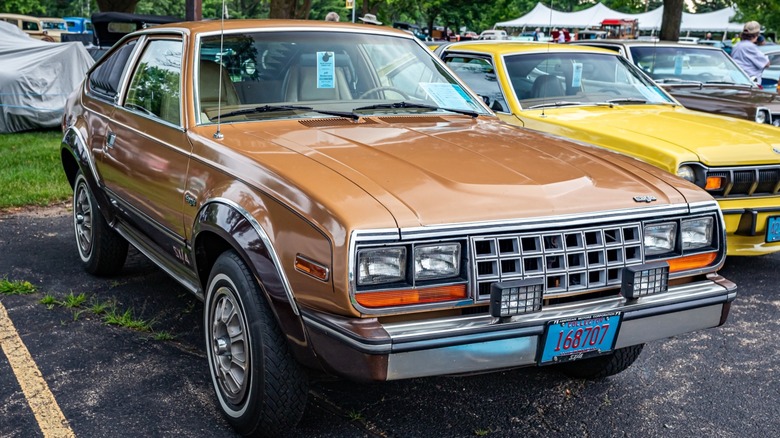
Developed by Roy Lunn (who also notably worked on the Ford Mustang and GT40), the American Motors Corporation's Eagle debuted in 1980. Lunn designed and championed this vehicle to AMC as a new niche, pushing the boundaries of specifications and government standards. The Concord — AMC's new sedan, a replacement for the Hornet — became the basis for the Eagle. Sitting on a new four-wheel-drive (4WD) system with viscous coupling, the Eagle received some lift and fender flares. It's easy to see this formula as the basis of many of the SUV coupes we see today.
Since it was based on a sedan, the Eagle was built with a unibody chassis, different from the typical SUV or pickup truck. Today, unibody construction is the basis for the typical coupe SUV. Vehicles like the Mazda CX-50 and Toyota C-HR are unibody, and are unlike light pickups such as the Chevrolet Colorado, which uses body-on-frame. These vehicles have the ground clearance and 4WD of an SUV, but drive like a car. This was AMC's intent, too: It didn't want this new vehicle to be seen and classified as a car, but as a sport utility vehicle.
Car? Truck? Both?
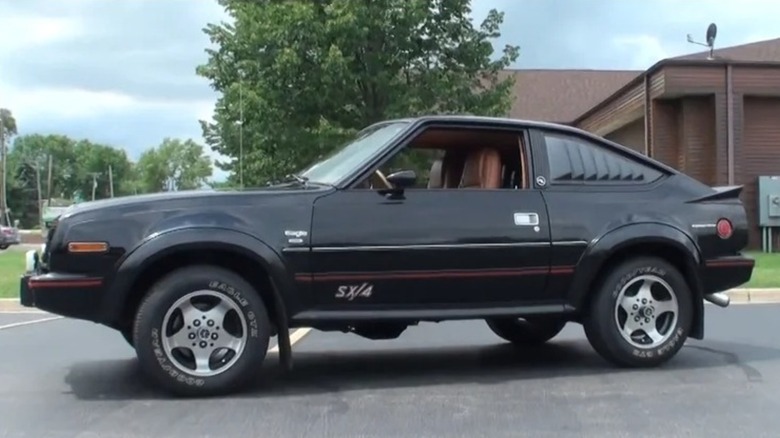
The Eagle was designed to meet the specifications of a light truck. This was useful to get around federal fuel economy and emissions rules that were stricter for cars. While the 4WD system was new, the rest of the vehicle was from an existing sedan platform, the AMC Concord, which helped keep design and implementation costs down. Because the Eagle was made from a sedan, it was smaller and easier to drive than any light truck or SUV-type vehicle. It was quieter, and drove closer to a car, both overall benefits.
It was marketed as a vehicle that can do it all — highway, sand, dirt, and snow. The Eagle even had advertisements that showed off a capability of 32 mpg in some versions of the vehicle. It also had six body styles, from a four-door sedan to a two-door notchback. And there was a sport version in the Eagle SX/4, though the specifications are staggering: 4.2-liter inline-6, 100 horsepower, three-speed automatic, 0-60 in 15.6 seconds, quarter-mile in 20 seconds. Top speed? 92 mph.
Speed sure wasn't the thing for this vehicle, was it? Drifting around mud and plowing through snowbanks were its natural elements. Its strength was the new viscous-coupling drive system providing the 4WD. Looking back, 4WD was a win for owners in states that turned cold and snowy for a good portion of the year. This drivetrain let them better manage the slippery conditions.
Emerging markets
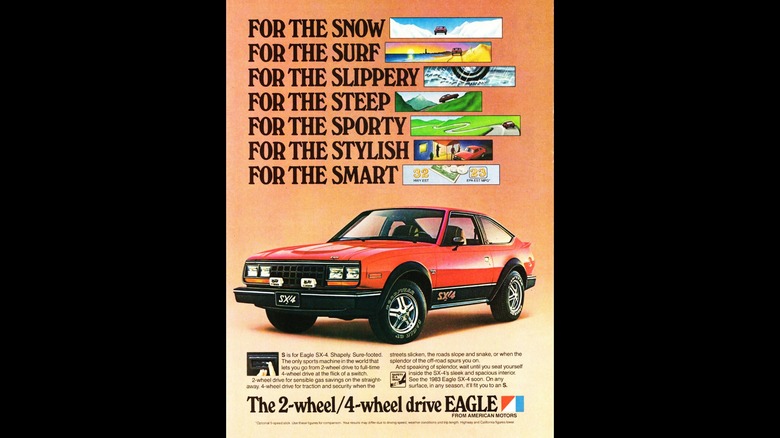
Roy Lunn's pitch to AMC was timely. Rising prices for gasoline during the oil and gas crisis of the 1970s led consumers to start looking for more fuel-efficient vehicles. As a result, the company was being impacted by imports, and on the other end, it didn't have the deep financial pockets to compete with Ford, Chevrolet, and Chrysler. AMC needed a product that stood out and provided something different to its customers. Lunn identified an emerging market in the 1970s that has become a standard today.
Chrysler bought AMC in 1987 and a new division was created, named Jeep-Eagle. The following year, production of the Eagle was canceled. Try to remember when the last time the Jeep-Eagle division was mentioned. Like the branding, time has seemingly forgotten the one of first versions of the modern coupe SUV.
Subaru debuted the Legacy only a year after the Eagle's run, then built its identity and persona from the idea of 4WD passenger vehicles, and seems to have thrived on it. Imagine if Chrysler had continued the Eagle and built on that design. Should it be resurrected? Would it have a hemi? Could a new Eagle survive today?