

Weird And Quirky Consequences You Might Experience When Your EV Gets Close To 0% Charge
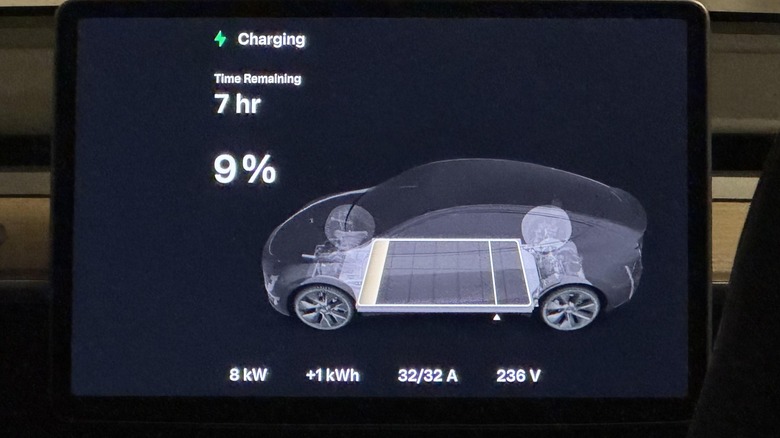
Like your gas car, an EV constantly runs math in the background to determine remaining range. If you flip the way your brain thinks, consider that the amount of gas in the tank of your car is no different from a battery. Both supply power to move the car.
What's all that got to do with range – and running out of it? EV makers tend to show you your EV's battery percentage, which is like an O.G. full-to-empty meter in a gas car. When you're down to an eighth of a tank, that really only has value if you have a rough idea of your car's fuel economy and tank size. With an EV, you'd need the size of its battery and its per-mile efficiency (miles per kWh). You can typically see the latter in the instrument cluster, but knowing your car is traveling four miles per kWh and its battery size still requires doing a lot of math in your head to calculate the remaining range.
So, as with late-model gas cars, EV makers show you range in miles. As you get closer to 0% charge, the car often goes into limp mode, where performance falters. The owner's manual of the Chevy Equinox EV actually says you'll experience,= "reduced acceleration," but that "brake and steering assist will continue to operate." The Hyundai Ioniq 5 manual says, "The driving speed may be limited, and the vehicle may not properly drive uphill." Ominously, the Kia EV6 manual reads, "Go to a safe place and request rescue." And, yes, it gets quirkier from here. One of your biggest challenges might be the 12-volt battery, not the high-voltage one.
Your 0% mileage will vary
Plenty of YouTubers have shown that you can keep driving an EV at 0% charge. But how far? Reuters reported that Tesla was keeping a fudge factor of an extra 15 miles of range even when the gauge showed 0%. Hyundai's manual for the Ioniq 5 (unlike Tesla's for the Model 3) tells you that when a range warning light comes on the dash — at 10% charge — the car has between 18 and 31 miles of range remaining. However, they also say your actual remaining range may not be between 18 and 31 miles.
If you don't have firsthand experience with your EV's battery reaching 0% charge, like our friend from Edmunds in the Tesla, we'll walk you through it. First, as mentioned, the car will stop moving, possibly in fits and eventually stop entirely. The manuals for EV models like the Kia EV6, Hyundai Ioniq 5, Chevy Equinox EV, and Tesla Model 3 all use some version of language to explain that power will be limited, acceleration and speed are being cut, etc., and that you'll have to pull over. This isn't exactly different from a car that runs on gasoline.
But there's another worry: a can of gas can't rescue you, which is an added layer of complication. In addition to the big traction batteries, EVs have 12-volt batteries that power pretty much everything. They can't run without them. The makers of the Chevy Equinox EV, Ford Mustang Mach-E and Lightning, Tesla Model 3, and Volvo XC40 Recharge all have language that says once the traction battery is depleted, the sole charging mechanism for keeping the 12-volt going is now in jeopardy. It could leave the vehicle with no power whatsoever, which may impact whether or not it can be recharged.
Route planning to the rescue

After a National Highway Traffic Safety Administration (NHTSA) investigation into the Kia EV6 for allegedly losing power, and after its twin, the Hyundai Ioniq 5, also had issues, both carmakers issued recalls due to system failures in charging their respective 12-volt batteries. NHTSA has also conducted a separate investigation into Tesla Model Ys with their own 12-volt issues, which should make you wonder what happens when the main battery is powerless and the 12-volt is dead.
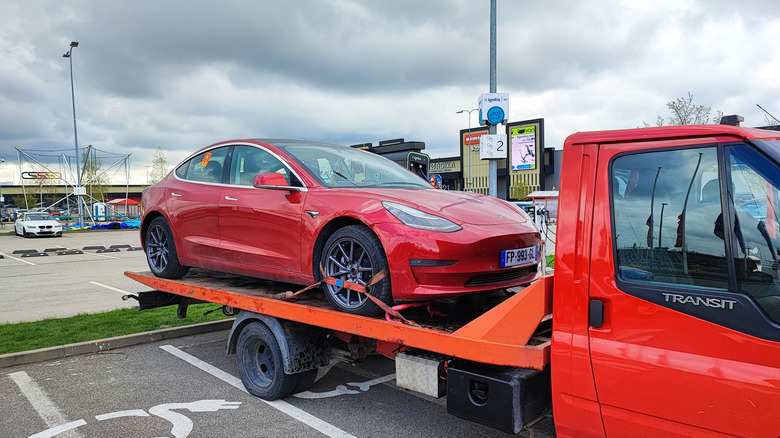
That wee battery powers accessory mode and lets you, for instance, release an electric parking brake and put your bricked EV into tow mode. That's like neutral in a gas car, and prevents drivetrain damage in the event you need to be towed. This will almost surely have to be by flatbed — which is also to prevent drivetrain damage. Then there's a last step: with some EVs, the 12-volt battery needs to be jump-started before you can charge the main battery.
If you want to avoid this weirdness (i.e., headache), use your EV's GPS. In most EVs, it's not only estimating state of charge, but its route planning is designed to steer you to charging stations before you run dry. Also, consider carrying an adapter for Level 1 charging via a standard wall plug. That's ultra-slow, perhaps netting three miles of range per hour. But you could top up anywhere with electricity and, eventually, you'd have enough juice to drive to a faster plug.