

At $10,000, Is This 1987 Toyota 4WD Cargo Van Almost As Good As Free Candy?
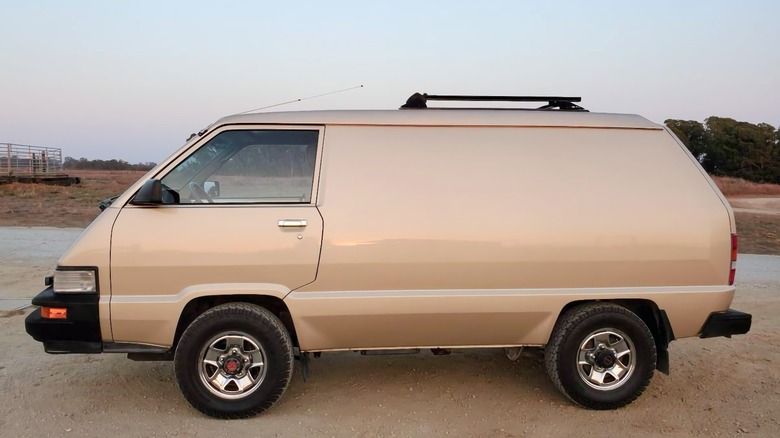
Today's Nice Price or No Dice Toyota van is a model that was once dubbed the "Space Wart" by its most ardent admirers. This one offers both a utilitarian, windowless cargo area and capable AWD to get that cargo (or whatever) through the slushiest of weather. Let's see what that combo might be worth.
Yesterday, we looked at a 2007 Dodge Magnum SRT-8, a model that was sold in very small numbers. That factor evidently led to it being sequestered in someone's car collection for years, meaning that it is now offered with few miles and little to no wear. It seems the joke's on us, however. If we want a like-new Dodge from that same era, all it takes is a quick waltz down to your friendly neighborhood Dodge dealer and an inquiry about how many Durangos they have on hand right now.
The Durango, for whatever reason, has been on sale, with little to no change for a full 16 years. To top that off, our Magnum's $50,000 asking price would buy a fairly well-equipped Durango—also with a Hemi—and it would come with a handy warranty for when anything breaks. None of that was lost on the vast majority of you who sent our Magnum packing with a 97% 'No Dice' loss.
An Ace up your sleeve
One has to grieve for the family station wagon. Once a stalwart certainty of the suburban landscape, it was relegated to also-ran status in the 1980s by the rise of the minivan, then fully kicked to the cul-de-sac curb by the advent of the SUV and crossover crowd.
Alas, we're not here today to celebrate or mourn the wagon. Instead, we're going to look at a vehicle that features a two-seater, mid-engine layout, a manual gearbox, and available 4WD. Yes, that description conjures images of exotic cars with inscrutably unpronounceable names—and the Audi R8. It's also, however, an apt identifier for this 1987 Toyota 4WD Cargo Van.
Originally sold as the Master Ace in its home market of Japan, the Toyota Van arrived in the U.S. for the 1984 model year to do battle with Chrysler's K-car-derived minivans. Unlike the Mopar minis, which featured a fairly conventional FWD drivetrain in a two-box body design, the Toyota was an old-school forward-control one-box van with the engine in a doghouse between the seats and RWD. American carmakers had long abandoned this format, but Japanese manufacturers still embraced it, with similar models arriving on our shores from Nissan and Mitsubishi around the same time as the Toyota.
Cargo panzer
Toyota sold the Van in two formats: a passenger van with windows all around and a cargo van like this one. Like almost all vans of this era, the Toyota has only one sliding side door, conveniently on the curb side. It opens into a load area with a flat floor that extends all the way back to the gaping rear hatch, interrupted only by the wheel arches. Ahead of the cargo area is a cross-cab bump that houses the 102-horsepower 2.2-liter 4-YE four-cylinder engine. The van's two seats ride atop the box on either side with the occupants' legs ahead of the front axle line.
It's hard to say how many of us would, at any time, postulate how we might want our '80s Toyota Cargo Van optioned. However, if we were to undertake such a spurious task, we would probably arrive at this van's spec. Those specs include a five-speed manual gearbox and part-time 4WD. The manual means the 4WD transfer case is two-speed, offering a rock-crawling low. Automatic-equipped vans lacked that handy-dandy feature.
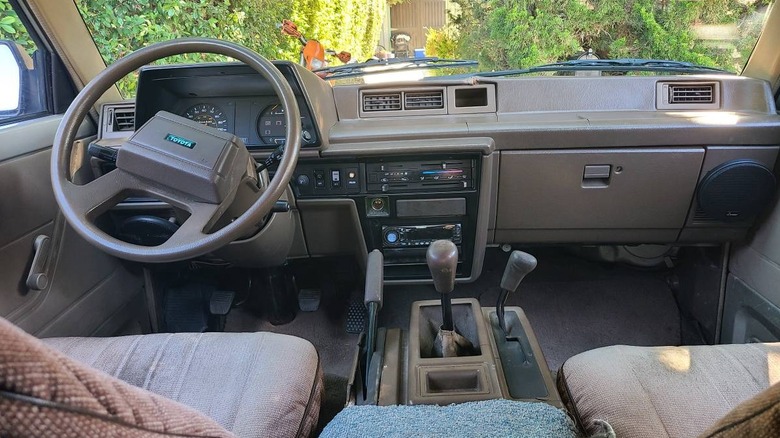
It's not all that surprising that this van is still alive and kicking. It is, after all, an '80s Toyota, and aside from the cool drivetrain componentry, it's pretty parsimoniously equipped, with no A/C and hand-cranked windows. That makes the 203,000 miles on the odometer a bit less onerous a consideration.
One owner
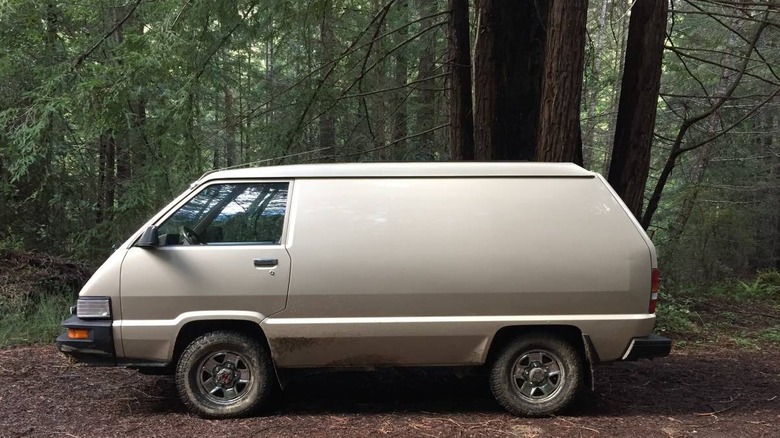
Another check in the plus column: this is a one-owner van. That means its service history should be well known to that owner, and anything kept for that long has probably been pretty well cared for. In fact, the seller includes images of the van's Carfax report in the ad to show that care.
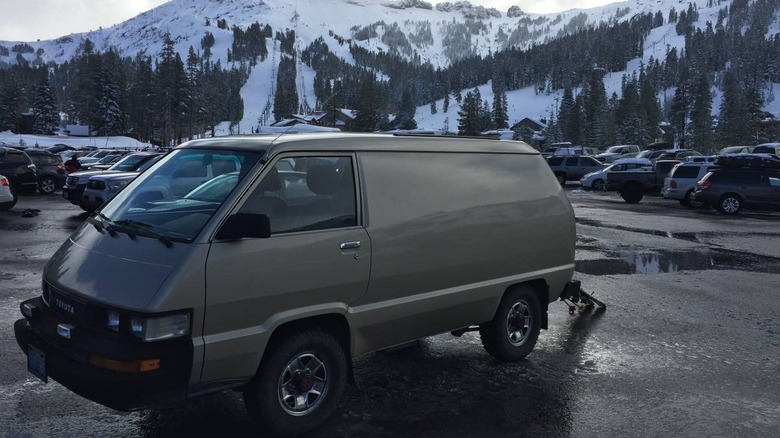
It also looks great in the ad's pictures. The champagne paint is surprisingly still shiny, as are the chrome steel wheels, when they're not covered in mud, that is. Those are shod with knobby meats of an undisclosed age, but appearing to have plenty of tread.
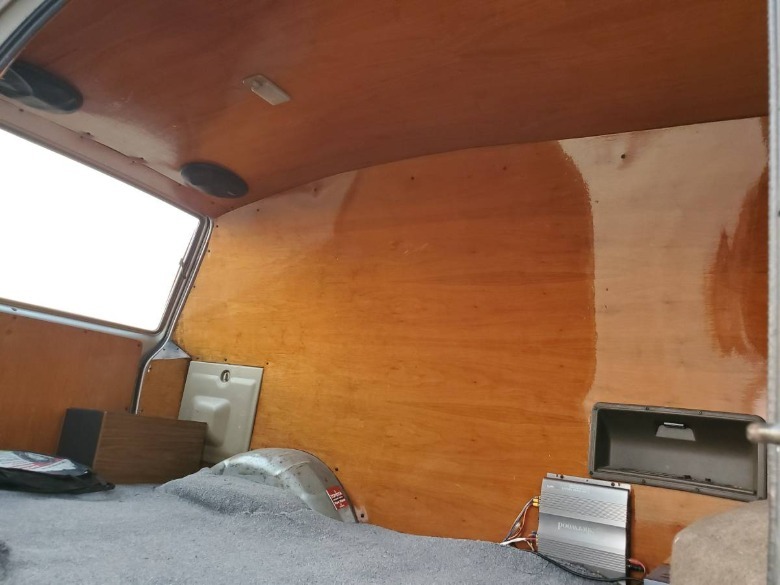
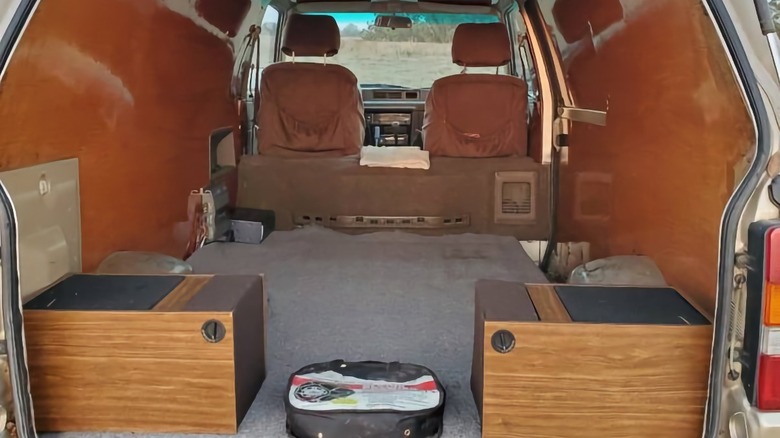
Things are a bit rougher in the cabin, but it's not like it's a sin bin or a crime scene. The dash has several small cracks across the top, and the factory speaker grilles have been cut out for larger aftermarket units. A more modern head unit powers those. In the back, there are more speakers: two in the ceiling and a pair on the floor that look like they're out of somebody's house. An amp to power the sound system is bolted to the inner wall just behind the driver. All of the cabin is paneled in shiny lacquered wood and looks fairly tidy. The carpet on the floor looks like it was cut to fit with a pair of dull scissors, but it probably keeps the noise down.
Van Life
According to the seller, this van has a clean title, current tags, and has passed its smog test. As we often hear, the reason for the sale is a lack of space owing to too many cars. The seller demands "CASH Only" for the van and asks for $10,000 of that cash.
What do you think about this opportunity? The pictures in the ad showing the van parked near the ski slopes suggest it's still a viable workhorse. It's also one of the quirkier options for such endeavors. Could it really be worth that $10,000 asking price for the honor? Or is that just too much to pay to have someone else's wart removed?
You decide!
San Francisco Bay Area, California, Craigslist, or go here if the ad disappears.
Help me out with Nice Price or No Dice. Hit me up at robemslie@gmail.com and send a fixed-price tip. Remember to include your commenter handle.