

These Race Car Safety Innovations Now Make Your Daily Driver Safer
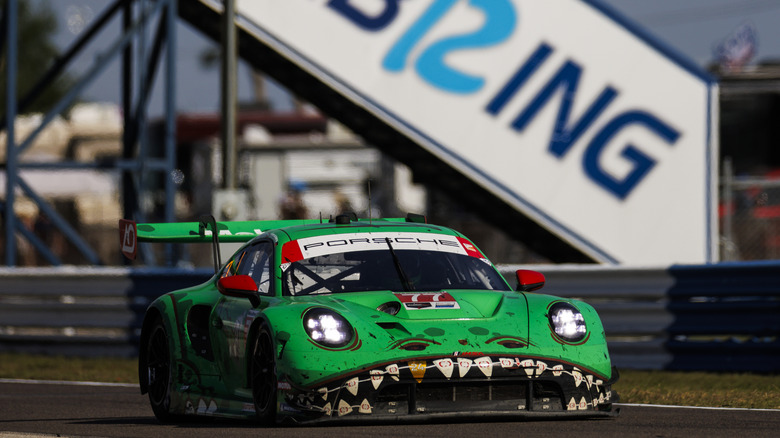
Automotive technology has advanced unbelievably far since the first horseless carriage Benz rolled out of a workshop and onto the public road, over 140 years ago. But its evolution into the cars of today isn't just thanks to driving around on the public road — motorsport has played a massive role, too. It's pretty cool to think that even the most mundane and basic rides feature innovations that were originally designed and tested on race tracks around the world.
They range from very simple to quite complex, and either first appeared and or were heavily developed in racing. Rear-view mirrors, disc brakes, hydraulically actuated brakes, tire technology, biomechanical research, engineered crumple zones; these race car safety innovations now make your daily driver safer. Sadly, some came about in the wake of some horrific crashes, but passionate engineers worked tirelessly to get to the point of them being features that we barely think about today. Let's dig into exactly how they went from the circuit to street duty.
Checking behind you and coming to a stop
The first piece of equipment is perhaps the most basic on this list: the rearview mirror. It came from the Indy 500 in 1911, its first recorded use. Before drivers could simply, well, look in a mirror, mechanics sat with drivers to not only monitor the cars' systems but also look behind them to keep an eye on the action. Ray Harroun, that year's winner (who started at P22) didn't have anybody to ride with him, so he cut a piece of mirror and placed it above his dash. Such a concept sounds so obvious — why wouldn't someone use a shiny thing that reflects what's going on behind them — but we can all thank Harroun for doing so first, and being able to tell what's going on at our six while cruising down the road.
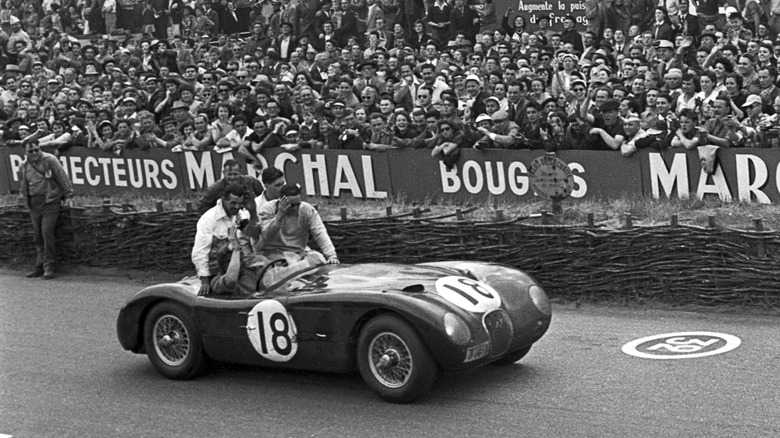
Then, disc brakes as we know them today first appeared on Jaguar's C-Type race car at the 1953 24 Hours of Le Mans. Their unmatched resistance to fade under high-heat proved their worth in this legendary endurance race, and within years, they started appearing on street-going vehicles for better and more reliable stopping power. The 1955 Citroen DS was the first car to come with disc brakes as standard. Interestingly, going back in time even further to 1921, Duesenberg claims the title as first introducing four-wheel hydraulic brakes from racing into its passenger cars.
Similarly, a lot of innovations in tire design and compound has come from motorsport. Tread patterns for evacuating water in wet conditions, compounds that can maintain grip during prolonged periods of high heat, and even kevlar linings to prevent damage in rally racing have become commonplace in modern passenger vehicle tires.
Biomechanical innovations
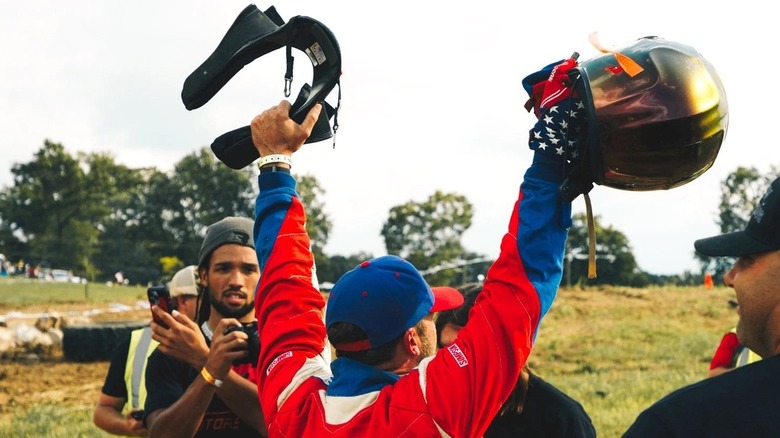
The Head And Neck Support (HANS) has a very sad history; it's rooted in trying to prevent the basal skull fracture, an injury that's claimed many pro drivers' lives in motorsports, including Ayrton Senna and Dale Earnhardt. Simply put, HANS came too late. However, the silver lining is its wide adoption across all of racing has drastically cut down on racing deaths. Before you dive into the comments exclaiming that nobody wears a head-and-neck restraint while driving, we've included this in our list because the biomechanical data from HANS testing helped improve head-restraint geometry (like the relationship between seat and seatbelt) and airbag deployment timing in street-going fare.
For those who would like to learn more about the history of motorsports safety, how the HANS came to be, and how it changed racing for the better, this author can't recommend 'CRASH! From Senna to Earnhardt –- How the HANS Helped Save Racing' enough. There's fascinating background throughout its pages. Also, fun fact: the second racer to ever utilize this fascinating piece of technology was none other than Paul Newman. Jim Downing, the HANS co-creator, was the first.
Then, engineering the ideal safety structure with crumple zones and adequate rollover protection is rooted in motorsports, too. These ensure energy is properly absorbed and occupants are amply protected, in addition to the use of seatbelts and airbags. There are more race car safety innovations that make your daily driver safer, these are but a few, some of which you might not have known. Not only is motorsport one of the greatest (well, actually, the greatest) man-made spectacles ever, it's helped make driving much safer since for everyone.