

What's The Difference Between A Highway And A Freeway?
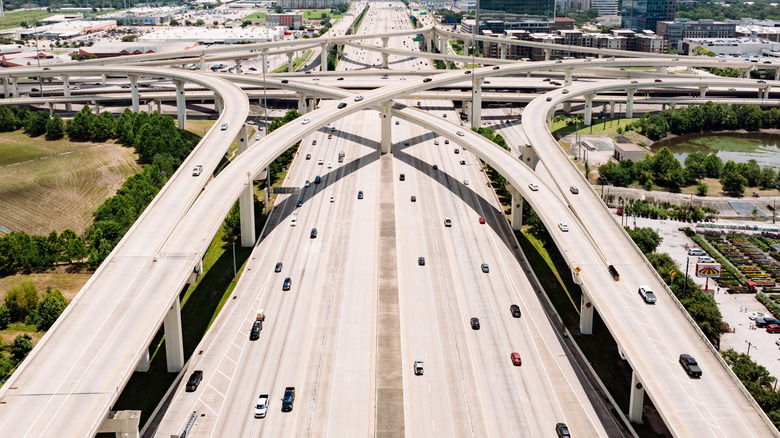
You may have used the terms "highway" and "freeway" interchangeably in past conversations, but have you ever wondered if there actually is anything that sets them apart? As it turns out, highways and freeways indeed aren't the exact same thing. The short answer is that every freeway is a highway, but not every highway is a freeway. The word "Highway" is a broad umbrella term for major public roads — it can describe anything from a two-lane rural route to a massive multilane interstate. The term "Freeway," on the other hand, refers to a specific type of highway that has full control of access.
To put it simply, a freeway is a high-speed road designed for continuous movement of traffic — no traffic lights, stop signs, pedestrian crossings, or intersections to slow you down — where vehicles can enter or exit only through designated ramps, and every crossing road passes over or under the road rather than through it. A highway, on the other hand, can include traffic signals, stop signs, direct driveways, and intersections, all of which can interrupt the flow of traffic.
Access control is the key differentiator, not speed
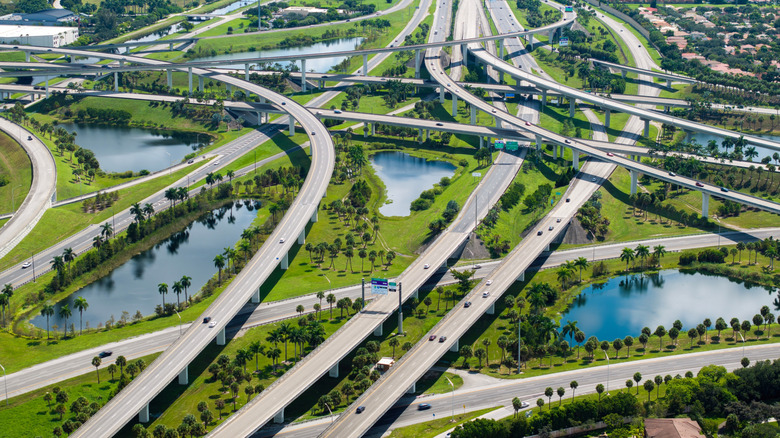
You might think that given the nature of freeways, they have higher speed limits than highways. While that generally is the case — 65 to 80 mph on freeways and 45 to 65 mph on highways — speed limits aren't among the criteria that set freeways and highways apart. A major distinguishing factor between them is how vehicles get on and off the road. Freeways restrict entry and exit exclusively to designated interchanges, using on-ramps for vehicles to accelerate and merge with traffic and off-ramps for them to decelerate and leave the road. There are no at-grade intersections (roads that directly intersect with each other), traffic signals, or pedestrian crossings on the main lanes on a freeway — overpasses or underpasses are used instead. On a freeway, opposing traffic is also separated by a median or barrier. All of these factors allow vehicles to move much more freely on a freeway — hence the name. That said, traffic can still pile up on a freeway, often in case of accidents.
Highways can have multiple lanes and relatively high speed limits, but they still allow direct access from driveways, businesses, or side streets, and can include intersections and traffic signals along their length. Speed limits aren't a reliable dividing line between highways and freeways either, since posted limits vary by state, road design, terrain, and traffic conditions. Highways are much more common than freeways and can serve long-distance travel just as well, especially if you're headed to rural areas.
Where Interstates, expressways, and other terms fit in
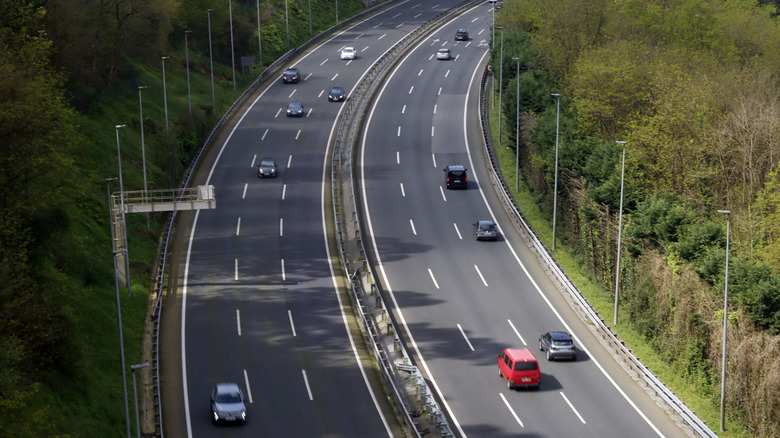
Now that the differences between freeways and highways have been laid out, let's clear up the several related terms surrounding them, such as Interstates, expressways, and turnpikes. "Interstate" refers to a federally funded, controlled-access highway that's part of the U.S. Interstate Highway System. As the name suggests, Interstates are designed to travel across multiple states.
"Expressway" describes a road generally designed for higher-speed travel and uninterrupted movement of traffic. However, expressways and freeways are not the same thing. Expressways have partial access control, meaning they can have some characteristics of a freeway while still permitting certain at-grade intersections, such as smaller roads or driveways. Therefore, the exact definition of an expressway varies and doesn't guarantee full access control the way "freeway" does. Lastly, a "turnpike" simply refers to a toll road, which has controlled access and brings in money for infrastructure maintenance and development.