

Henry Ford Felt More Safe With A Mortsafe
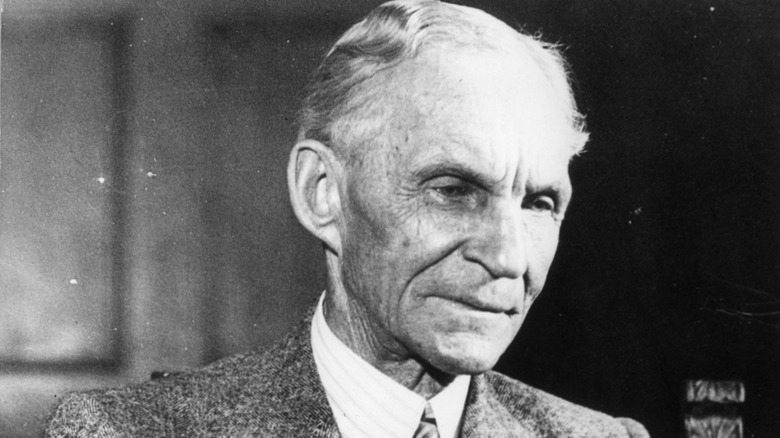
Welcome back to our Cemtember coverage of graves of famous automakers. Last week we brought you the impressive Egyptian-inspired tomb of John and Horace Dodge, and this week we have another heavy hitter in the Detroit automotive world. That's right, the man, the myth, Henry Ford.
I've written extensively about the weirdness of this father of modern motor manufacturing. Like how Ford ensured generations of children would learn to square dance to this day due to his hatred of jazz, how he kept a vial of Thomas Edison's final breath, now on display at his museum, and how he was the progenitor of the unboxing video starting with Abraham Lincoln's assassination chair. Henry Ford proves that becoming a little bit eccentric due to extreme wealth knows no era in the U.S., and that interesting way of viewing the world extended to Ford's final resting place.
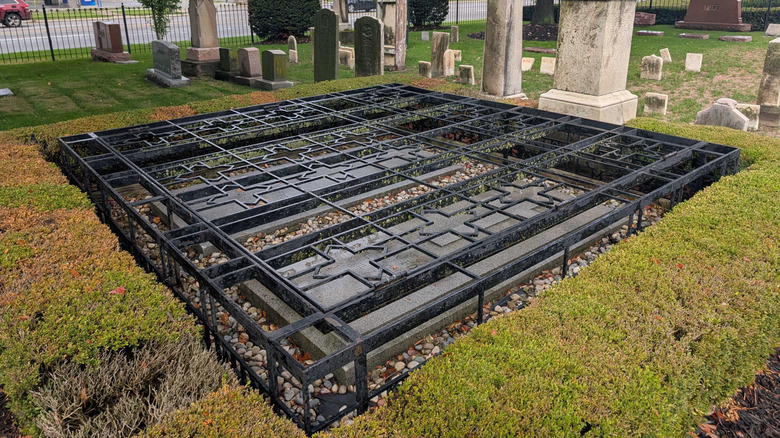
In a humble family plot next to the now-shuttered St. Martha's Episcopal Church on the very edge of Detroit lies Henry Ford next to his wife, Clara, surrounded by family. The Fords are secure in their unique burial site as an intricate cast iron grate sits on top of the two graves. Known as a mortsafe, the intricate gates were popular in the Victorian era to keep body snatchers out of one's final resting place.
The largest funeral in Detroit history
Henry Ford retired for a second time from the automaker that bore his name on September 21, 1945, but he still made Ford his business. On the evening before his death, during some of the worst floods in Dearborn, Michigan's history, Ford and his chauffeur were out in the streets, touring his properties to assess the damage. The Rouge River was overflowing its banks and had already knocked out several Ford properties, including the powerhouse planned by Thomas Edison himself. That left Fair Lane, Henry Ford's sprawling mansion, in the dark. The tour also included swinging by a small cemetery on Joy Road in Detroit, the Ford Family cemetery, where his mother, father and–within 72 hours–he himself would be buried.
When he got home late to Fair Lane, the lights were still out. Candles and kerosene lamps burned in their place as if Edison had never laid the cornerstone of the powerhouse. Ford complained of not feeling well and went to bed early. Sometime in the night, his wife Clara noticed he was breathing heavily and in distress. His last words were to ask Clara and a maid to put the candles out. He died in darkness on April 7, 1947 of a final stroke.
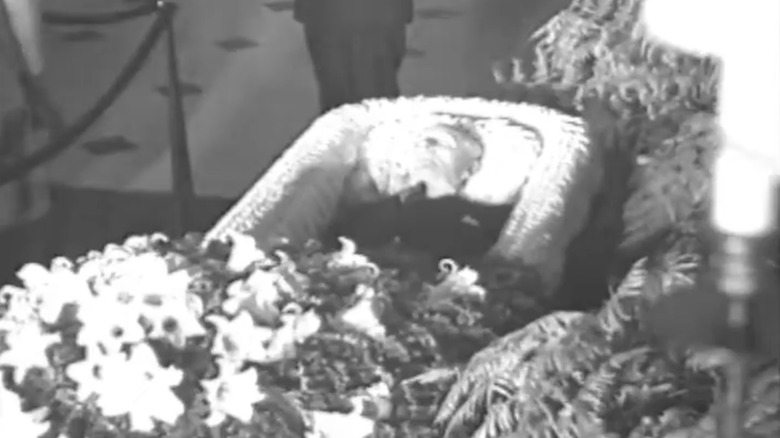
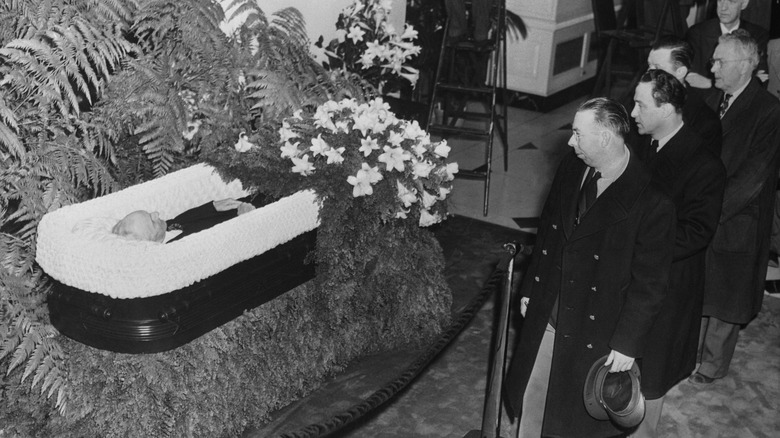
A man like Ford, can't just go out without a bang, however. What followed is what is still considered the largest funeral in Detroit history. Ford was fascinated by the film camera, so his funeral was well documented by his own team. In the footage we can see a small glimpse of the some 100,000 people who shuffled through Greenfield Village to pay respects to the automaker's body. We even get a few aerial views of the mourners out side of the Henry Ford Museum. The video then cuts to downtown Detroit where Ford's body arrived via a Packard hearse to St. Paul's Episcopal Church. Again, the streets are packed.
Wait, a Packard?
If a Packard seems inappropriate, just know Ford's boys tried to get a big blue oval for their boss's final ride, but no Ford-branded hearse could be found anywhere in the country. Just a few years earlier, Edsel Ford's body was transported to his final resting place at Woodlawn Cemetery (that's right, he didn't want to be buried in the family plot near his overbearing father) via a Lincoln hearse — the brand championed by Edsel — but no one knew where it was in time for Ford's funeral. Cadillacs were already popular vehicles for hearses in this era, but Ford's men refused to let the boss be carried to the burying grounds in a GM product. The Packard was the best compromise.
Residents began lining up at 6 a.m. along Woodward for a spot at the funeral and soon people filled up rooftops or hung out of windows to get a good look at the precession for the man who'd made Detroit. Some 20,000 mourners stood in the pouring rain in the early hours of April 10, 1947. An estimated 100,000 more folks lined the streets leading from the Church to the family plot on the city's far westside. George Mason, president of Nash Motor Company, called up the other automotive executives and got them all the cease production for one minute in honor of the start of Henry Ford's funeral. Dearborn's mayor at the time declared the burial day as Henry Ford day, and shops and businesses across the city closed.
Caged graves
Ford's father bought the land as a burying ground for the family. It sat less than two miles from the former site of the family farm and Ford made it clear that was were he wanted to be buried. The space wouldn't allow for a grand mausoleum like other city founders, but Ford wanted to be near his parents. Today, the little church yard is kept in immaculate condition, the lush green grass cut to within an inch of its life, but the grounds of the former St. Martha's Episcopal Church are in rougher shape.
The church has been closed since before 2012. The parking lot asphalt has degraded into a crumbling dirt road, and there was a shady guy in a rusty Honda Element parked in the far back corner. That well-kept lawn is littered with downed tree limbs from this summer's storms, some rotten and soft, some with green leaves still attached. The empty church sits on busy five lane Joy road, running through a solid working-class neighborhood. In fact the church was one of the only empty buildings I came across in the area, which is kind of rare even in the trendiest of Detroit neighborhoods.
The little graveyard is behind an unlocked wrought iron fence. The graves are beautifully cared for and tightly packed together, but one grave dominates them all; the resting place of Henry and Clara Ford. Above their simple slate gray granite grave markers sits a wrought iron grate. I've checked my small library of automotive history books, the Detroit Free Press archives and the Ford Heritage site, and I can find nothing about the design of this grave or its purpose. And while I can not confirm 100% that Ford intended this lattice as a mortsafe, it sure looks like one.
Henry protected his body, but believe his spirit would get a new one
Mortsafes are extremely rare in the U.S. to begin with, and fell out of favor around the turn of the century in Europe, when the practice of donating bodies to science became more widespread. Doctors-in-training no longer needed to buy bodies from shady grave robbers to continue their education. However, Ford may have been thinking more about his fame than his anatomy.
While Ford never spoke (at least from what I can find) about a fear of having his body stolen, he was a great admirer of Abraham Lincoln, so perhaps the attempted body snatching of the president in 1878 put the fear of losing his bones to nefarious dealers into his mind. And while I can't find any mention of this grave being behind a mortsafe in any of my books (I even bought a new one for this blog: The Last Days of Henry Ford by Henry Dominguez) or other sources, if it looks like a duck...etc. Ford, at least, wouldn't have to worry about rising from the grave on judgement day and getting caught behind the mortsafe, at least, as Dominguez notes:
If Henry believed in anything, it was reincarnation. He had said as much to his cousin, Artemas Litogot, many times. On one of those occasions, he said, "You know, I think when a person dies, their spirit goes into a newborn baby. That's why some people are so much farther advanced in knowledge than the others and are gifted..., like Einstein or Edison...." Actually, he was talking about himself, because he firmly believed that he had lived once before.
Ford was a man of his times. He was born in a world lit by candles and run by horses and was buried next to a busy road filled with the cars he helped popularize. Spending his eternity next to a bustling Detroit road isn't such a bad end. And who knows? Maybe Henry was right and he's already walking with us again.