

The Dodge Brothers Share An Ornate Egyptian-Inspired Mausoleum As Their Resting Place
Happy Cemtember everyone! Throughout the spooky months of Cemtember and October, I'm bringing you a new grave from a different famous automotive figure each week. I've wanted to do a series about automakers' final resting places for a while, but the idea really solidified when one of my favorite content creators declared September a month where we celebrate the art of the memorials in grave yards. A Cemtember to remember, if you will.
Artist Tyler Gunther, aka greedy.peasant, first coined the term a few years ago, and ever since he spends the month of September educating his followers about different kinds of tombstones, the meaning of different symbols, and just celebrating the lovely details found on graves. Is this spectacular month widely observed? Hell no! But it's gotta start somewhere and I'm happy to give it a leg up. Especially because I love cemeteries! They're so beautiful and peaceful and full of the kind of art that speaks the most about ourselves and our times.
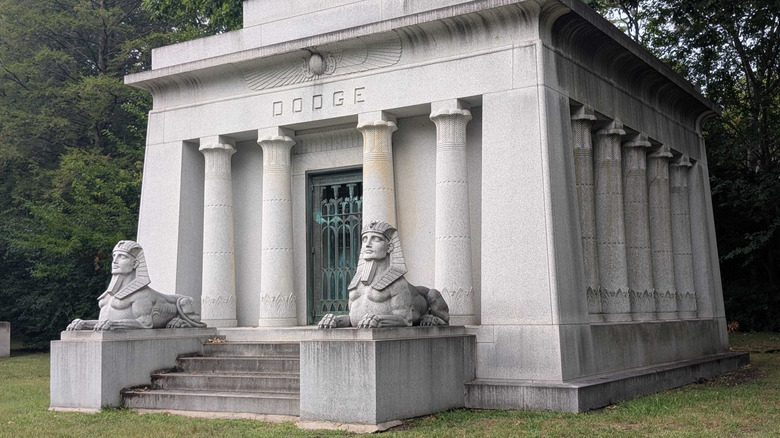
This week I visited the mausoleum of the brotherly founders of Dodge, everyone's favorite bro brand, in the historic Woodlawn Cemetery right on the corner of the only two roads anyone outside of Detroit knows: Woodward and 8 Mile. Woodlawn serves as stoic and impressive resting place of many Detroit legends, including Aretha Franklin, Rosa Parks, a smattering of Motown legends, and Henry's long suffering son Edsel Ford (more about him and his daddy's grave next week). Nestled in the center of towering oaks and beautiful art deco monuments stands a granite memorial that looks more like a temple in ancient Egypt than a midwestern mausoleum for a couple of Irish car guys. It's here that the fiery red-headed duo, John and Horace, ended their final ride.
Other than that, how was your 1919 New York Auto Show, Mr. Dodge?
In life the Dodge brothers were as rowdy and uncompromising as the brand portrayed in their commercials. John and Horace Dodge were whipsmart businessmen who owned a very early machine shop in Detroit. They invested early in a fellow Irish-American automaker and helped get Henry Ford's little company off the ground, then took Ford to court over not paying shareholders and won in a court case against Old Hal that would set the stage for late-stage capitalism America as we know it. A year later, in 1914, the Dodge brothers parted ways with Hal to start their own company, which would rocket to becoming the third largest automaker in America. The brothers are rumored to have punched people in the street, terrorized yacht clubs that didn't admit them by racing cars in front of their clubhouses, and many other hijinks. So it's strange that the fiery brothers should die, not with a bang, with a whimper.
While attending the 1919 New York Automobile Show just five years after the first Dodge-branded vehicle rolled off the line, the industrialist brothers fell seriously ill. The brothers were reportedly infected with the last gasp of the disastrous 1918 Spanish Flu epidemic, and rumor has it the cause of their illness was actually a batch of tainted alcohol as prohibition had just kicked in. This is likely not true, however, as there was still plenty of properly produced alcohol flowing in New York at this time, especially for a pair of extremely wealthy men like the Dodge brothers. Whatever the cause, their heavy drinking didn't help matters and the flu-like symptoms turned into pneumonia.
John would never leave his suite at the Ritz-Carlton. He died on January 14, 1920 at the age of 55. Horace never fully recovered following the illness and the grief he felt over his brother's death. He died the following December in Palm Beach, Florida, of what the New York Times reported to be cirrhosis of the liver. The Dodge children had no interest in running an automotive company and so, five years after they passed, the Dodge widows sold the automaker for $146 million, or $2.8 billion in today's dollars.
Dying like a Dodge
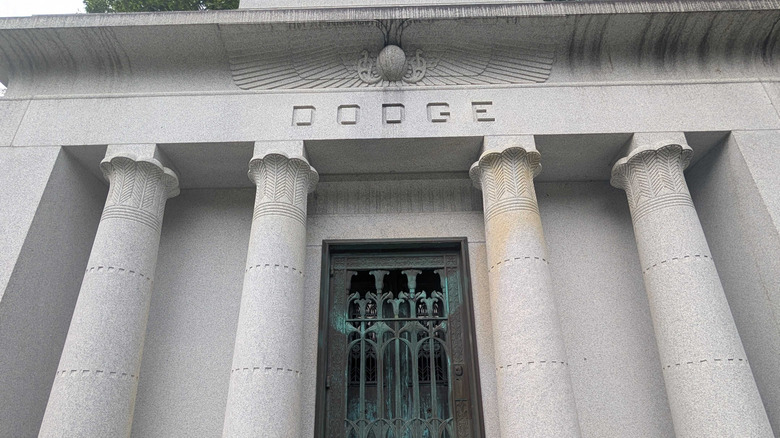
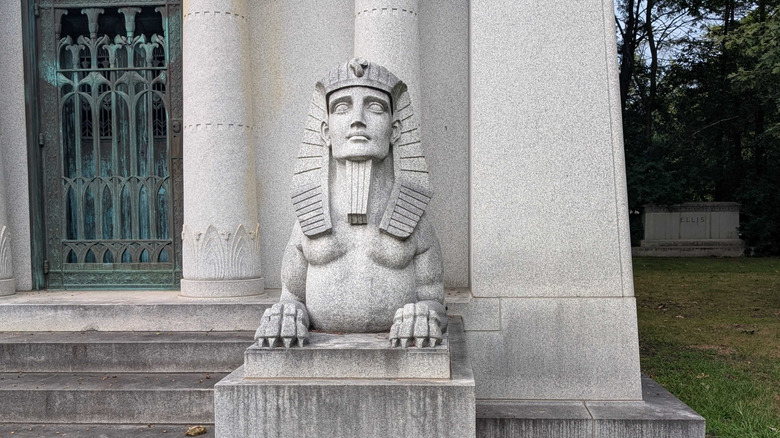
The brothers are buried (along with about a dozen family members) in what is one of the most ornate and beautiful automaker graves in Detroit. I will admit, I began this series with the star of the show here. The memorial prominently features two giant granite sphinxes flanking the entrance. The columns are decorated with papyrus plants along the base, which symbolized youth and regeneration to the ancient Egyptians, as well as date palm fronds along the top that recall the columns used in ancient Egyptian temples. Palm fronds also signify victory in the ancient world from Egypt to Rome. The sphinx is the great guardian of the Valley of the Kings, where the Old Kingdom pharaohs are buried in their pyramids, so to have two seated in front of your grave was a very powerful message indeed. Unlike the serene great sphinx statue in Giza, these creatures have sharp claws and a determined, oddly hot look on their faces.
Above the bronze gates of stylized reeds, another plant native to the Nile — oh, and by the way, the Dodge Brothers were born in Niles, Michigan — there is a sun disc flanked by outstretched falcon wings carved into the granite. This is immediately recognizable by ancient history nerds like myself as a symbol of the falcon-headed Egyptian god Horus. You might have thought Horace was just having fun with that one, but the symbol was used over doorways in ancient Egypt as protection from evil. There are also two rising cobras, or uraeus, on either side of the sun disc. The uraeus were believed to be protectors of the king and queen that spat venom in the eyes of their enemies, and they can represent either Wadjet, goddess of marshy green deltas, or the eyes of Ra, the sun king. Clearly, the brothers wanted a royal tomb that denoted their kingly lives in the city.
Rot like an Egyptian
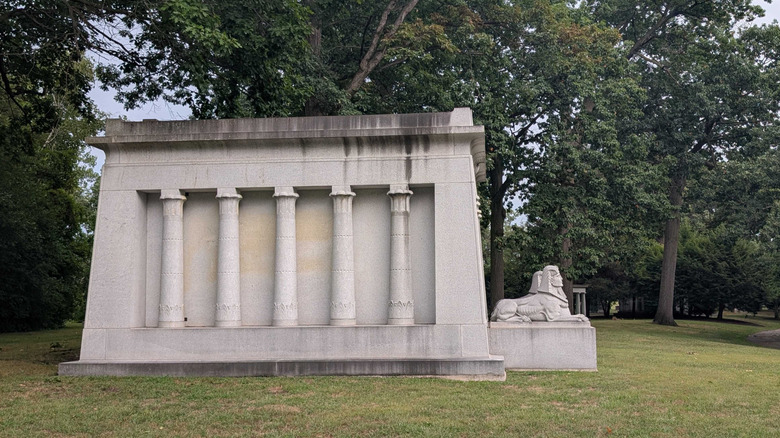
But why would two Michigan-born Irish-American brothers, who died in New York and Florida and then were buried in Detroit, choose to litter their gravesite with references to ancient Egyptian? Egypt-mania started way back when Napoleon invaded the country at the turn of the 19th century. From there the craze ebbed and rose into the 20th century, especially in the worlds of architecture and the arts. In the late 19th century, Egypt was all the rage again after the Hieroglyphs were cracked and the Suez canal was built, which brought intense focus on the region. Victorians hosted mummy unwrapping parties, went to Egypt-themed operas and balls, and built all sorts of structures with intense Egyptian themes. The complex death rituals and beliefs of ancient Egypt lend its art a particular power to the turn of the century mind, especially in cemeteries. Wandering around Woodlawn Cemetery you can see that the Dodge brothers were not alone in their Egypt-mania, with plenty of mausoleums and gravestone containing symbols like scarabs, the sun disc, and vipers.
The Dodge brothers were men of their time, and their ostentatious monument, filled with references to kingly protection and blessings from the gods, certainly spoke to how the two men saw themselves: Titans of industry, whose legacy would live on long after they were gone.
Join us next Friday for another famous automaker's gravesite! If you live near an automotive industry legend's final resting place and want to send me some pics, I'll add your submissions to the pile.