

Long Before The Ford Fathom, A Dealership Sit-In Saved Ford's First Electric Pickup
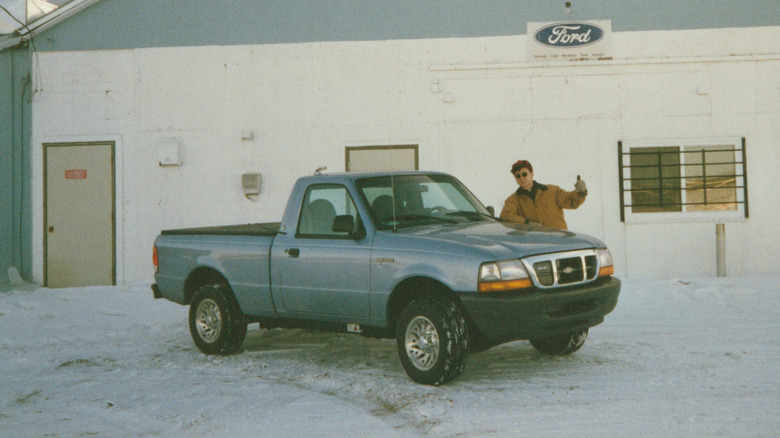
Ford wants to somehow sell 100,000 Fathoms in its first year, and yes, that may seem a bit optimistic. But it wouldn't be the first time that the company's electric pickups inspired a passionate following. And we're not talking about the F-150 Lightning, either. From 1998 through 2002, Ford would produce about 1,500 all-electric versions of its Ranger small pickup, primarily for California. The Blue Oval only built the trucks to comply with the state's air-pollution rules at the time, which required automakers to offer a certain number of vehicles without tailpipe emissions.
Yet their owners — actually mostly lease-holders — loved them. In fact, when Ford announced it would shut down the program and take back all the trucks, it led to a full-on protest explicitly modeled on the civil-rights playbook. In this case, the result was a 2005 sit-in at Downtown Ford in Sacramento, California, where Ranger EV fans gathered for seven days of demonstrations — and got Ford to change its plans. Oh, the company was still going to cancel the EV program, even as folks were "calling on America's worst-ranked automaker to revive its EV program and immediately implement existing technology to improve the bottom-of-the-barrel fuel efficiency of the rest of its gas-guzzling fleet."
But the effort did at least save some Ranger EVs from the same crushing fate as the GM EV1. Ford decided to let then-current lease-holders purchase their trucks outright for $1, without warranty coverage. For former lessees, the company created a lottery system allowing them to buy "refurbished" trucks for $6,000 (about $12,400 today).
Let's check the tech specs of the Ranger EV
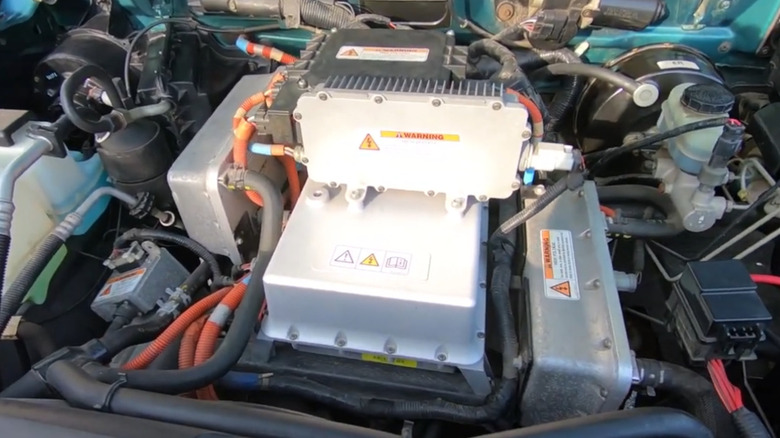
They may be among the electric vehicles you never see anymore, but the all-electric Ford Rangers were basically the same as the gas-powered models, with obvious modifications. The onboard charger and associated hardware were under the hood instead of a gas engine, as was a radiator to help with cooling, while the battery pack was located underneath the truck and between its frame rails. As for the batteries themselves, the original setup hinvolved a 23-kWh lead-acid battery for an EPA range of 50 miles with ratings of 62 MPGe city/54 MPGe highway/58 MPGe combined. Ford would soon switch to nickel-metal hydride battery chemistry, which would raise the Ranger's travel distance to 55 miles, albeit while reducing its ratings to 50/44/47.
Oh, and the electric motor and gear-reduction system were back near the rear axle for a RWD-only driving experience supported by 90 horsepower and 140 pound-feet of torque — which compared to 112 horses and 135 pound-feet of torque in the gas Ranger's entry-level 2.3-liter I4. It was enough to get from 0 to 50 mph in about 12.5 seconds with a top speed of 75 mph, per the manufacturer. Ford also claimed a 700-pound payload — versus up to 1,650 pounds for the traditional Ranger — but does not seem to have published a maximum tow rating.
Still, the Ranger EV was tough enough for truck-style tasks, according to its owners. Those Ranger activists mentioned above were led in part by a pair of cattle ranchers, who praised its ability to pull a stuck forklift out of the mud when their diesel-powered pickup couldn't.
Was the Ranger EV the first-ever electric pickup?
Nope. Electric trucks can be traced back to at least 1898. That's when one from the Riker Motor Vehicle Company became what's considered to be New York City's first-ever all-electric delivery vehicle. Fast forward to 1911, and we find the Rapid Motor Company expanding its previous truck lineup by adding electrified models to the roster. Rapid, though, was owned by GM, and its products became the basis of the GMC brand's electric trucks by 1913. At that point, the latter had a portfolio of eight different all-electric commercial trucks ranging in price from $1,500 to $2,500.
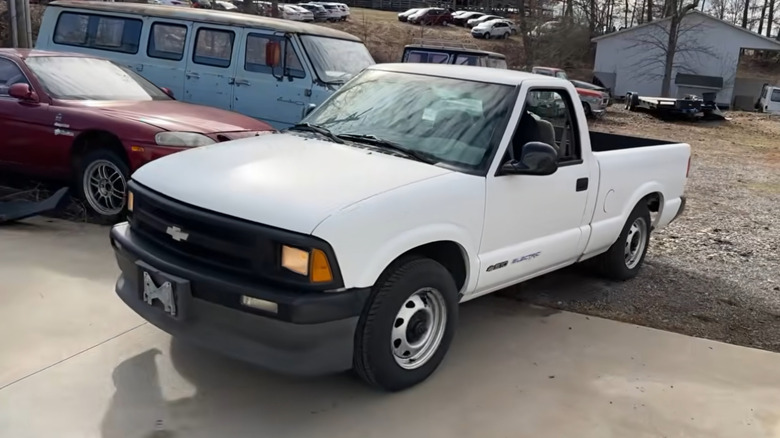
It was then GMC's parent company — General Motors — which introduced the first all-electric pickup-style truck offered to the public by an OEM. The General just beat Ford to the market with a 1997 Chevrolet S-10 pickup EV.
The S-10 EV couldn't top its Ranger rival in most other categories, however. Like the Ford, the Chevy premiered with lead-acid batteries — but they were only good for an EPA range of 33 miles, which is less than you get with some of today's plug-in hybrids. Ford also followed Chevy's lead in offering a longer-range NiMH battery pack with a driving range of roughly 72 miles. On the other hand, the truck's efficiency ratings cratered to 28/28/28 as a result. Another result? There was a lot less customer demand, with the Bowtie brand delivering a mere 500 units or so during its two years of production. Nor was there much of an outcry to save the ultra-rare electric S-10 from the crusher. That said, a few did survive, including a trio rescued by a single person in Indiana.