

Why Florida Sometimes Allows Cars To Drive On Highway Shoulders
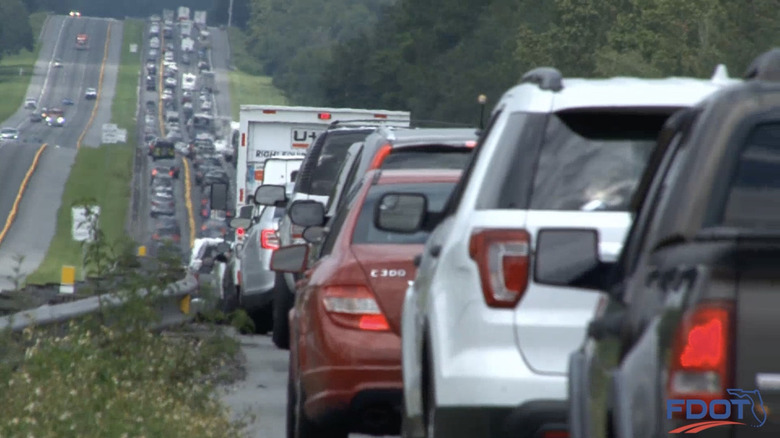
Florida is a strange place full of strange people and strange laws. That being said, a broken clock can still be right twice a day, and that's exactly where its Emergency Shoulder Use policy comes in. While the idea of adding "one more lane" doesn't really do much to decrease traffic on a permanent basis, sometimes you've just got to move as many people as possible from one place to another in a pinch, and that's the purpose of ESU — a strategy to temporarily increase traffic flow and capacity during major hurricane evacuations by making use of paved shoulders. Why not, ya know?
The program was first developed back in 2017 ahead of Hurricane Irma as a replacement for what the state called One-Way Plans, which are also known as contraflows and lane reversals, according to the Florida Department of Transportation. That's where both directions of travel are turned into one-way streets, allowing the most people possible to travel away from an impending disaster. But the ESU system allows there to be two-way traffic, while also increasing the flow of traffic away from things like Hurricanes, which is always good for a number of reasons.
A study conducted on Emergency Shoulder Use in 2020 found that it was preferable over the contraflow method because contraflows "can only be operated during the [daytime], requires massive resource allocation, and hampers emergency services [reaching different] parts of the state." It goes on to say that ESU offers "minimal disturbance to traffic and is easy to deploy."
How ESUs work
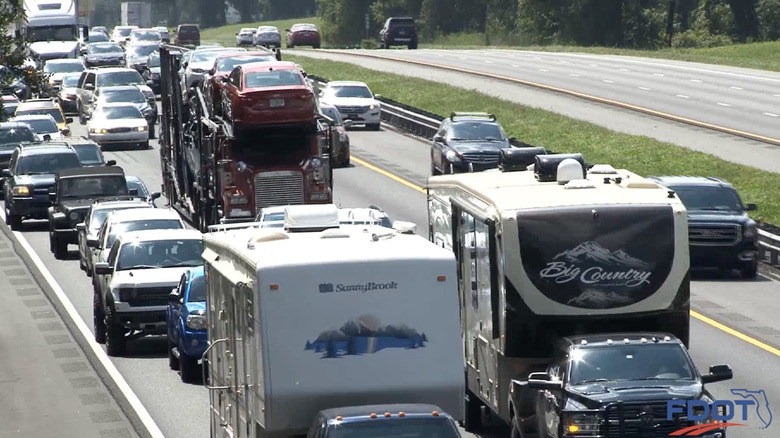
When ESU is operating, anyone can use the shoulder as a travel lane, except large trucks, buses, and drivers with a trailer. It can be entered and exited at designated locations where police are stationed with posted signage. It makes use of the left or inside shoulder on six-lane roadways (three lanes in each direction), and the right or outside shoulder is used on four-lane roadways (two lanes in each direction).
If you do find yourself in Florida during a hurricane and you need to travel in an ESU lane, there are some things to keep in mind, as the shoulder isn't exactly like a normal vehicle lane. They're two feet narrower than standard lanes, so it's best that you slow down and navigate carefully. FDOT says you should watch out for gutters, inlets, and other places where the shoulder narrows for obstacles like bridges, overpasses, guardrails, and barrier walls. You might also notice the continuous and slightly annoying noise/vibration of driving over rumble strips for a long period of time. Oh, and watch out for debris, because most trash, nails, tire treads, and falling detritus from cars and trucks end up on the shoulders of highways.
Right now, Florida has ESU routes ready to go on different sections of seven different highways throughout the state: I-4, I-10, I-75, I-75 Alligator Alley (somehow different from the other I-75), I-95, Florida's Turnpike, and SR-528. Keep in mind that only certain sections of these roads have ESU capabilities, but the state annually reviews routes, plans and standard operating procedures to see if more can be added.