

The British Army's Great Panjandrum Was The Most Bonkers Vehicle Ever Dreamed Up
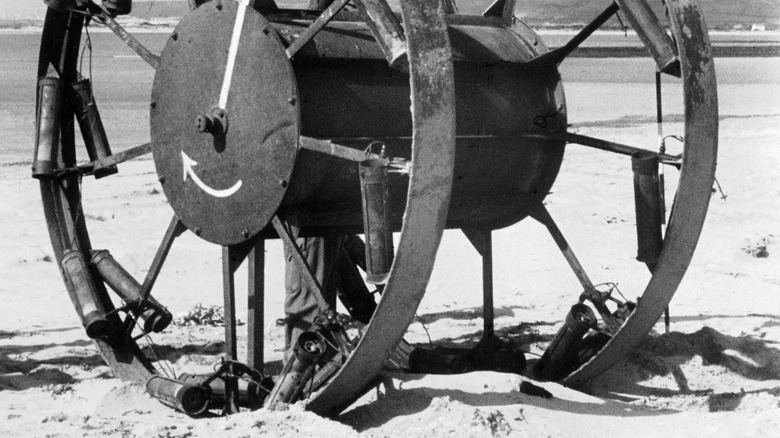
Using unpersonned war machines is pretty routine today, now that so many military groups are turning to drones. Heck, Ukraine is even using drones to ram other drones. But there was nothing ordinary about the Great Panjandrum. It was a driverless bomb-delivery vehicles created to help the Allies on D-Day.
The Great Panjandrum somehow got its name from a made-up word invented as an insult during an 18th-century actors' feud — it means a self-important person. As for the World War II thing, that was the brainchild of C.R. Finch-Noyes, who had also contributed to the invention of the bouncing bombs used during Great Britain's dam-busting raids into Germany. He created something that looks a bit like a large spool, with two massive 10-foot steel wheels on each side of a barrel-shaped axle. In that barrel would be more than a ton of explosives, and the idea was to rely on rocket power to get the Great Panjandrum up 60 mph or so, and then crash it directly into the German defenses.
When we say "rocket power," we don't mean the type of setup used by rides like a rocket-propelled go kart. The Great Panjandrum had up to 70 small cordite rockets attached along its wheel rims. This way, in theory, the rockets would directly spin the wheels. In practice, that worked about as well as you might expect.
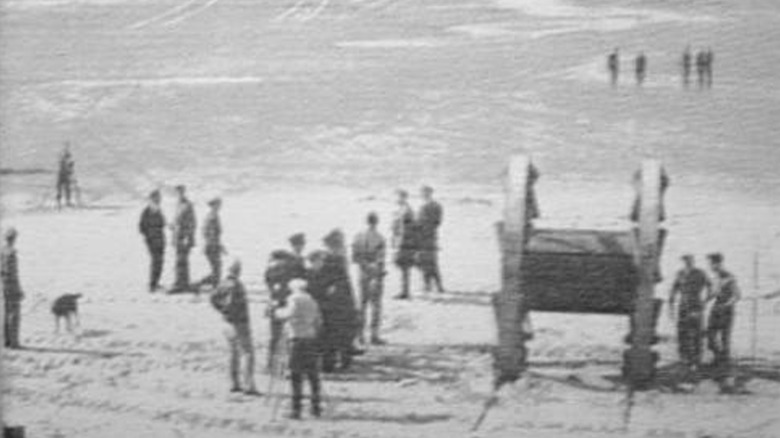
Even when the rockets weren't flying off on their own, there simply was no practical way to control the Great Panjandrum — especially when you remember the state of the beaches on which they'd be driving. After failing a 1944 test in spectacular fashion, the Great Panjandrum was mothballed in favor of the modified tanks known as Hobart's Funnies.
What other custom military vehicles were designed for D-Day?
Although the Great Panjandrum certainly didn't live up to its name, the British did engineer a number of driver-operated vehicles that had been customized for beach warfare. And much of the credit here goes to another fantastically named Briton, Percy Cleghorn Stanley Hobart.
Hobart's military career had its ups and downs, from serving with honors in World War I to being forced into retirement in 1939 over apparently irreconcilable differences with other officers about how to use armored vehicles. Yet Winston Churchill was ready to try out some of those radical ideas in 1943, when he brought Hobart back and turned him loose on the army's fleet of standard tanks — usually one of the many U.S.-made Shermans built for the war, but sometimes based on the Churchill Armoured Vehicle Royal Engineers (AVRE) tank as well.
The results were collectively called Hobart's Funnies and included an AVRE modified to carry a 34-foot-long assault bridge to help avoid anti-tank ditches. The bridge could be deployed in under two minutes and was robust enough to carry 40 tons. The Sherman Crab, meanwhile, had chain flails mounted on a revolving cylinder, letting the chains whip the ground to explode enemy mines. More frightening was the Sherman Crocodile. It had a flamethrower on its turret instead of a gun, with the flame's fuel carried in a separate trailer pulled by the tank.
Another Sherman, the DD, for Duplex Drive, is a further example. These tanks, invented not by Hobart but by Hungarian-born Nicholas Straussler, who had moved to England, were modified for amphibious driving to get from the landing ships directly to the beach. In the end, none of the Funnies was as crazy as the Great Panjandrum, but all were more effective.