

Raindrops Can Cause 9,000-Volt Zaps That Eat Through Your Car's Paint
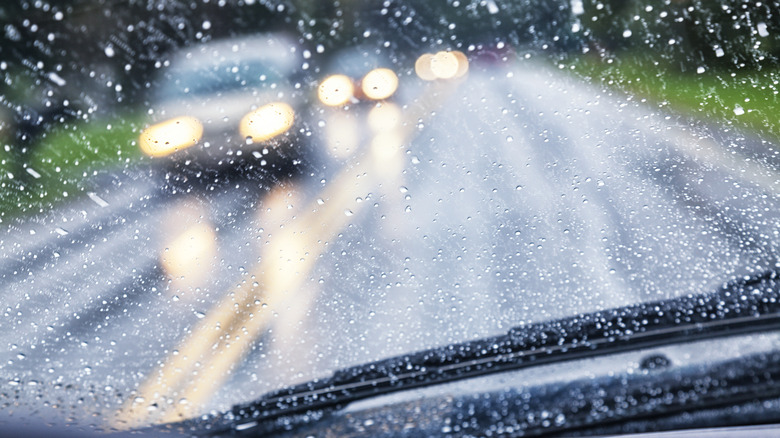
The list of external factors car enthusiasts attempt to avoid to protect a car's paint is overwhelming. But special clear coats, rustproof coatings, frequent washes, and outright physical barriers against the elements can't protect paint from everything. A new study reported by Ars Technica found that raindrops, thought to be a calm and soothing result of nature, can zap their way through a car's paint and contribute to yet another form of corrosion.
We humans have created some brilliant coatings to protect our cars from corroding via the elements, but even those protections can wear away with time. The researchers who investigated this phenomenon used this study, available on Nature, to see how known charges collected in water droplets from sliding across surfaces could contribute to corrosion, and it's seriously fascinating.
Consider that charged drops occur naturally via thunderstorms, the crashing ocean waves, waterfalls — basically anything that can create water droplets and release them into the air. These little spheres of water then land onto a surface. Upon impact though, there's no charge. What does create a charge though is called sliding electrification. That raindrop or water droplet (one in the same) then moves across an insulated surface and exchanges charges, leaving one charge behind while picking up its own charge. In this particular study, researchers found that the charge exchange could help a droplet collect upwards of 9,000 volts which could discharge on certain surfaces. For simple reference of how much 9,000 volts are, your common plugs throughout homes and businesses are typically rated for 120 volts. A typical electric fence used for livestock can contain a voltage upwards of 5,000 to 10,000 volts.
Making it rain... for science
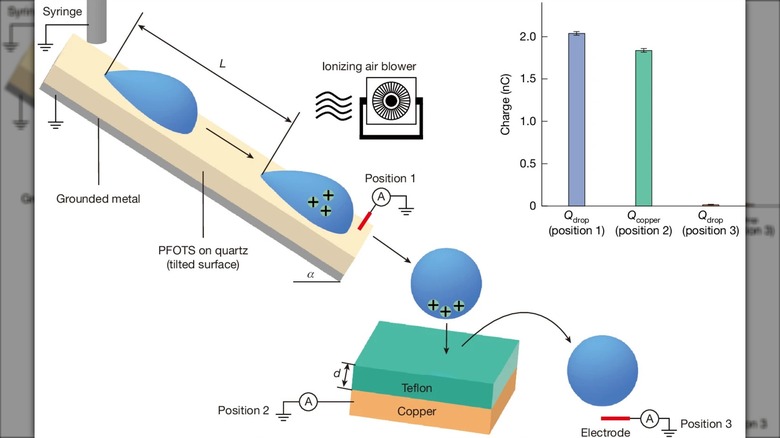
To test this theory researchers first set up a copper sample coated in Teflon film, considered one of the most chemically-resistant coatings available on the market today. That sample was then laid at a 10 degree angle and exposed to 3,000 water droplets containing a tiny amount of salt to mimic real-world raindrops. 3,000 water droplets was determined to be about the same amount of droplets a surface would interact with during a moderate rain event for an afternoon. Researchers found that this initial surface experienced no changes or damage from the raindrops at all.
Next, researchers prepared four kinds of insulated surfaces: a plant leaf, construction material via a polyvinyl chloride (PVC) foam board, a window made of polystyrene glass, and a chemical water repellant (perfluorooctadecyltrichlorosilane known as PFOTS) coated onto a quartz plate. All were selected to mimic real-world examples of everyday items rain would interact with. These samples were then tilted at about 50 degrees and 3,000 water droplets were dropped onto each of these surfaces. This time, water droplets were meant to slide down the surface and drop onto another copper sample coated in Teflon sitting only 5 millimeters below the sample.
Using atomic force microscopy, researchers found defects on the surface that had eaten through both the Teflon film and the copper. Researchers also filmed the droplets with a high-speed camera and were able to see the water droplets change as they dropped onto the Teflon-coated copper surface.
Researchers wanted to see if this same approach applied in different thicknesses of coatings on copper, as well as gold. They found that no matter the thickness or type of metal, all experienced corrosion similar to the initial Teflon-coated copper surface from the first part of the experiment.
Rain, rain go away. Leave my paint alone today
A water droplet collects a positive charge, while the metal (copper or gold in this case) holds a negative charge. As the water droplet approaches a metal surface, the electric field between the two increases and upon impact is discharged. This voltage is what causes the hole and breakdown or complete destruction of the coating, like it did in the Teflon and then the metal. The salty water is left behind on the damaged surface and further erodes at the metal. What doesn't help is the droplet has essentially created a small pocket or divot for the water to hang out in, so the salt water just sits.
The results do not bode well for generally any coating out there, and it means not one is really safe from these electrified raindrops. But it's important to remember the charge happens when the water droplets run down an insulated surface, like houses, or trees and then drop onto another metal surface. Thanks to another part of this experiment they found droplets that fell onto a non-conductive material didn't experience corrosion. I guess that's a win for plastics?
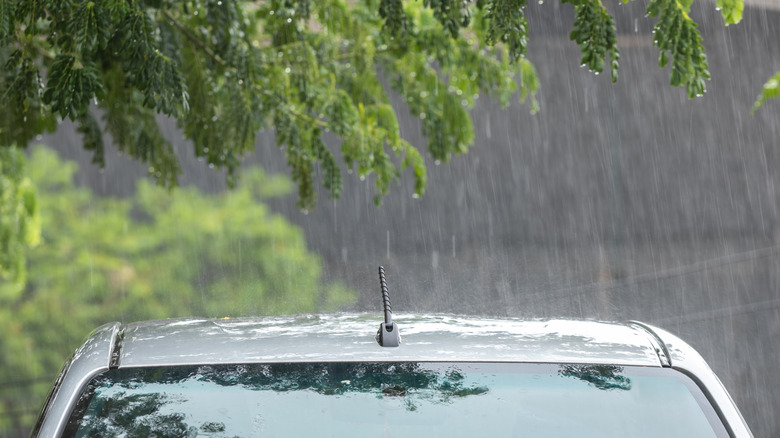
What this means for you — now there's even more incentive to keep your car covered and away from awnings, homes, trees, cars, semis, etc. Every loose raindrop may be collecting a charge that's looking to zap your clear coat away, and rust your car with it. Doesn't science rule?