

Back When Standard A/C Was For Luxury Cars Only, This Sedan Brought It To The Masses
In 1902, Willis Carrier invented the first air conditioning system as we know it, evidently not to make people more comfortable but to prevent the profit-sucking scourge of humidity from wrinkling paper at a publishing company. His eponymous climate and energy solutions company endures. It would be about four more decades before luxury automaker Packard stuffed optional A/C units in passenger car trunks to make motoring more comfortable. Cadillac and Chrysler weren't far behind, promising an end to the days of drivers getting creative with airflow to cool off — if they could afford it.
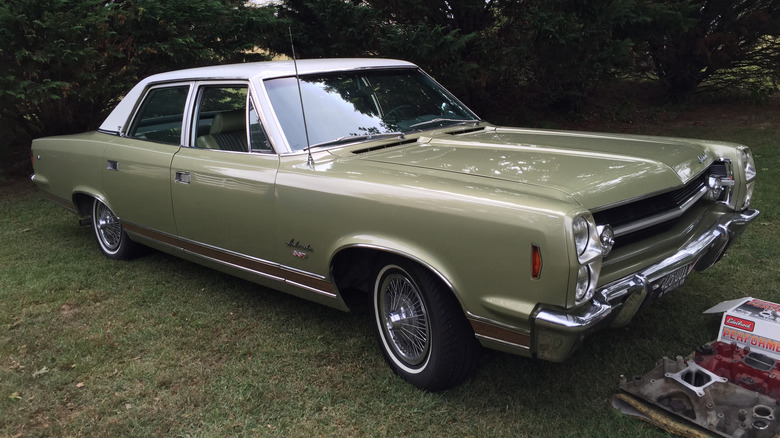
And that took a while. It was American Motors and the 1968 AMC Ambassador sedan that would ultimately bring standard A/C to the sweaty motoring masses — "standard" and "masses" being the operative words here. In terms of standard equipment, you could have it in a Rolls-Royce, and General Motors put A/C in the 1957 Cadillac Eldorado Brougham, which stickered for $13,074. That's about $154,000 today. Not quite mass-market.
Ten years' worth of inflation later, the '68 Ambassador sold for around $2,800, the rough equivalent of $27,000 in 2026. Dropping no-cost A/C in an affordable family sedan was a bold choice, especially when other incidentals like power brakes and power steering remained optional. But AMC was nothing if not oddly cool and beautifully weird. And A/C innovation was in its DNA.
The Ambassador of affordable climate control
By 1968, the AMC Ambassador was a Wisconsin-built, quasi-luxury car — elegantly angular, tastefully chromed, with a cool headlight design stacked like a 1968 Cadillac Fleetwood Brougham. Years prior, Ambassador was a range-topper from Nash — the company that merged with Hudson to form AMC. According to the Savoy Automobile Museum, Ambassador was once the longest-running nameplate in history, spanning 1927 to 1974.
When the '68 Ambassador arrived, A/C had been available to buyers for years. You could add it to early Mustangs. A handful of '57 Chevy Bel Airs left the factory with A/C. It wasn't cheap. Think $450 ($5,300 in today's money) for the option on a Bel Air Convertible selling for $2,600 ($30,000 in 2026). And this was after A/C became more affordably packaged — thanks in part to technology stemming from Nash.
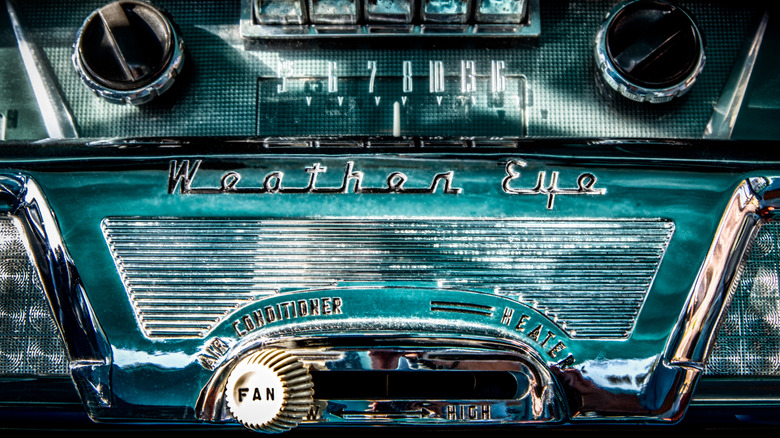
Like many early forms of consumer tech in cars, rear-mounted automotive A/C systems were effective, but clumsy. Condensation dripped on passengers from above. In 1954, GM's Harrison division simplified the plumbing by relocating the A/C components in a Pontiac engine bay. That same year, Nash delivered the future of climate control, called the Weather Eye — a name first used in 1939. The innovation combined heating and cooling in the cowl for an advertised cost of $395 (nearly $5,000 in today's money). With standard A/C, the 1968 Ambassador brought AMC full circle, democratizing a luxury feature it had pioneered. The last vehicle to offer A/C as an option? The 2022 Jeep Wrangler — a brand once owned by none other than AMC.