

It Took 60 Years To Finish The Last 8 Miles Of This 1,900-Mile Highway
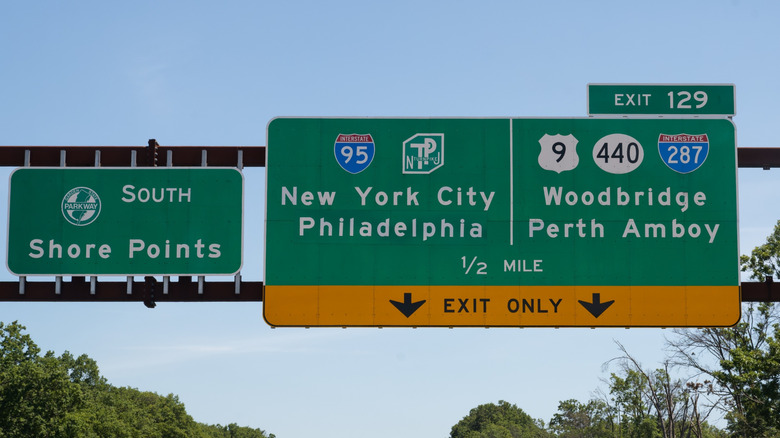
Interstate 95 is the most prominent highway on the East Coast of the United States, stretching over 1,900 miles from Maine to Miami. Despite linking the Northeastern cities of Boston, New York, Philadelphia, and Washington, D.C., the interstate spent most of its 69-year history with an inconvenient split. I-95's eight-mile gap near the border of Pennsylvania and New Jersey was finally closed in 2018 as state officials finally overcame the region's most notorious obstacle: not impassable terrain, but local opposition.
While the Interstate Highway System is a federal project, it requires state-level funding and local cooperation. If the opposition is stiff enough in an area, a highway won't be built through it. This was the case in Mercer County, New Jersey.
The agreed plans for I-95 featured a controversial bypass north of Trenton, called the Somerset Freeway. The local opposition was led by Bill Mathesius, the then-chief executive of Mercer County. He told NPR in 2010, "There was a specific revulsion to tearing up a rustic community — a rural community — and putting 95 through it." As a result, Congress officially canceled the interstate segment in 1982. Drivers instead had to use local roads to find their way across the gap and then the Delaware River as if they were George Washington in the Revolutionary War.
I-95's missing link had to be built in a different state
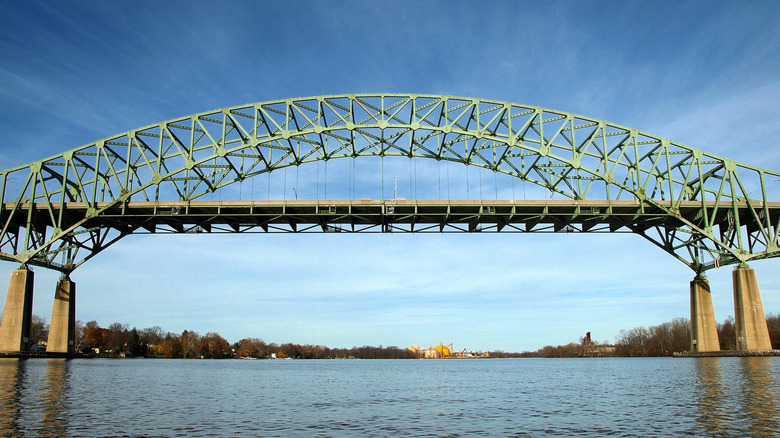
I-95's "missing link" wasn't entrusted to the State of New Jersey. The same federal law that canned the Somerset Freeway also tasked the Pennsylvania Turnpike Commission with building a three-level interchange to route traffic between its state's northernmost section of I-95 and the eastern end of the Turnpike. I-95 was effectively redrawn on existing roadways, crossing the Delaware River-Turnpike Toll Bridge, roughly eight miles south of Trenton.
Constructing the I-95 Interchange Project was far more easily said than done. The necessary studies were not completed, and federal funding wasn't authorized until 2004. It took six more years to actually design the interchange, and then construction began. In September 2018, the interchange's flyover structure finally opened to traffic. According to Bloomberg, the decades-long ordeal cost $425 million.
We found out in 2023 how catastrophic it would be if I-95 were suddenly severed, highlighting just how important it was to eventually complete the project — even if it did have a high cost. A tanker truck crashed and caught fire underneath an interstate overpass in Northeast Philadelphia. The blaze caused the structure to collapse. Drivers were forced to take a 43-mile detour, and officials took emergency measures to mitigate the disaster. SEPTA, the city's regional transit agency, scheduled additional commuter trains to alleviate road traffic. Pennsylvania Governor Josh Shapiro declared a state of emergency and mobilized his state's resources to reopen the collapsed section of I-95 in just 12 days.