

U.S. Police Car Fleets Are Mostly Fords For A Reason
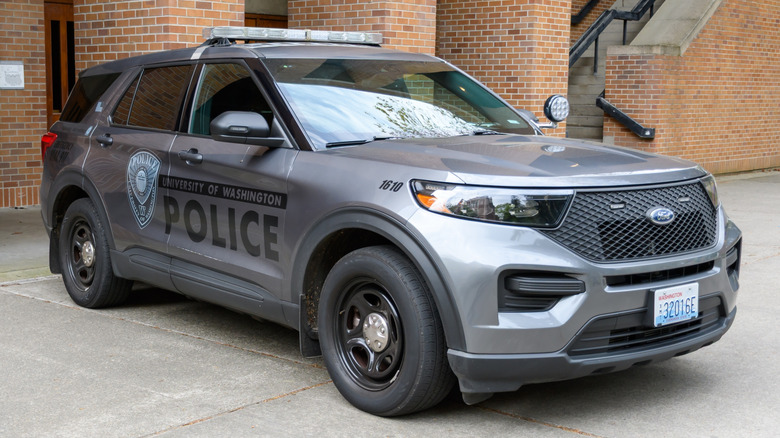
Ford is one of the biggest carmakers in the world, producing everything from heavy-duty commercial-grade Ford F650's to compact family-friendly crossovers like the European-market Ford Puma. Ford also supplies many government agencies. For instance, the U.S. Postal Service bought 9,250 Ford E-Transit vans in 2024, meaning that the first EVs in the USPS all-electric fleet will come from Ford.
Be that as it may, nowhere is that government relationship stronger than with U.S. law enforcement. According to a recent assessment by CNBC, more than half of the roughly 12,000 U.S. police departments drive Ford vehicles, and Ford claims its share of the law enforcement market is closer to two-thirds.
The blue oval also became "the first automaker to offer a dedicated police package" back in 1950. Still, the reason why most law enforcement vehicles on the roads today are Ford has to do with one vehicle that became almost synonymous with the police car: the Ford Police Interceptor Utility, which alone accounts for half of all new police vehicles sold in the country.
Moreover, the SUV-ification of the police force has also got a lot to do with it. When looking at the Michigan State Police Precision Driving Unit's annual testing data, two out of eight police vehicles in 2010 were SUVs. Fast forward to 2022, and nine of eleven are SUVs. Here is why U.S. police car fleets are mostly Fords, and why the Ford Police Interceptor Utility dominates the ranks.
Why the Ford Police Interceptor Utility dominates the force
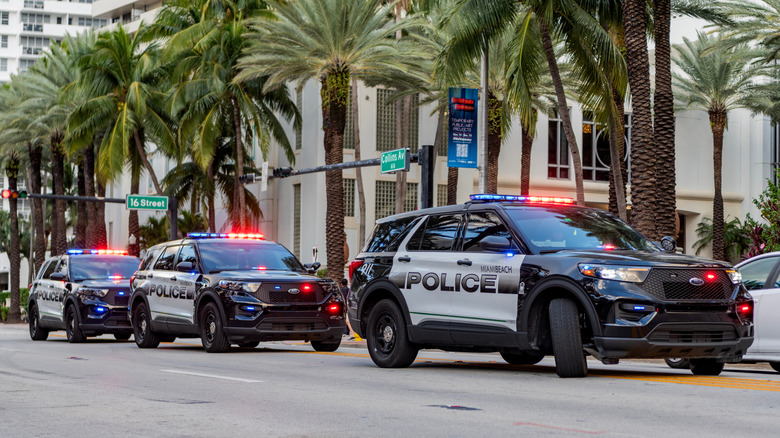
Ford's Police Interceptor Utility dominates because it combines pursuit-level performance with the space and payload of an SUV, as demonstrated in the Michigan State Police 2026 Police Vehicle Evaluation. The Michigan State Police evaluation ("Blue Goose") is one of the most influential tests of its kind where police vehicles have been independently tested and compared for more than 50 years.
The Interceptor Utility 3.0L EcoBoost AWD hit 148 mph, the fastest of any gas-powered vehicle tested, and reached 60 mph in 5.95 seconds — quicker than the Tahoe PPV's 7.29 to 7.83 seconds and the Durango Pursuit's 7.24 to 8.26 seconds. That speed carried over to Grattan Raceway's 32-lap pursuit simulation. This is where the EcoBoost Explorer posted the fastest average lap among gas vehicles at 1:35.95, ahead of the Tahoe PPV's 1:38.09 and the Durango Pursuit's 1:38.30.
Braking followed suit: the 3.3L AWD's projected stopping distance from 60 mph was 131.23 feet, edging out the Tahoe's 132.09 feet and beating the Durango's 141.10 feet. MSP's ergonomics score, which rates comfort, visibility, and instrument placement, also favored Ford at 8.02, versus 7.95 for the Durango and 7.93 for the Tahoe.
The one exception is interior room: the Tahoe's 123.2 combined cubic feet edges out the Interceptor Utility's 118. So Ford's advantage isn't space — it's speed, handling, braking, and comfort combined. Even though having an all-SUV police force does help with policing, the dangers of an all-SUV police force fleet is not to be sniffed at, especially when it comes to pedestrian safety.
Ford's rich history with U.S. police departments
The Ford Police Interceptor Utility dominates, but it isn't the only Ford you'll find chasing you down with its blue lights on. Sometimes it can also be the Ford F-150 Police Responder truck, or even the Ford F-150 Lightning Pro SSV. The force also relies on the Ford Expedition MAX SSV, the Ford Transit Prisoner Transport Vehicle, and even the all-electric Mustang Mach-E.
Given how performance is such an important metric for a superior police cruiser, one would expect the ICE Ford Mustang to be represented, but officially it isn't. Ford does not offer a factory-built police Mustang, but that's not stopping some departments from using it. For example, in early parts of 2026, the Missouri State Highway Patrol added 10 Ford Mustang GTs to its force, while the New York State Police also acquired new Mustang GTs for protecting its roadways.
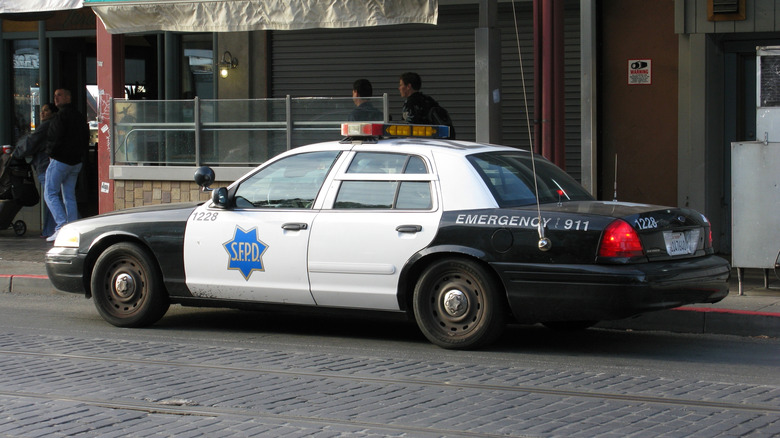
The connection between the Mustang and U.S. law enforcement goes back to the 1980s. Ford built Special Service Package (SSP) Mustangs used by highway patrol units in 32 states between 1982 and 1993, along with agencies like the FBI and U.S. Postal Service. Quite possibly the most iconic police car to come out of the U.S. was the trusty 1992-2011 Ford Crown Victoria.
According to Ford, "in 1998, the Crown Victoria police package accounted for 85% of police pursuit sales in the U.S. and Canada," meaning that the "roughly half" figures associated with the new Ford Police Interceptor Utility look modest by comparison.