

Why The SCCA Made The 1965 Shelby GT350 Get Rid Of Its Back Seat
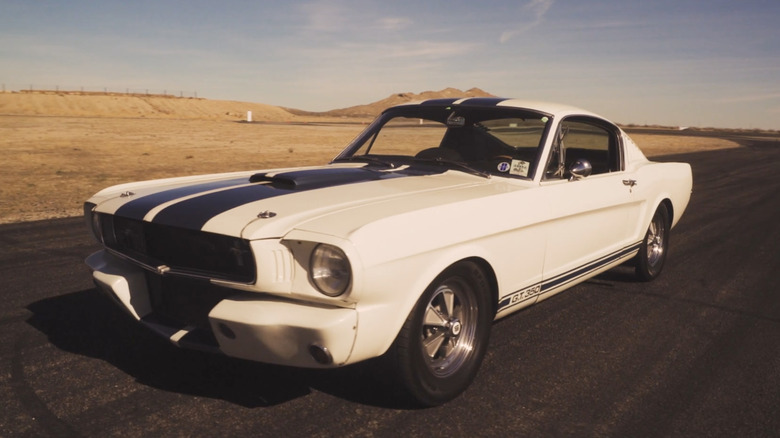
The 1965 Shelby GT350 didn't shed its rear seat because Carroll Shelby wanted to save weight. Rather, it lost it because the SCCA – notable for booting contestants like the C4 Corvette at will — didn't consider Ford's prized pony car as a true sports car. Removing the back seat was the specific fix that changed that classification and kicked off the Mustang's legacy.
When Ford introduced the Mustang in mid-1964, it was an immediate commercial success. What it wasn't, in the SCCA's view, was a sports car. The Mustang's 2+2 layout — a front seat and a smaller rear seat — placed it in a different classification than the two-seat sports cars the SCCA sanctioned for its B-Production racing category. Ford needed the GT350 to qualify for that class to compete against the Chevrolet Corvette and other rivals.
Lee Iacocca, then Ford's president, asked Carroll Shelby to iron out the GT350's hiccup. Shelby arranged a meeting with SCCA Executive Director John Bishop and asked directly what it would take to get the Mustang into the sports car category. The answer was straightforward: remove the rear seat and make the GT350 a true two-seater.
Two less seats for three SCCA titles
Ford's San Jose assembly plant delivered the Mustang fastbacks to Shelby American's Venice facility without the rear seat and other parts that weren't needed for the GT350 conversion. In place of the rear seats, Shelby installed a fiberglass shelf that covered the spare tire while the battery was moved to the trunk for improved weight distribution.
Removing the rear seat wasn't merely a bureaucratic checkbox — it changed the character of the car. The cabin became purposefully stripped, and what filled the gap conveyed Ford's racing goals with the Mustang. To homologate the GT350 for the 1965 racing season, Shelby needed 100 street-legal examples available by January 1, 1965. On that day, 100 Wimbledon White fastbacks were lined up outside Shelby's Venice facility for SCCA inspection — each donning the same modifications that would go on to win three consecutive SCCA B-Production championships from 1965 through 1967.
The name GT350 is way more random than you think and came from one of Carroll's tales. The story goes that, during a meeting with some Ford execs, Shelby asked for an estimate of the distance between shop buildings. An employee said it was approximately 350 feet – and, thus, the name stuck. With a name that came about as randomly as that, it's amazing to see how legendary the GT350 moniker has become, transforming into one of the wickedly cool Carroll Shelby cars that made the man a legend.