

James Webb Space Telescope Discovers New Type Of Star Powered By Black Holes Instead Of Fusion
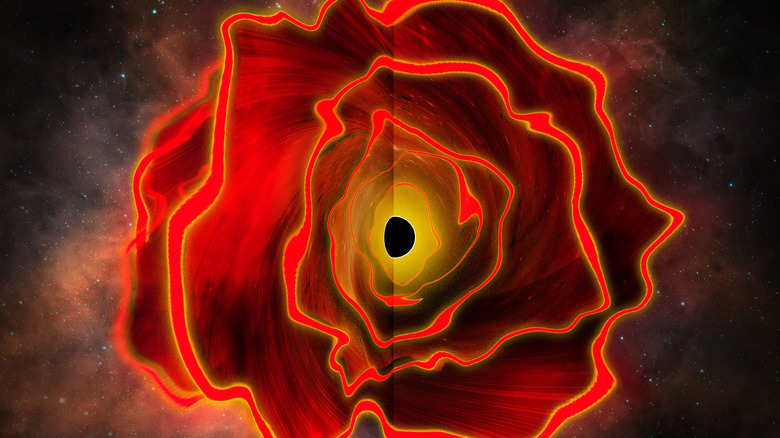
In a major breakthrough for astronomy, scientists have discovered an entirely new category of thing in our universe. Not a quasar, not a pulsar, not a neutron star, and certainly not a conventional star like our Sun — it's a so-called "black hole star," a dense gas cloud surrounding a black hole. In other words, this is a star being powered not by the nuclear fusion of the gases at its core, but by the colossal energy that scientists have long known radiate out from the voracious cosmic predators.
This creates a celestial object that features some characteristics of both stars and black holes. This particular one, which led scientists to the discovery, is fully 100 billion times brighter than an ordinary star. It's also very, very old — so old that it probably doesn't even exist anymore.
It represents something of an accidental discovery, in that the scientists were initially looking for something else. The team used NASA's incredible James Webb Space Telescope to tease out the galaxies most distant from us, per the Guardian. While they succeeded (they found Mom-Z14, the farthest now-known galaxy), they also noticed something weird in the image: a little red dot. This isn't the first time: these little red dots have been popping up in pretty much every photo Webb has taken of deep space, something never before observed and until now unexplained, per MIT News. The one in this photo was especially, even shockingly, bright. What off Earth was going on?
The greatest power in the universe
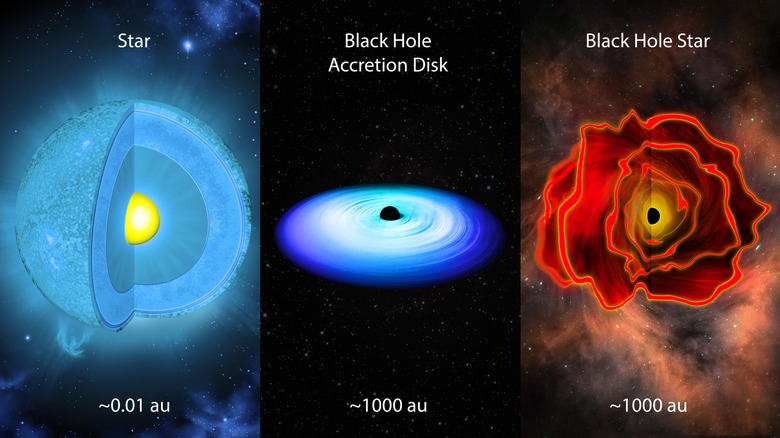
The team ran a number of computer simulations, trying to see if they could recreate the conditions of this bizarrely bright dot. After many permutations, they finally found one. All you need is a black hole 100,000 times more massive than the Sun and a cloud of gas to entirely surround it. To be clear, this is distinct from the famous accretion disks that astronomers have known about for decades. These are flat, essentially two-dimensional accumulations of matter spiraling inwards towards the inescapable event horizon. The black hole at the center of a black hole star will also have an accretion disk, but the whole thing is completely enveloped with gas.
While most famous for sucking in everything around it, black holes also emit colossal amounts of energy and even matter (from the accretion disk, before it crosses the event horizon). They are, in fact, the major power sources of our whole universe. The basic idea is that titanic energy is blasting its way through the gas cloud, making for a red dot so bright it actually outshines the very galaxy it's within. Nobody tell my cat, because he will chase it.
Ancient powers long passed
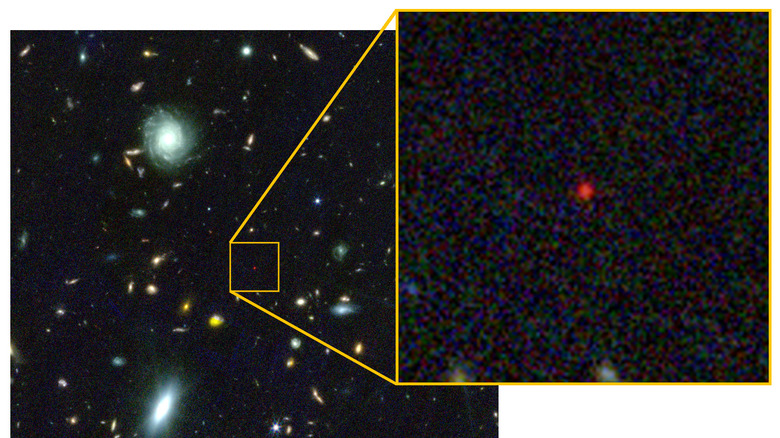
Here's the thing, though: All of these celestial dots are very old. Only Webb has ever seen them, and only when it's pointing at the early parts of the universe. As a reminder, light moves at a known speed, so when we look at stars or galaxies, that light is already thousands or millions or billions of years old. That allows telescopes to "peer through time" as they observe the light of things from cosmic dawn. The universe was not even one billion years old (a mere child!) when these little red dots were shining. None have been observed in the more modern universe.
That might be because wrapping itself in a shroud is just part of a moody goth phase the black hole goes through before growing up. In fact, it's possible that supermassive black holes (the biggest entities in existence) are actually formed in exactly this way, per Gizmodo. Presumably, the cosmic omnivore eventually consumes all of the gas, stripping itself bare but also bulking itself up.
Black hole stars are a brand new discovery, so there's a lot of research that remains to be done. It's not often that astronomers get to start theorizing about an entirely new thing. For all that we've found, we have so much yet to learn.