

Catwalk Cars: New York City's Weird Wafer-Thin Electric Vehicles Used By Tunnel Police
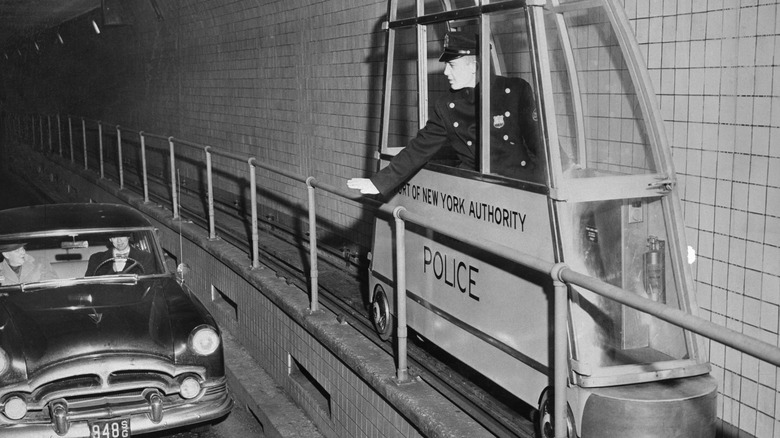
A train track used to run underneath the Holland Tunnel that links lower Manhattan and Jersey City, New Jersey. The thing is, when it was designed in the 1920s, the Holland Tunnel wasn't built for trains. Instead, the track that covered a good stretch of the 1.6-mile-long tunnel was added much later, in 1954, for cops to be able to patrol the byway and report on accidents. It ran adjacent to traffic on a thin, elevated catwalk that sits a few feet above the lanes, and the sole train that went to and fro between the mouths of both ends was a single-seat electric machine just 2 feet wide.
This 1,300-pound choo-choo was powered by a three-horsepower electric motor capable of a maximum of 12 mph. Once it got to one end of the line, the machine couldn't turn around. Instead, the seat swiveled (no doubt, to the chagrin of the cops' knees), so the driver could rotate their body and roll back into the Holland. It's almost as interesting as how the ceilings of tunnels get cleaned.
The glam job of policing tunnels
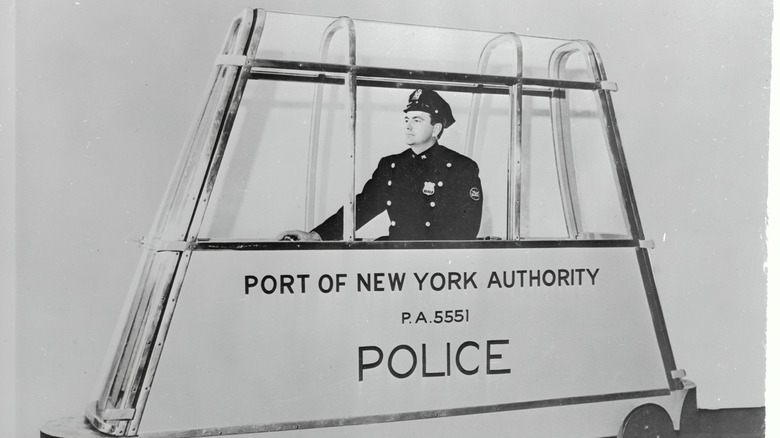
According to Popular Mechanics' coverage at the time, the justification for needing this system was to enable four rather than six police officers to patrol the entirety of the tunnel. A retrospective at the Hoboken Historical Museum in 2012 — the 85th anniversary of the Holland Tunnel and the 75th anniversary of the Lincoln Tunnel –was covered by The New York Times. The piece noted that the justification for a tunnel was that it was cheaper: $11 million versus $42 million. Yes, the cost ballooned to $48.5 million upon completion in 1927. Just for context, that's more than $1 billion today, and no way should you believe we could pull this off for a mere $1 billion in 2026.
Probably out of jealousy, the Lincoln Tunnel also got its own skinny not-rods in 1960. Theirs were gas-powered, open-top, and could rocket to 35 mph. They weren't made of plastic, but instead, of steel and aluminum. But, in an emergency, the Holland Tunnel cars could handle up to three officers, whereas the ones darting through the Lincoln were strictly solo jobs. Rather shockingly, according to the New York Times, catwalk cars weren't retired until 2011.
The air in the Holland Tunnel is cleaner than you'd think
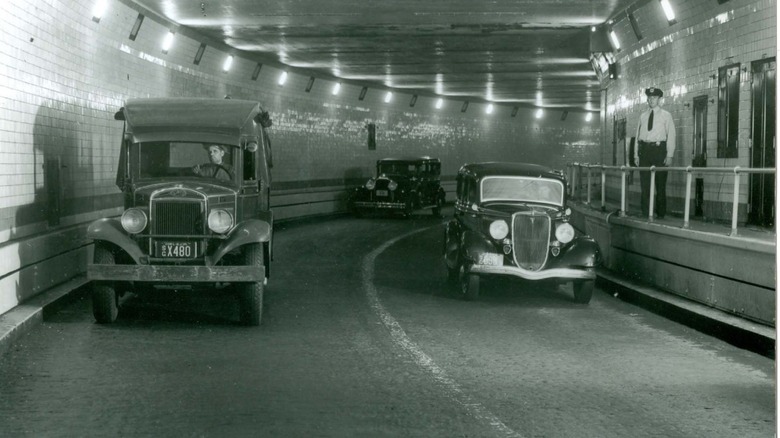
You'd guess that the cops who had to ride the railway cars back and forth in these tunnels would be gasping for air. However, the Holland tunnel has four huge buildings — two on each side of the Hudson River — which house 84 fans that run constantly, exchanging the air in the tunnel every 90 seconds. According to the Times' reporting about the 2012 exhibit in Hoboken, that innovation was later used in the Lincoln Tunnel as well.
Here's something else you probably didn't know. The Holland Tunnel isn't named for the country — and fortunately, it doesn't have a dumb and clunky name like the Convention Center Loop Tesla Tunnel, which remains hilariously bad. We've never had a president Holland, so unlike the Lincoln Tunnel, it's not named after a president either. As a tribute, it bears the name of its first chief engineer, Clifford M. Holland, who came up with the design. But Holland died before the tunnel's completion, and so did his successor, Milton Freeman, less than a year later. Lastly, Ole Singstad — the third chief engineer who spearheaded the Holland Tunnel's completion — later went on to design the Lincoln Tunnel.
The police aren't the only folks who've walked the tunnel on foot. Just before it opened to cars, thousands of spectators poured through the tunnel upon its inauguration. Several hours later, at the stroke of midnight, November 13, 1927, the gridlock began. And charging people to drive into Manhattan became a grudging tradition that's now nearly a century old.