

The Mazda Navajo Wasn't Made By Mazda, It Was A Ford Explorer Built In Kentucky
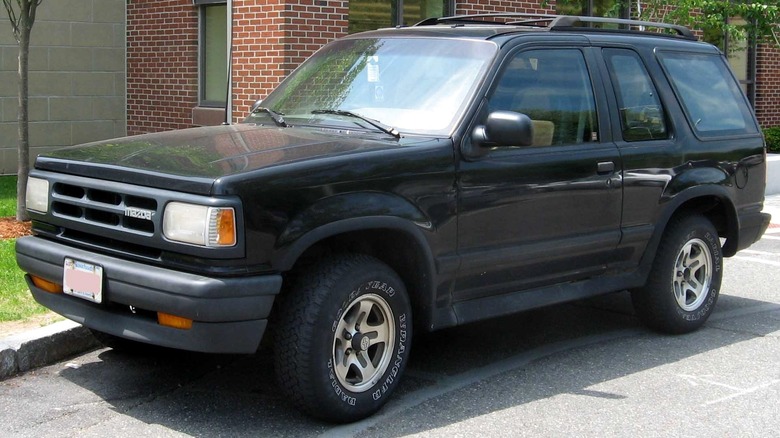
Today, if you stand near a road and watch the traffic roll past, you'll spot numerous crossover SUVs sporting Mazda's stylized "M" badge. The Japanese automaker has gotten so good at making crossovers that it now builds a succession of highly respected models that continue to earn it the loyalty of families and individuals worldwide. However, rewind a couple of decades to 1991, and Mazda had to lean on badge engineering to get its foot in the SUV market. At the time, Ford had a 25% stake in Mazda, so the two found it easy to strike a supply deal, allowing Mazda to stick its badge on a first-generation two-door Ford Explorer Sport, which itself was introduced for the 1991 model year as a replacement for the lawsuit-plagued Ford Bronco II. Thus, the Navajo, which was assembled in the same Louisville, Kentucky plant as the Ford Explorer, became the first in a long line of SUVs to be sold under the Mazda brand.
With Mazda offering the likewise newly-introduced Proceed Marvie in international and Japanese domestic markets in 1991, the sales brief called for the Navajo to be sold exclusively in the U.S. Aside from the badges, Mazda did make slight adjustments to the exterior in an attempt to visually give all of those Navajos a somewhat different appeal to the Explorer. These included a different front fascia along with new headlights, taillights, and wheels. But even with such light-touch tweaking, the Mazda was considered deeply impressive enough to be named Motor Trend's Truck of the Year in 1991. But it was sadly only produced for a few short years, from 1991 to 1994, before being discontinued.
A better look at the Ford (Mazda) Navajo
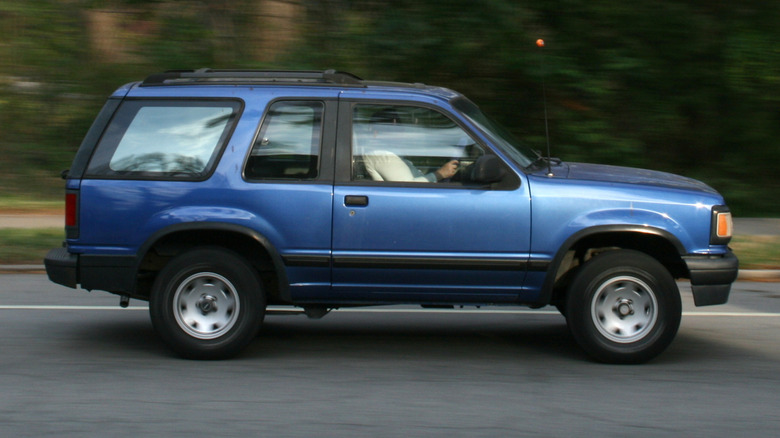
Ford's 4.0-liter Cologne V6 powered every Mazda Navajo from launch right up until the model was discontinued after the 1994 model year. There was only one trim level for 1991, which made 155 horsepower and 220 lb-ft of torque, funneled to the wheels via either a standard five-speed manual transmission or an available four-speed automatic. A part-time four-wheel drive and rear-wheel anti-lock brake system that could kick in only when the Navajo was in two-wheel-drive mode were also part of the package. The 1992 model launched with the choice of two trims – DX and LX — each with a rear-wheel drive version, but the German-built V6 carried over unchanged, resulting in the vehicle putting out the same numbers as it did in 1991.
However, power increased to 160 hp for the 1993 model year. Equipped with the standard five-speed manual, it sprints from 0 to 60 mph in around 10 seconds. While that's still a far cry from the current midsize SUV market, with the likes of the luxurious Mazda CX-90 generating between 280 and 340 horsepower, it was decent enough for the time. The good news is, if you're considering the Navajo, you can pick one up for under $4,000 on the used market, evidenced by a 136,000-mile example with a listing price of just $3,795 on Edmunds.