

Volvos And Saabs Were Once Used As "Friction Testers" For Airport Runways
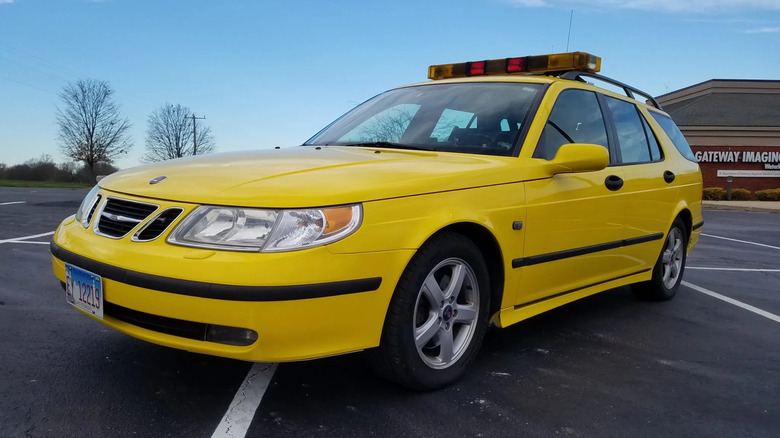
The Swedes are known to be a progressive, sensible, and innovative people, and the cars they've produced reflect that. Saab is no longer producing new cars, but it left a lasting mark on the global automotive landscape with its quirky yet safe cars, and Sweden's remaining automaker Volvo, carries the proverbial torch with a similar reputation.
The smart Swedes didn't just put their energy into making cars, though. In fact, Saab started its life as an aviation company and airplane manufacturer after World War I, and only got into the car business after the conclusion of World War II. In the late 1970s, the National Swedish Traffic Research Institute and the National Aeronautical Research Institute of Sweden partnered with Scandinavian Airport and Road Systems (SARSYS) and Saab automobiles to create a new intersection of Swedish automotive and aeronautical excellence, with a safety innovation called the runway surface-friction tester. In Saab's absence, SARSYS has pivoted to installing its friction testing equipment in Volvo wagons and other vehicles.
These rigs are designed to test the friction levels between a simulated airplane tire and the runway with the goal of reducing the risk of aircraft hydroplaning during takeoff and landing, which are the most dangerous parts of a flight. We've even seen a few of these specialized Swedes come up for auction in the past, if for some reason you want one of your own.
Friction testers use a rather ingenious measurement system
Even a dry runway may present friction issues for planes due to residual rubber buildup left behind when airplane landing gear go from stationary to over 100 mph at the moment they come in contact with the ground during a landing. Of course, adding rain or standing water to the equation reduces friction even further.
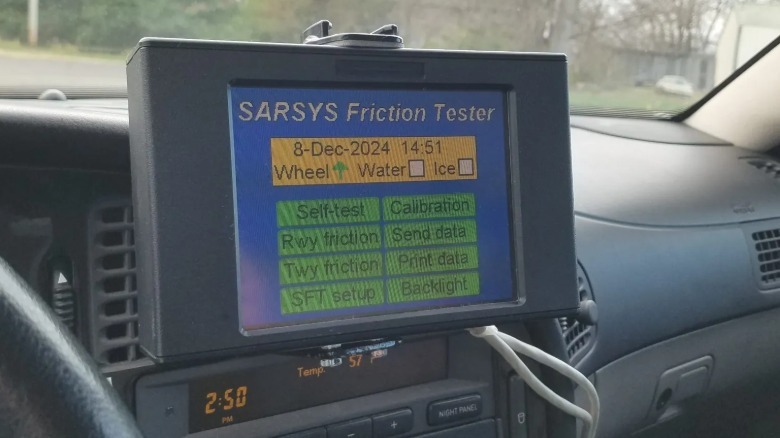
Runway friction testers, whether Saab or Volvo, are retrofitted with a retractable airplane wheel called a skiddometer, a water tank, a computer measurement system, and an onboard printer. To measure the friction levels, the driver deploys the auxiliary wheel while driving on the runway, and a computer system constantly reads friction levels between the wheel and the runway. The water tanks can dispense a constant-rate spray in front of the wheel and measure the friction levels in adverse weather conditions.
Since Saab is no longer producing new vehicles, SARSYS friction testers take many different forms, from small towable trailers to massive tanker semi-trucks, but Volvos are also converted to serve this noble purpose.