

4 Econoboxes That Keep Getting Modified Into Limos
It's a different kind of madness that occurs when an enthusiast with a welding machine and too much free time looks at a hopelessly tiny, terribly built budget car and thinks to himself, "I know what this needs — a hot tub and a mini-bar." Limousines are supposed to represent the pinnacle of automotive opulence. Traditionally, they are born from vehicles that already possess a baseline of luxury and heavy structural integrity — think Lincoln Town Cars, Cadillac Fleetwoods, or massive Mercedes-Benz S-Class sedans. These are cars designed to glide silently down the interstate, coddling corporate executives, prom couples, and diplomats in a vault of leather and wood veneer.
However, there exists a dark, hilarious underbelly of the coachbuilding world, and we are not talking about the dope Hummer H2 Limo we found on sale online recently. This is the realm of the econobox. Why do they do it? Irony is a strong drug, and there is an undeniable joy in taking a car meant to be cheap and stretching it to the length of a city bus. It's an act of automotive defiance, and it seems certain econoboxes get subjected to it more than others. From home-brewed garage monstrosities to professional coach-built oddities, here are five humble econoboxes that keep getting transformed into stretch limousines.
The stretched Yugo GV: the Yugoslavian Cadillac
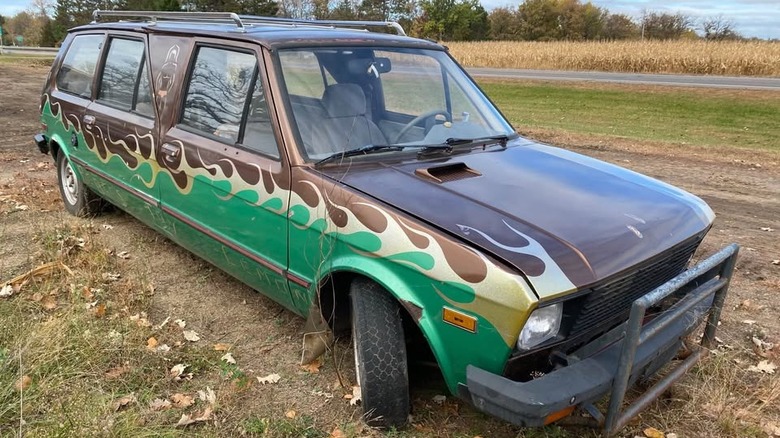
The Yugo GV is widely regarded by automotive enthusiasts — and anyone who had the misfortune of owning one, really — as one of the worst cars ever sold on American shores in the 1980s. Built in Serbia, under a crumbling Yugoslavian regime, the Yugo was a prime example of industrial minimalism. It is slow, unsafe, and unreliable. Yet, a talented enthusiast in the tiny town of Pierz, Minnesota, decided that the Yugo was the perfect canvas for a stretch limo. When it was posted for sale for $3,500 on Facebook Marketplace, this Yugo limousine became a hilarious testament to what happens when classic American hot-rod culture collides with Cold War economic leftovers. He wasn't the only one, either, as you will find multiple Yugo limousines peppered over the internet, including this six-wheeled contraption we found on Reddit.
In this case, the builder took two practically brand-new Yugo GVs with odometers hovering near zero. He split both of them and welded them together. To ensure nobody missed this monument to Balkan-American relations, one side of the car was painted blue and the other green, with a long flame decal separating them from the brown top. It is nothing like the process regular cars undergo to be turned into stretch limos. Beyond the extensive metal stretching, though, the car's mechanicals remained completely stock. That means the poor, factory spec 1.1-liter engine and 5-speed manual transmission were suddenly tasked with lugging around twice the curb weight they were engineered for. Before old age forced the builder to relegate the car to a barn, the "Communist Cadillac" reportedly racked up over 43,000 miles.
Fiat 500: Castagna Milano's high fashion muse
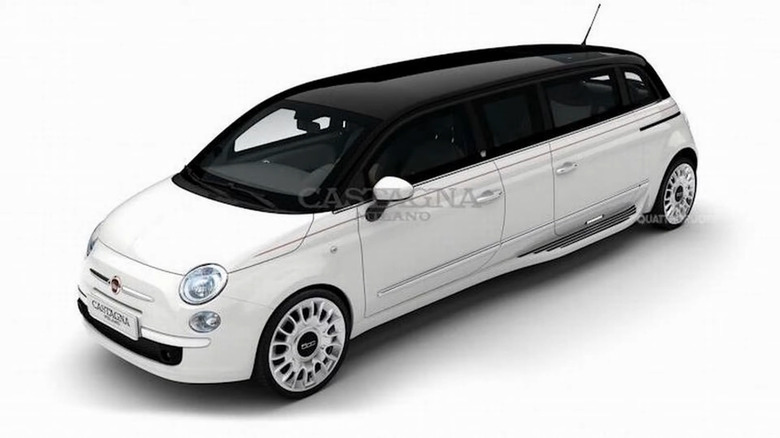
Not all econobox limousines are built in Midwestern barns. Sometimes, high-end European design houses get in on the action. Take Castagna Milano – a historic Italian coachbuilder famous for creating bespoke, ultra-luxury machinery. In 2012, the company decided to take the retro, pint-sized Fiat 500 city car and stretch it to the length of a full-size luxury sedan. They didn't just build one; they created three distinct flavors of the elongated "Bambino" – the LimoCity, the LimoCity Presidential, and LimoSun. The latter was designed specifically for beach resorts, featuring an open-top rear passenger cabin with rows of seats facing each other, which could be enclosed with clear, see-through panels in case of rain.
Instead of leaving the standard buzzing gas engines up front, Castagna Milano replaced the powertrains entirely. They converted the stretch Fiats to pure electric drive, packing two electric motors that could propel the long wheelbase micro machine to a top speed of 100 mph with a range of roughly 155 miles. It represents the absolute peak of high-fashion irony –- taking a car designed to squeeze through the tiniest of Italian alleyways, and making it as long as a full-size sedan, all while covering the interiors in premium leather and wood. The Fiat 500, in both vintage and neo-retro avatar, remains an unusually popular base for limousine conversions. An electrified one was listed for sale on Cars & Bids earlier this year.
The 16-foot Volkswagen Beetle: the Rollswagen.
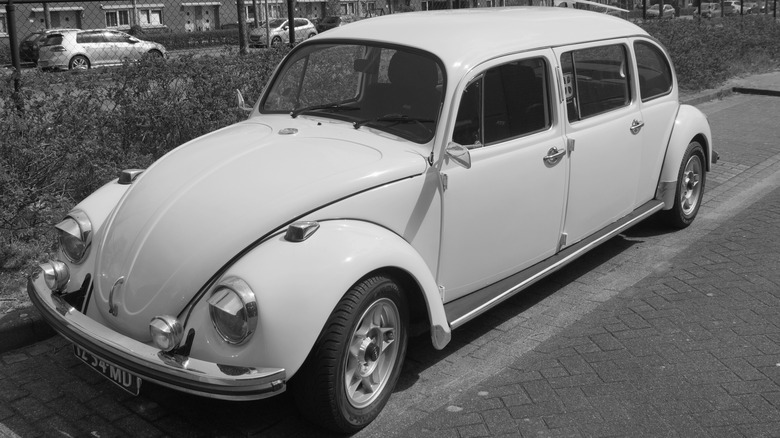
The original air-cooled Volkswagen Beetle was a gateway for weird cars and the ultimate people's car. It was built to provide cheap, reliable, no-frills transportation for the masses. Its shape is iconic, its engine note is unmistakable, and its interior space is tight. Perhaps that's the reason why enthusiasts like to convert Beetles – both old and new –into limousines. Back in the late 1960s, a prominent West Coast Volkswagen and Porsche importer named John von Neumann looked at the humble Bug and saw an opportunity. According to Hagerty, von Neumann commissioned the Culver City-based coachbuilders Troutman-Barnes to slice a 1969 Type 1 Beetle in half and stretch it into an over-16-foot-long VIP cruiser. The result was dubbed the "Rollswagen."
Troutman-Barnes didn't cut any corners (pun intended). They outfitted the interior with the finest luxury features available in the era — a power-operated division window, an intercom system, a high-end stereo, rich mahogany trim, and a fully stocked minibar. To help cope with the extra 400 pounds of metal, glass, and trims, the standard 1,600cc air-cooled flat-four was upgraded with a pair of Weber carburetors. Even with the extra power, the Rollswagen was bound to be slow, but it was never meant for speed.
Volkswagen loved the absurdity of the creation so much that they actually featured it in a period advertisement, bragging about "the $35,000 Volkswagen" at a time when a brand-new Mercedes 300SEL cost roughly $11,467. It was even movie legend John Wayne's ride to the 1970 Academy Awards. Decades later, this ultimate ironic people's car crossed the block at RM Sotheby's Monterey auction, selling at an outrageous sum of $355,000.
The Trabant Trabi-XXL: ostalgie on six wheels
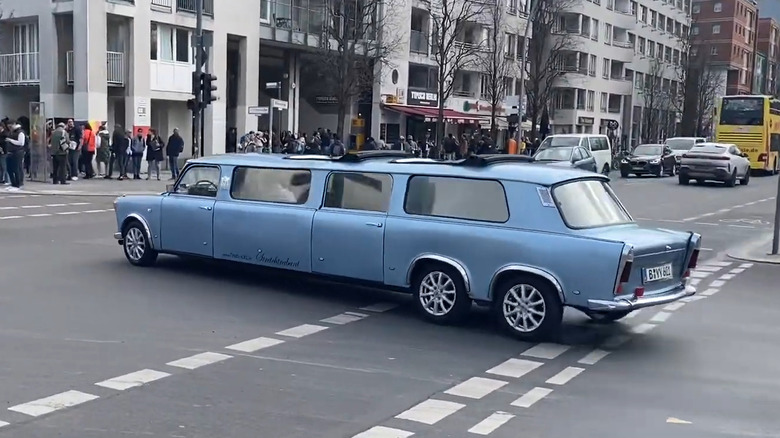
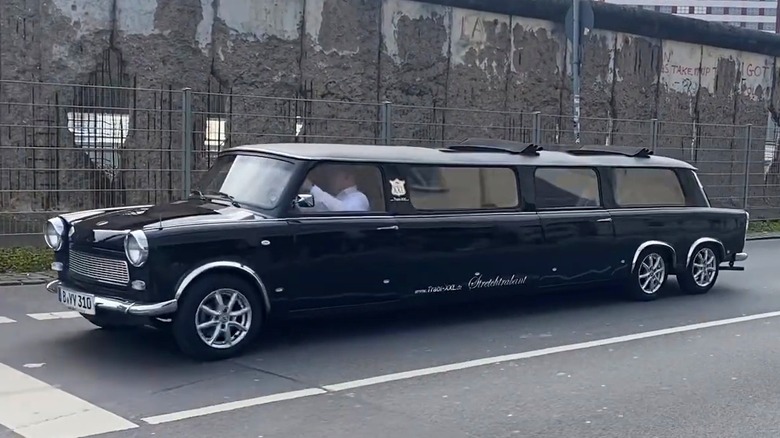
If you thought the Yugo was the bottom of the automotive barrel, allow us to introduce the Trabant. The "Trabi" was the official automotive symbol of East Germany -– a car with a body made from Duroplast, a form of plastic reinforced with recycled cotton and wool waste. It was powered by a smoky, buzzy, two-stroke two-cylinder engine, and was comically slow. It was an eco-capsule born out of extreme communist shortages, requiring citizens to wait over a decade on a sign-up list just to receive one. Fast-forward to modern-day Germany, where a phenomenon called Ostalgie (nostalgia for all aspects of life in East Germany) has turned the once-despised little car into a cult icon.
A fleet of stretched Trabants, collectively known as the "Trabi-XXL", has become the ultimate way to tour the historic streets of Berlin. Tourists can hire these elongated pieces of socialist history to cruise past Checkpoint Charlie, the Berlin Wall, and the Brandenburg Gate. It is the ultimate piece of performance art –- a car that was originally engineered to represent uniformity and minimalist utility transformed into a stretched, capitalist party barge designed explicitly for showing off.