

Drive-Thru Bans Are Increasing, But Then, So Are Drive-Thrus Themselves
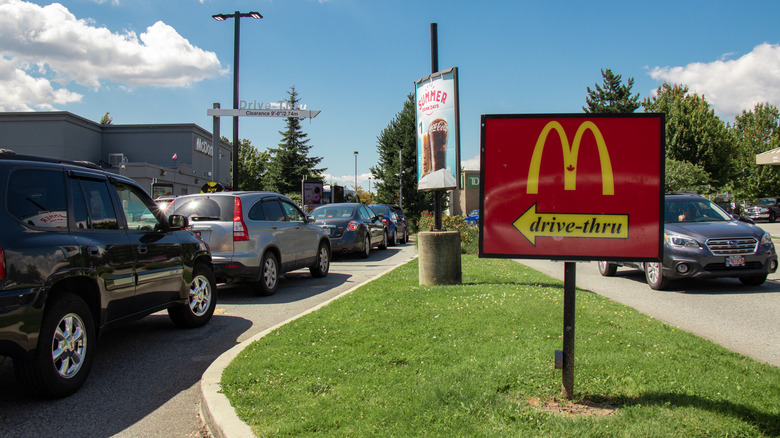
It's become something like a Whack-a-Mole nightmare: Drive-thru restaurants are popping up across the country in ever-larger numbers, despite more and more cities trying to drop the hammer on new drive-thru construction. Now, there doesn't seem to be a national database of drive-thru restaurants in the U.S., but we can still find real-world data to show their growth. For example, the country counted an estimated 215,000 fast-food restaurants as of 2025. That represents a 20,000-store increase since 2020 — and 68% of fast-food outlets include drive-thrus (via Actowiz). Some relatively new players to the drive-thru game are expanding their presence, too. Chipotle is a case in point. The company opened its 1,000th drive-thru "Chipotlane" store in 2024 and added another 257 in 2025.
On the other side of the battle are local and state governments like the one in Culver City, California. The town's last drive-thru opened in 1997, but when In-N-Out — one of your favorite Drive-Thru restaurants — came a-calling this year with plans to open a location with a 26-car drive-thru, the city was quick to respond. A 45-day moratorium on drive-thru construction was the first step, and when this article was published, the Culver City government was considering both an extended — but still temporary — pause and an outright permanent ban. Nor is this only a West Coast thing. Atlanta has also banned drive-thrus in its BeltLine area, with nearby Tucker, Georgia, recently shifting its moratorium to a full ban, too.
Why are cities banning drive-thrus?
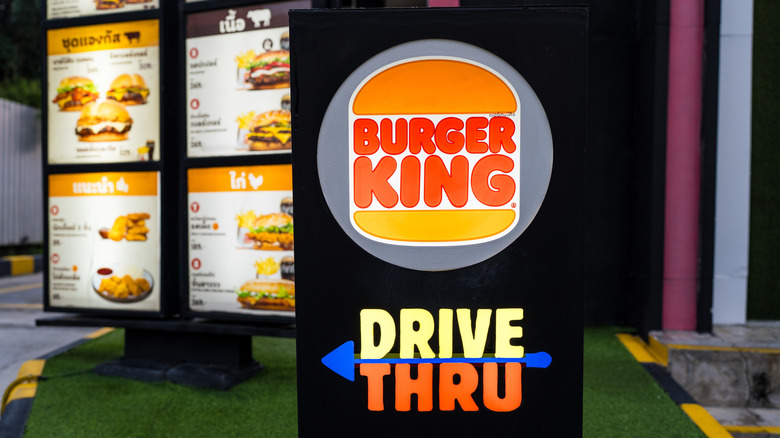
It turns out that not only is eating fast food bad for your health, but so is waiting for fast food — at least when you're stuck idling in a drive-thru lane. In fact, the average drive-thru wait time at both Burger King and McDonald's is just a tick over six minutes, according to a study by Intouch Insights and QSR. And during that span, the average gasoline-powered passenger car will emit about a pound of CO2 into the atmosphere. The American Lung Association — for one — says that "The science is clear: Carbon dioxide and greenhouse gases endanger public health." Needless to say, folks stuck in drive-thru traffic surrounded by all those emissions are particularly at risk. They can be so bad for local air quality that the state of Indiana explicitly warned people to stay away from drive-thru lanes during a recent heat emergency. It was a reflection of how extreme temperatures can make the health effects of emissions even worse.
Drive-thrus can also be dangerous to people who aren't in the waiting lines themselves. After all, when the lines get too long, they can end up obstructing bicycle paths and creating unexpected traffic stoppages on nearby roads — all of which can lead to more opportunities for accidents. The situation is especially problematic in low-income neighborhoods. Some sources, for instance, call out a specific connection between fast-food restaurants and pedestrian deaths in these areas. The bottom line: Many cities are taking a new approach to planning — one that emphasizes keeping cities safe and walkable and their people healthy – and drive-thrus are coming in direct conflict with those goals.
Why do they keep building drive-thrus?
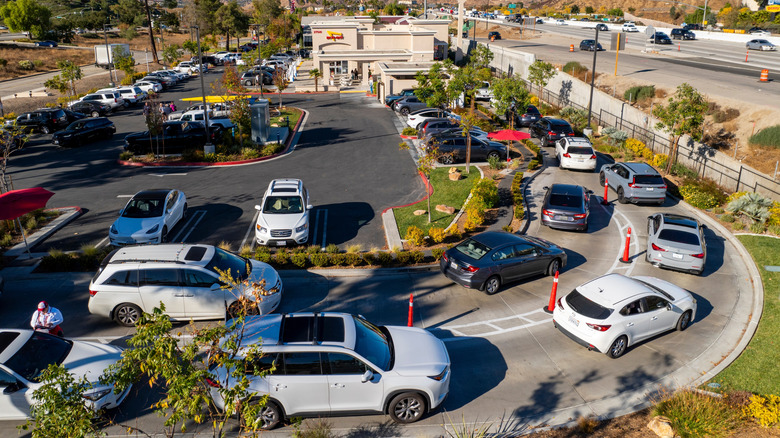
The answer to this should be obvious to anyone living in our hyper-capitalist society: The restaurant industry is expanding the number of drive-thrus because that's where the money is. Modern drive-thrus, relying on pickup windows instead of carhops, date back to at least 1947 — with the opening of Red's Giant Hamburg in Springfield, Missouri. Today's surge in drive-thru growth is also a product of the Covid-19 pandemic, when most people were hesitant about being out in crowded public spaces. In fact, drive-thru sales spiked to $133 billion in 2022, representing a 30% increase over 2019. The top chains now earn about 50% to 70% of their overall revenue from visitors to their drive-thru lanes, according to QSR. On the demand side of the equation, the National Restaurant Association reports that 42% of U.S. adults visit a drive-thru at least once a week — and younger people may be more likely to use them. According to Food & Wine, about 50% of Gen Z and Millennials view drive-thru (and takeout) meals as "essential."
On the other hand, all is not rosy in the drive-thru world. Although Food & Wine lumps drive-thrus and takeouts together, separating them shows a different trend. QSR shows that drive-thru orders represented about 83% of all quick-service restaurant orders in 2020, and fell to 65% in 2025. Takeout orders still seem to be doing a lot of the heavy-lifting for the younger generations — even if they're sometimes taken at the back seat of a Cadillac Escalade iQ.