

What's The Difference Between Honda's B-Series And D-Series Engines?
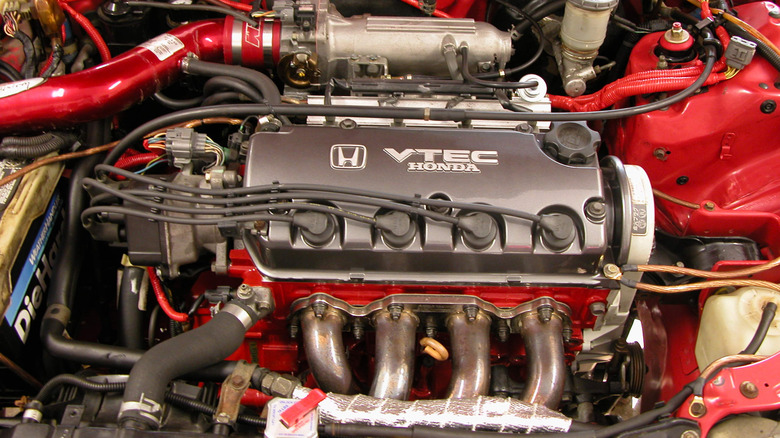
Few engines have generated more conversations among Honda fans in the last few decades than the Honda B Series, and it's easy to see why. It was the first car engine to benefit from VTEC, a contracted acronym for Variable Valve Timing and Lift Electronic Control. It was also a high-revving, highly tunable engine family with room for 500 to 1,300 hp depending on the tuning. Needless to say, the little engine was quite reliable.
But long before it came about in 1988, the equally diminutive D-series had been putting a shift in small Honda cars and continued to do so after the B-series got discontinued in 2001, with production lasting from 1983 to 2005. While they belonged to different engine families, there were some similarities between the Honda B-series and D-series engines. One such is their configuration, as both were naturally aspirated inline four-cylinder mills. They were also all-aluminum engines that could be specified in DOHC, VTEC, and non-VTEC forms.
However, each of these engine families had its unique characteristics and catered to different types of drivers. All B-series featured DOHC valvetrain (not to be confused with the older Honda B20A-series engine family in cars like the second and third-gen Prelude which had both SOHC and DOHC configurations) and were aimed at buyers wanting relatively cheap enthusiast cars that were characterful and fun to drive such as the Honda Civic Type R. Members of the D-series family, for there own part, were mostly SOHC engines (with a couple of DOHC versions) designed for those who were more concerned about cost and economy than performance.
How Honda's B Series and D Series engines are different
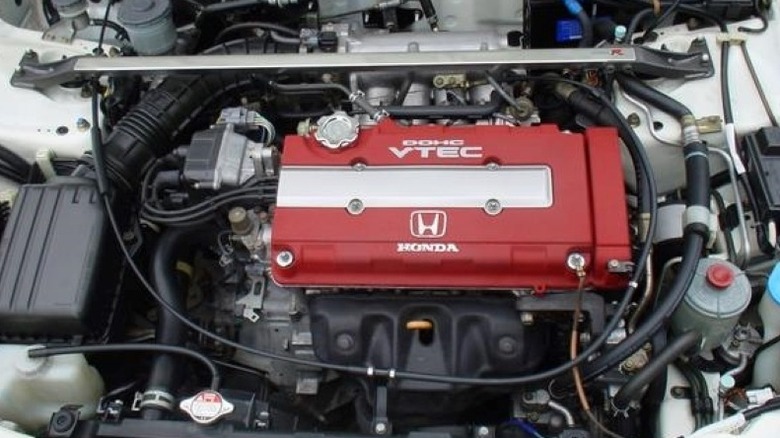
One of the key differences between Honda's B-series and D-series family of engines is that the B-series has a larger-displacement engine overall, with the smallest B engines being 1.6-liter (B16) mills. From there, you have the 1.7- (B17), 1.8- (B18), and 2.0-liter (B20) options. The D engines are smaller by comparison, with the largest being a 1.7-liter engine, while the smallest D-series unit displaces 1.2 liters (D12).
In addition, stock B-series head design features a more aggressive cam profile and larger intake and exhaust valves, allowing the heads to flow significantly more air than D-series heads. B-series also has stronger head casting and internals from the factory, with thicker rods and stronger crankshaft enabling it to survive when making big power.
Crucially, all performance B-series VTEC engines feature dual overhead camshafts (DOHC) and change the valve timing of the intake and exhaust valves, whereas D-series VTEC engines typically have a SOHC layout and only change the timing of the intake valves. Between the two, the D-series also stands alone in using the VTEC-E technology (D15B5 and D16Y5), which cleverly keeps one of the intake valves closed below 2,500 RPM for better fuel economy.
When you combine the B-series' larger displacement, flow advantages, and other performance-enhancing attributes, you get an engine that makes more horsepower, with up to 195 hp on tap from the DC2 Type R's B18C5. The D-series, by comparison, tops out at 130 hp. However, because the D-series has a longer stroke in most applications, it produces more torque as a percentage of its horsepower than the B-series.