

That's Amore: Thousands Rally In Rome On Two Wheels For Vespa's 80th Anniversary
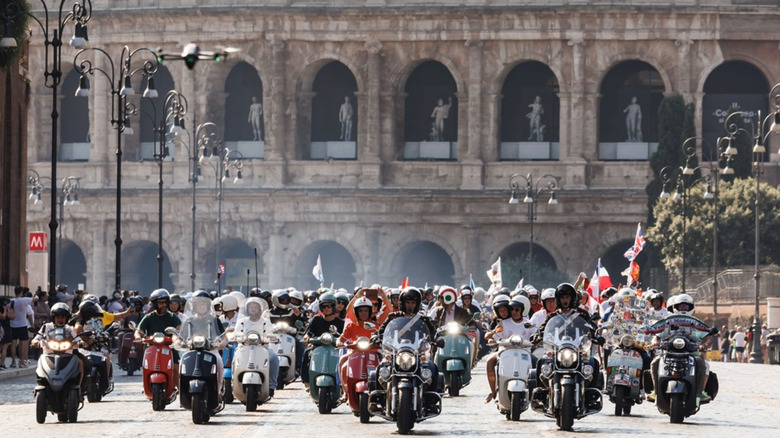
The Vespisti invaded Rome this week, and if you don't know who or what a Vespisti is, then that might sound concerning, but it's not a kind of Goth warrior. A Vespisti is a Vespa owner, and to celebrate 80 years of the cutest moped on two wheels an estimated 25,000 of them from 67 countries paraded through Rome.
The gathering hosted an array of models from the 160 produced over the 80 years Vespa has been on the market, according to the Piaggio Group. Some riders were brave enough to bring their extremely rare Vespa 98s through Rome's streets, which was the first-ever Vespa production model. It features a two-stroke single cylinder 98 cc engine that debuted in 1946.
The ride toured Rome much like Audrey Hepburn and Gregory Peck's excursion à la "Roman Holiday," though this trip included a loop around the Colosseum, the Piazza Venezia, Altare della Patria, and Fori Imperiali before concluding at "Vespa Village" at Foro Italico, where the four-day party welcomed more than 50,000 visitors with music, shopping and street food.
The 'staccato exhaust racket' keeping Italy mobile
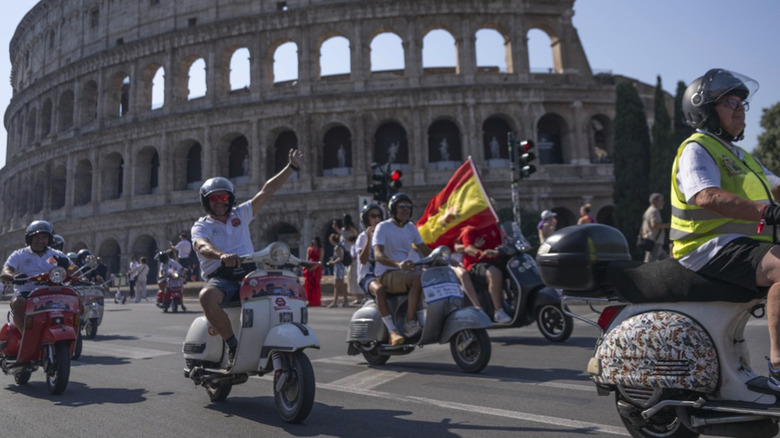
It's a fitting homage for a vehicle that has kept Italy mobile since its inception post-World War II. Piaggio at the time had been an aircraft manufacturer with a factory in Pontadora, but itwas destroyed by war bombings. Needing to make a drastic pivot, they looked to scooters. The company's first real prototype, the MP6, featured the "wasp-like" design look that earned it the Vespa name. From there, the Vespa 98 model was released to the public and the Italians happily embraced it.
The AP shared a bit from a 1950s article describing Vespa's presence in Italy that said the scooter's "'staccato exhaust racket' had downtown Rome sounding like the Indy 500." It added "There probably isn't a noisier scooter in all the world. ...The scooter quickly teaches visitors to look four ways at once at street crossings."
Luckily, Vespas today are not as loud as the brand eventually ditched the two-stroke engines for the more even-keeled four-strokes. But the design, which has evolved with the ever-changing times has remained rather timeless through every one of its 19 million units sold today.