

Here's What You Need To Tow Safely In Windy, Bumpy Conditions
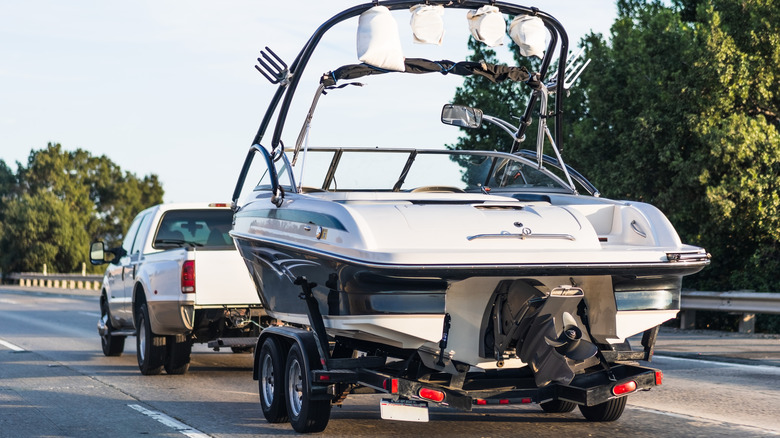
Towing a trailer can be challenging enough when cruising down the highway on a calm sunny day, which is why we recommend checking a few key numbers before you start. So when the conditions themselves get challenging — if the wind picks up, for example, or the roads get rough — even the towing pros may opt for some assistance.
Strong crosswinds are especially dangerous. They can push with enough force to move the trailer from side to side, causing it to sway back and forth on the hitch ball. If you're not careful, physics can amplify that motion to the point where you can't control the trailer at all. And it's a similar story, albeit for slightly different reasons, on rough pavement: In that scenario, bumps or holes in the road can load and unload the weight on the hitch as the trailer bounces around. Then, if something affects the trailer's direction when its weight is off the hitch, you're more likely to experience swaying.
Digging a little deeper, though, tells us that the root cause of both situations is the same: poor weight distribution. Knowing the effects this has on towing is vital. As shown by Australian auto journalist Robert Pepper, you'll enjoy more stability with a trailer's weight centered just ahead of its axles. Too much weight at either end of the trailer, or at both ends at the same time, can be a recipe for disaster. So while proper loading is one key to towing in windy or bumpy conditions, you also may want to consider a specialized hitch with dedicated weight-distribution and/or sway-control functions.
How do weight distribution hitches work?
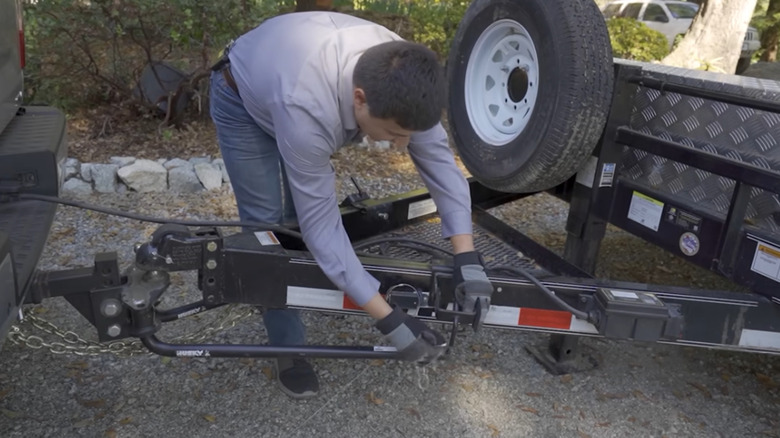
To be clear, there are some aftermarket hitches engineered solely to enhance weight distribution, and some focused on anti-sway measures, but manufacturers can bundle those capabilities into a single unit. Also, one difference between a factory and an aftermarket hitch is that you won't find either system on the latter.
Turning first to weight distribution, let's remember that, in a conventional setup, a certain part of the trailer's weight, the tongue weight, is pressing down on the hitch. This acts sort of like a seesaw, with the tow vehicle's rear axle as the fulcrum. When there's too much tongue weight, the trailer pushes the back of the car down, and the front comes up, lifting weight off the front wheels — you know, the ones responsible for steering. Needless to say, that makes it harder to control when you're already fighting the wind to stay on course.
To address this, a weight distribution hitch helps transfer some of that extra mass backward onto the trailer through its spring arms. These are robust metal bars that you can lock into place with one end on the tow-vehicle side of the actual connection point and the other on the trailer side. Now, when the trailer pushes down on the hitch, the bars physically limit any vertical movement at the point where the trailer and tow vehicle meet.
How do trailer friction bars help reduce swaying?
Anti-sway hitches help when there's too much weight at the rear of the trailer. In this case, you're faced with another seesaw situation, where the trailer axle is the fulcrum: The weight pushes down the back of the trailer, causing the front of the trailer to rise and taking weight off the hitch. It's now much easier for the trailer to move side to side, and with so much of that weight concentrated at the rear, the result can turn into a pendulum effect — even if you've forked out $110K on an absurd destination trailer.
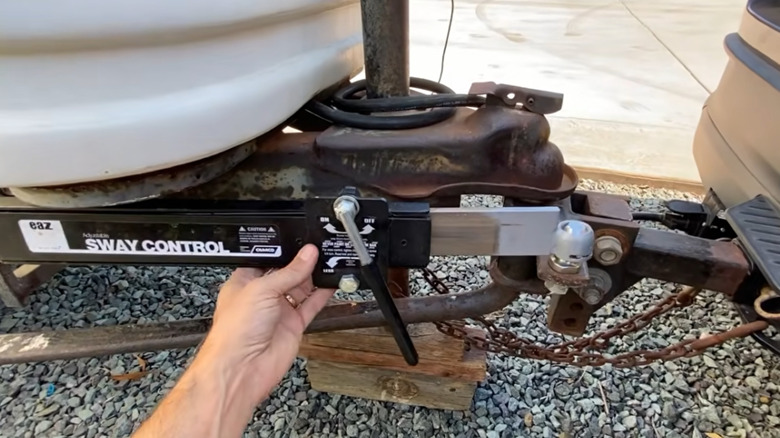
Anti-sway functionality comes in a couple of flavors. The basic setup involves attaching friction bars along the sides of the coupling, again in front of and behind the pivot point. These "bars" then operate a bit like pneumatic door closers. If you imagine making a right turn, the inner part of the friction bar on the left of the hitch has to be pulled part way out of the outer part. The extra drag helps mitigate horizontal swaying. For a next-level approach, some hitches have active measures designed not only to hold the trailer in place but also to add some pushing power — through cams, for instance — to get the trailer back in line with the tow vehicle.
In either case, you can gain a further advantage by adding a trailer brake controller. This will automatically synchronize the trailer's brakes with those of the tow vehicle for improved driving control. None of this will automatically help you become a towing master, of course, but it could keep you out of major trouble.