

Pikes Peak Is A Cruel, Unforgiving Mountain That Refuses To Play Favorites
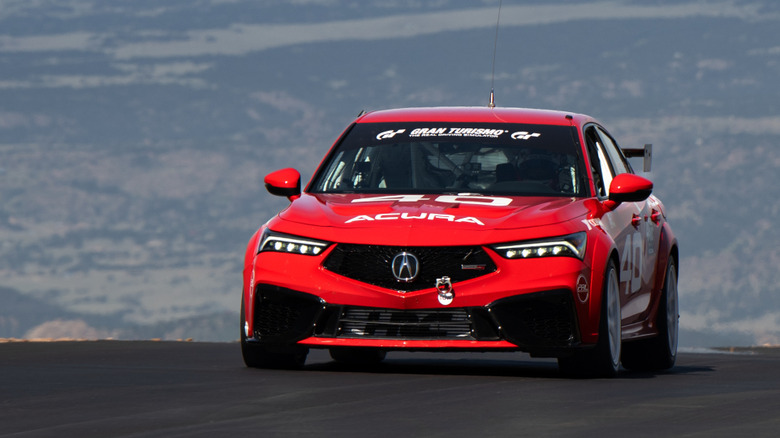
You can practice run after run in a simulator. You can memorize every single one of the 156 turns that make up the 12.42-mile course up Pikes Peak. You can learn every tip, trick, and tidbit during practice and qualifying that might give you an advantage on race day. But ultimately, no matter how much you prepare, when you line your car up at the start of your run, there's no way to know what you'll encounter. The road is paved (though it wasn't always that way), and the route is fixed, but the mountain is always changing. A new patch of dirt, a small rock in the road, a frightened marmot staring down a race car — one unexpected change could mean difference between glory and disaster.
This year, Acura wasn't chasing overall records. The second-generation NSX is dead and gone, but Acura's still racing, and its Integra Type S DE5 race car appeared poised to set a new record for front-wheel-drive, production-based cars. What counts as "production based" at Pikes Peak would stretch most people's definition of the term past its breaking point, but Acura didn't have its eyes set on beating the 1,400-horsepower Ford Mustang Mach-E that was ultimately named this year's King of the Mountain. Instead, it had its eyes on the previous FWD record of 10:48.094, a record that's stood since 2018, when Honda R&D engineer Nick Robinson set it in an Acura TLX A-Spec.
Full Disclosure: Acura wanted me to check the Pikes Peak International Hill Climb off my bucket list so badly, it entered a race car in the competition, flew me out for the race, put me up in a fancy hotel, and paid for food, drinks, some sunscreen, and all the passes I'd need to access the race. They also made me wake up at 3:30 am two mornings in a row, but I've since forgiven them for that one. Mostly.
Man versus mountain
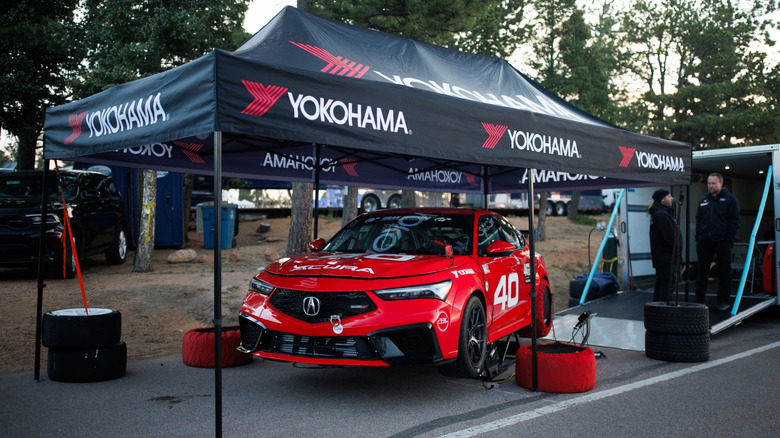
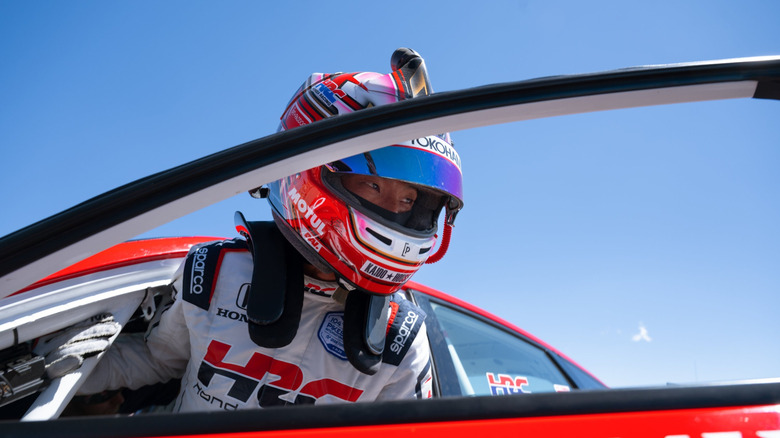
Eight years is a long time for a single record to stand, but everyone I spoke to at Acura sounded confident that Robinson's record-setting time would fall to the new Integra. I had no reason to doubt them, either. The team had probably run a virtual Integra Type S DE5 up the mountain in their sim more times than anyone could count, and they knew what it was capable of. Acura also had Dai Yoshihara behind the wheel — the two-time Formula Drift champion who won at Pikes Peak in the Unlimited Class back in 2020.
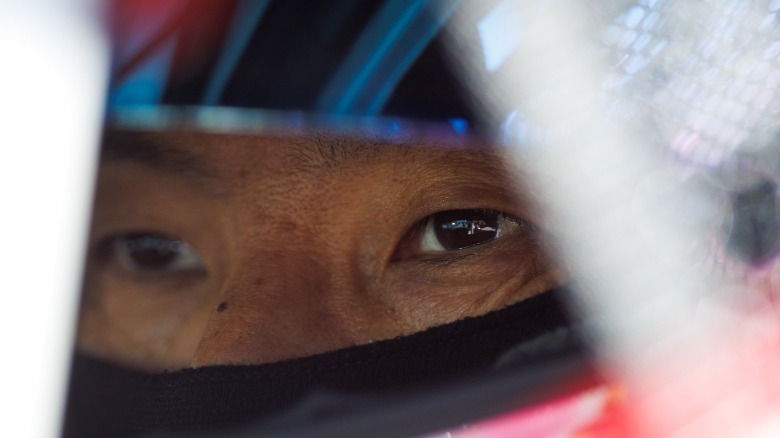
The day before, as I drove a regular Integra Type S up the same 12.42-mile course at a pace probably best described as "glacial," I didn't sense even a hint of nervousness or uncertainty from the racer in the passenger seat. He explained that he really had committed all 156 corners to memory, almost like it was nothing. Yoshihara told me he preferred using signs and the occasional guardrail to remind himself where to place his car in each corner. Apparently, rocks are more dependable than trees, but even rocks can move. Nothing is guaranteed, though, because one crash in the wrong spot could take that sign out, too.
Were Pikes Peak a different kind of race, Yoshihara would have competitors to worry about. Other times to measure himself against. But the feeling I got in the few conversations we had was that he was racing against himself and, perhaps more importantly, taking on the mountain itself. Because you can be ready. You can know your car. You can even have an incredible story. But the conditions on race day might trample on your best-laid plans. The mountain doesn't play favorites. If you need a win, the mountain doesn't care. It was here before we found it, and it will be here long after we're gone.
Your name has no power here
The Pikes Peak International Hill Climb doesn't care much about sleep, either, and a 4:00 a.m. call time comes early, no matter how well you adjust to time changes or altitude. Yoshihara was set to race midway through the schedule, number 32 of 72. Unlike some other races, teams didn't hide their cars away until the start. They sat out, often under tents, usually with little more than a trailer behind them. Every car there was worth a small fortune, and the total amount of money spent on that single race would probably make your head explode, and yet, it felt more like a grassroots event than any race I've ever attended.
Drivers with names big enough to be well known, even among casual racing fans, walked around without a hint of expectation. Anywhere else, a name like Jeff Zwart, JR Hildebrand, Romain Dumas, Emelia Hartford, and Rob Dahm matters a lot. On Pikes Peak, the only thing that matters is making it to the top in one piece. There's no room for ego on the mountain, only respect and humility. One mistake would be all it would take to end their story there. No one is too famous to avoid that fate, but they were there to race anyway. Getting to the top was all that mattered. Before long, Yoshihara was up.
For a long list of annoying but valid reasons, watching a full run up the mountain is more or less impossible. So we gathered around to watch what we could and wait for his times from each section, everyone pretending they weren't actually worried. Yoshihara had nothing to worry about, right? A little more than 10 minutes later, we got our answer. With a time of 10:33.174, he had not only made it to the top and beaten Robinson's 2018 record, he'd beaten it by almost 15 seconds. All that hard work and preparation had finally paid off. Dai Yoshihara was alive and officially the fastest person to ever drive a front-wheel-drive, production-based race car up Pikes Peak.
An 8-year-old record shattered
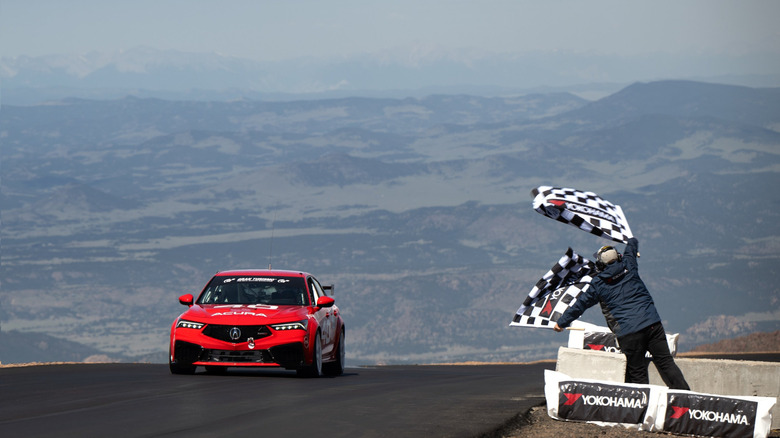
The race doesn't stop for one team's celebration, though, even if it's a new record. Other drivers still need their shot, and once you're at the top, that's where you stay until everyone comes down together. A Honda Civic TCR had already headed up the mountain behind Yoshihara, followed by a Porsche 911, and after that, a 2014 Volkswagen Golf. British racer Jim Morris's Volkswagen Golf, actually.
While Acura's Integra race car began life in the same factory that builds Integra road cars and still had a VIN, Morris's Golf was a fully custom-built race car wearing a Golf body. Well, a Golf body and a bonkers aero kit. Under the hood sat a turbocharged 2.0-liter engine cranking out more than 500 hp, giving it a 140-hp advantage over Yoshihara's Integra. And when he reached the top, a mere three cars behind Yoshihara, Morris's official time read 10:33.104. Seven-hundreths of a second faster. Three more racers was all it took, and Dai Yoshihara was no longer the fastest person to ever race a front-wheel-drive car up Pikes Peak.
 Acura
Acura
Seven-hundreths of a second. The time it takes to blink, if that. A difference so close to nothing, and yet, in racing, it proved to be the difference between setting a new record and holding onto it for another year. Absolutely heartbreaking. But the mountain didn't care. Pikes Peak is a cruel, unforgiving mountain, and it refuses to play favorites. Your time is your time, and if someone else's time is faster, that's just the way it is. Come back and try again next year. If you're brave enough to risk it all again, that is.
Later that night, as Yoshihara joined a few of us for post-race cigars, the mood was light, but no one was celebrating. At least, not really. The race had gone about as well as it could have, but a fraction of a second here and a sliver of a second there adds up. Still, if Yoshihara's heart was broken, he did an impressive job of hiding it. He'd had a job to do. He'd done it well. He just got a little unlucky. Besides, there's always next year. The mountain isn't going anywhere. It has time. Certainly more time than we do. We were on that mountain, and we're on this Earth, for two blinks, at most. But long after we're gone, Pikes Peak will remain. Still cold and indifferent, but standing there, daring whoever comes next to test just how fast they can race to the top.