

How To Spot An AI Scam When Shopping For Cars Online

Nefarious parties have been using AI recently to sell cars that don't exist to unsuspecting buyers. So, while you're trying to convince Grandma that the video she watched of the monkey administering CPR to a kitten isn't real, you may want to educate her on how to tell if a car ad is an AI-generated scam. That's not to say only elderly people are susceptible, though. AI scams are getting more and more sophisticated as the technology advances. Even Bring a Trailer accidentally listed an AI-altered Cadillac.
Just like you've learned to spot AI-generated images on Instagram, look closely at any photos a seller sends you for little discrepancies or big ones, in some cases. Does the communication from the seller read as if a person wrote it? Is the seller willing to meet in person before any money exchanges hands? Video calls can be helpful, but don't count as "in-person" since they can potentially be deepfaked. Nowadays, scammers are also spoofing entire fake dealership websites, so be careful where you shop.
Have you ever noticed how habitual liars will often include an inordinate number of details when telling a story? Sometimes scammers will volunteer lots of "proof", including photos, vehicle histories, and scans of titles. These have often been doctored by AI, so examine them closely. In the end, if something smells fishy, trust your nose.
Look closely at photos
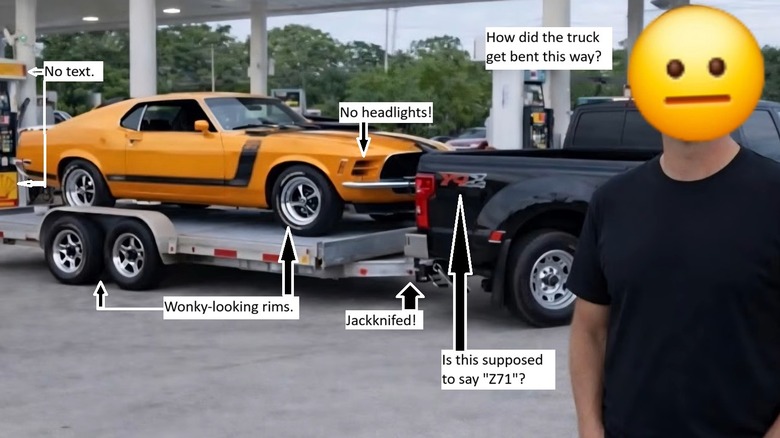
AI-generated images are getting better, but for now, they often contain tells and sometimes even dead giveaways. The AI image above, for example, was used by an alleged scammer in an attempt to sell a non-existent Ford Mustang. The guy standing in front of the car looks Photoshopped in, but the other parts are certainly AI-generated. Look closely at the shape of the truck and how it looks bent in the middle. The rims on the Mustang and trailer don't look right either. Where are the headlights? AI image generators don't handle text very well, usually. You see how messed up the "Z71" logo on the truck is. Zoom in on the car's tires, and the sidewall text doesn't look like text at all. From what we've seen, AI seems to have a hard time with engine components and tools, as well.
Giveaways in other AI images might include hands with extra fingers or bodies with extra limbs. Another thing you can do is to conduct a reverse image search on Google. Just drag and drop the image into the search bar in Google Images. Primarily, this will show you similar images, but it's a good way to see if parts of the image that were sent to you were stolen from other sources. It's also a smart idea to know the nuances of the car model you're intending to buy, because it's likely the AI will get at least one or two minor details wrong.
Check if the seller text reads like a human wrote it

Many folks seem to be pretty confident that they can spot "slop" written by AI. Most of them are wrong. In spite of what you may have heard, the presence of an em dash or the use of the rule of thirds is not proof that the text was written by AI, nor is the fact that you don't like how it was written. But if those are the kinds of things you look for, you might find yourself fooled by an AI car scam one day. (Besides, a lot of human writers love the em dash — we've used it long before ChatGPT was a twinkle in Sam Altman's eye.)
You mostly want to look for what's missing. Text generated by large language models is usually very polished, especially in terms of grammar. Writing by humans, however, contains the occasional typo, in spite of their best efforts to proofread. Additionally, good writers know when to break the rules of grammar to improve their writing flow. Human writers also use colloquialisms, slang, and little idiosyncrasies that indicate some personality. AI text generally doesn't have any of that, and long text by AI often includes at least one sentence that doesn't logically seem to fit. When it comes to ads, though, some real sellers and dealers may very well use AI for that, unfortunately, so AI-generated text alone isn't always a reliable scam indicator.
Ask for a video call

If you're already in discussions with the seller and haven't even met them or haven't seen the car in person, ask for a video call. Voices can be cloned, and someone even attempted to scam a Ferrari executive using a cloned voice of the CEO. Recorded video can be deepfaked, but it is harder for AI to fake live video communication perfectly. Responses might be delayed, mouth movements may not match the words, and the edges of hair might not look right.
Still, difficulty hasn't stopped scammers from trying to use AI to pull off fake video calls. There are programs that enable a caller to overlay someone else's face on top of their own. Fortunately, there are ways to tell when this is happening. Jim Browning, well-known on YouTube for exposing scammers, went viral with a video where he outs one of these fakers on a Zoom call by asking him to put three fingers in front of his face, which would have revealed if his face was real. The scammer refused to do it and ended the call.
Scammers have gotten wise to the three-finger trick, though, and the newest AI deepfake programs have gotten rid of this flaw. Still, there are other ways you can tell if they're being used. Huntress.com says that you can ask the person to turn their head or ask them to move their hand quickly in front of a light source to spot rendering inconsistencies with shifting shadows.
Look out for spoofed websites
Another thing AI scammers do is to clone an actual dealership's website. It might look identical in almost every way, except the prices are oddly low, and the contact information may have been changed. They may even be using the same name as the real dealership. Look up the real dealership on Google and compare the URL in the search results to the one the seller sent to you. If it's different, the URL that was sent to you goes to a fake website. Compare the contact information, especially the phone number.
Sometimes scammers create a fake dealer website and use a made-up name. Once again, Google is your friend. Look up the name and address of the dealership to see if it is real. You might even call the Chamber of Commerce to see if such a business exists. You can also check the Wayback Machine to see how long the website has existed.
Oftentimes, fake websites offer to send "trust kits," or a bunch of documents to prove the legitimacy of the business. This might include doctored VIN verification, dealer's license, photos, and other documents. One sure giveaway is if the "dealership" only accepts payments from methods that can't be reversed, like wire transfers, ACH payments, or cashier's checks.
Look for traditional signs of a scam

As AI improves, some of the ways we mentioned to spot a scam may stop working. However, AI scammers will always combine traditional scamming methods with the technology they use. Things that were red flags in the past can very well remain red flags in the future. For example, does the price seem too good to be true? That's a red flag. Does the seller want a deposit before you can even see the car? There's another red flag.
Along that line, unless you're ordering a new car from a major automaker, never send money to a seller before you actually see the car. Even if the car is across the country and the seller is offering to deliver, it's worth a trip to make sure you're not about to be defrauded. That goes double for a "dealer" who doesn't want to meet in person. Dealerships are not in the business of keeping people off their lots. No matter how advanced technology gets, insisting on meeting in person and seeing the car for yourself before any money exchanges hands can keep you out of a lot of trouble. There are ways to buy a car remotely without being scammed. Just use common sense and never let anyone pressure you into a purchase before you verify its legitimacy.