

How The Cosworth BDA's Belt-Drive 16-Valve Head Set The Bar For NA Engine Performance
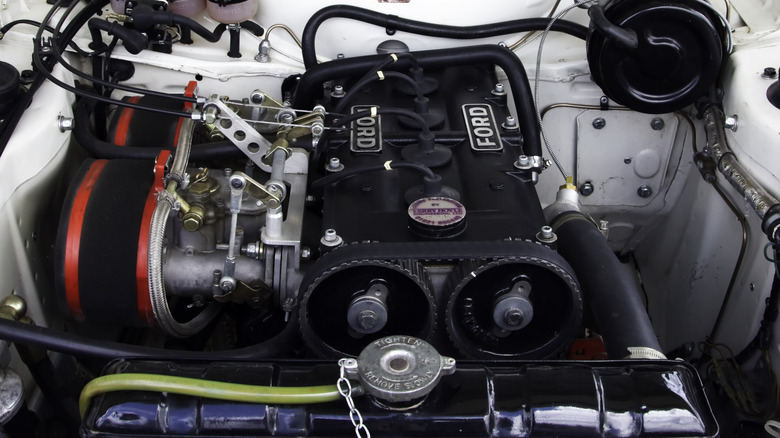
In 1969, Cosworth — still just a wee British engineering firm — took it upon themselves to shrink the cylinder-head philosophy proven in F1 for the road-going Ford Escort. The resulting motor and its architecture would echo through naturally aspirated racing for the next two decades.
Cosworth was founded by former Lotus employees Keith Duckworth and Mike Costin in 1958. The Cosworth name came about by combining the first half of Costin's surname and the second half of Duckworth's surname. By 1966, Cosworth had already built an engine — the four-valve FVA — worthy of being bought by Ford under a development contract. Just three years later, the Cosworth team had set its sights on designing an engine as capable as the FVA that would outperform the existing Lotus-Ford Twincam.
While Duckworth had been busy developing the DFV V8 that would go on to dominate 1970s Formula One, chief designer Mike Hall would take on the firm's newfound aspiration. Working from the Ford Kent block with a cylinder head derived directly from the FVA and DFV designs, Hall's team chose to drive the camshafts with a toothed belt rather than gear trains, as in past designs. The engine's name, BDA, came from its most innovative feature — Belt Drive, Type A.
While the BDA got its name from its belt drive, the real performance gain came from the cylinder head geometry. Early overhead-valve engines from the 1920s had included valve angles around 90 degrees with hemispherical combustion chambers suited to low-octane fuel and compression ratios as modest as 4.5:1.
The BDA's included angle had closed to roughly 40 degrees to produce a pent-roof combustion chamber with a centrally located spark plug. The flame had less distance to travel, meaning the charge ignited faster and more completely.
Revolutionary engine performance that would take over motorsports
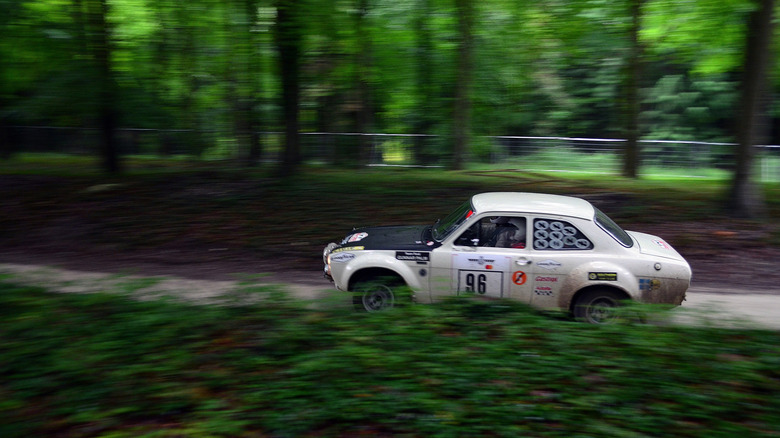
The original 1969 BDA displaced 1,601cc and produced around 120 horsepower — though that was just the beginning. Before long, Mike Hall and company stretched bore and stroke to create an alphabet of variants: the BDB and fuel-injected BDC for the Escort RS1600 rally program, the BDE and BDF for Formula 2 regulations, and eventually the BDG in 1973. Bore limits on the original iron block forced Cosworth to switch to an aluminum casting, which let displacement climb to 1,975cc.
At its peak, the BDG produced 280 horsepower at a screaming 9,250 rpm from a 12.0:1 compression ratio. The best part was that this was all achieved without forced induction. Throughout the 1970s, BD-series engines accounted for more than half of the company's total turnover.
By this point, the BD platform powered everything from Formula 2 cars to Le Mans-class Chevron sports prototypes. But undoubtedly the most celebrated contribution of the BD platform was in rally. The BD-powered Ford Escort 1600 would take home the company's first world championship in 1973 and would spark the flame for Ford's rally pursuit that continues today, as the Ford CEO wants to create a 1,000-HP Beast To Win Dakar. Through the 1970s, BD powered Escorts won a slew of other rally and touring competitions across Africa and Europe.
Even after Cosworth embraced turbocharging, they continued to produce BD-series rebuild kits into the 1980s while the methanol-fed BDP and BDT-E carried on the bloodline decades after the original Escort engine first ran.
While Cosworth today is busy redefining norms with the recent Gordon Murray and Cosworth 12,000- RPM V12, motors like the BDA built their legacy. The BDA was eventually beaten by an industry that spent the next two decades trying to replicate exactly what Cosworth's pent-roof, belt-driven head had already figured out.