

What That Small Mountain Symbol Means On Some Tires, And What They Went Through To Get It
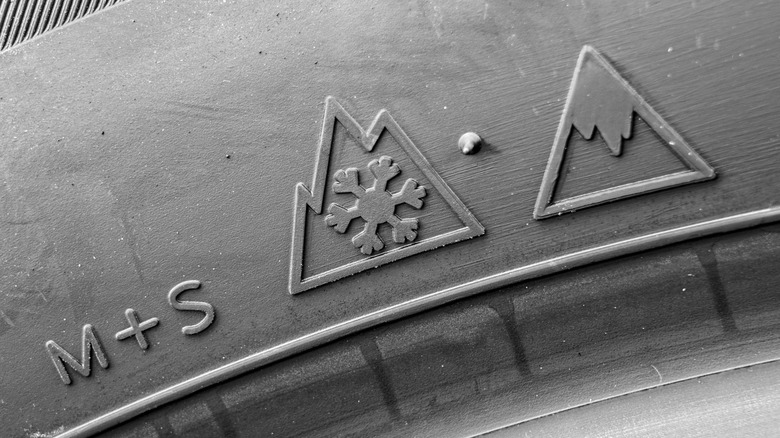
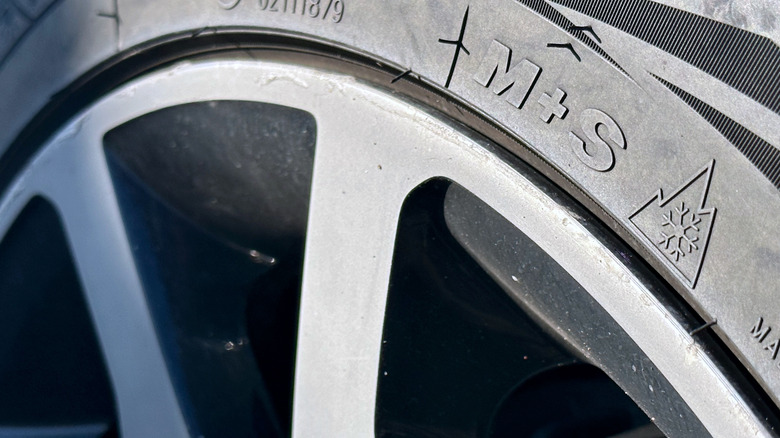
Although capable in their own way, all-season tires do present their fair share of disadvantages, especially when it's extremely snowy or icy. A step above when it comes to traction, and distinguishing itself from the all-season variety – without being a dedicated winter tire – is the all-weather tire, which typically features the 3PMSF (three-peak mountain snowflake) symbol on its sidewall. Unlike the typical M+S script you see on most all-seasons, which is nothing more than a manufacturer-assigned label based on tread geometry, the 3PMSF is a performance-based rating. Tires must pass a standardized test (ASTM F1805) set by the American Society for Testing and Materials to be awarded the rating.
For a tire to wear the 3PMSF symbol, it must deliver at least 12% better accelerative traction than a standard reference test tire (SRTT). This used to be a P195/75 R14 tire (and only required a 10% minimum traction threshold) but is now a P225/60 R16 tire, as per the latest ASTM F2493 standard.
According to this research paper on winter traction performance, the ASTM requires several parameters to be met before testing starts, which includes prepping the surface and establishing the snow's shear strength using a CTI penetrometer. Because a medium-packed snow surface is chosen, ambient air temperature cannot exceed 38 degrees Fahrenheit, and the snow surface temperature must fall between 5 degrees and 25 degrees Fahrenheit. The test tire is then mounted to a specialized truck and spun to evaluate its traction coefficient and, consequently, its tractive performance relative to the reference tire.
However, the test, according to Tire Rack, does not factor in braking or turning, which is perhaps why testers found that certain all-seasons performed better in the real world than some all-weather tires with the 3PMSF label.
Understanding the latest Ice Grip rating
Where these all-weather tires struggle to deliver grip is where proper winter/snow tires excel. In addition to the 3PMSF pictograph, certain winter tires feature another sidewall marking (an icy mountain), known as the Ice Grip symbol, which requires compliance with a standardized braking test (ISO 19447:2021) put forth by the International Organization for Standardization.
You might've seen the Ice Grip symbol on a Nokian Hakkapeliitta R5, which is among Consumer Reports' top picks when it comes to winter tires. To get that symbol printed on the sidewall, the tire has to go through multiple rounds of brake tests on a flat, polished ice surface and deliver a minimum of 18% better grip than the reference tire (per ASTM F2493). According to Car and Driver, the icy test bed is properly prepped to make sure the surface temperature is between 5 degrees and 23 degrees Fahrenheit and the air temperature (measured 3 feet above the surface) is between 5 degrees and 39 degrees Fahrenheit, with no snowfall or rain.
A test vehicle with ABS that supports multiple wheel sizes is selected. The test tires are then inflated to manufacturer recommendations, after which they're broken in by driving on dry pavement for 62 miles. Once everything is in order, the actual test begins, involving a series of braking runs conducted across three separate test cycles, during which the tire is evaluated for its grip after coming to a complete stop from a speed between 12 and 15 mph. As a fairly new addition to the tire grip/safety landscape, the Ice Grip rating should help consumers clearly distinguish between dedicated winter tires that stop well on ice and other tires bearing the 3PMSF symbol, which only certifies a tire's snow-traction capabilities.