

Why You Might Want To Detune Your Engine (And What Long-Term Effects This Could Have)
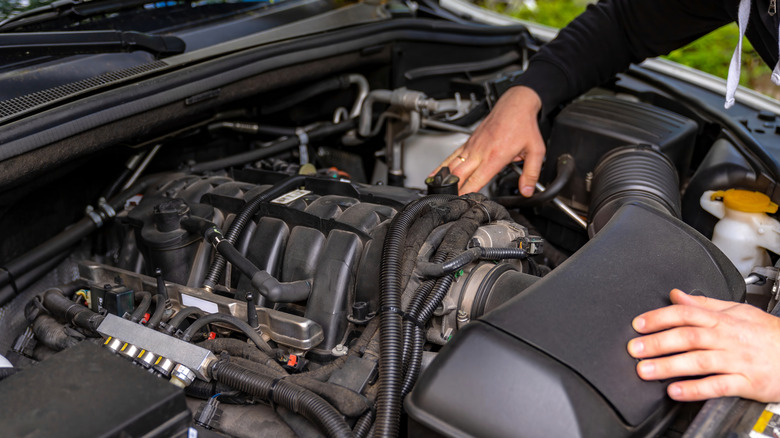
In the car world, you've probably heard the phrase "it needs more power" more times than you can count. When Car and Driver reviewed the 2017 Toyota 86, they said: "Great balance and fantastic steering, but it needs more power." MotorTrend said something similar about the 2026 Toyota Corolla FX. We even wrote a dedicated article about cars that just needed more power from the factory.
But what you almost never hear — outside of hypercars and serious sports cars — is someone asking for less power. Still, there are potential benefits to an engine that wasn't pushed to its limits from the factory. Sometimes, it can even make practical sense to detune your own engine to reap some of those benefits. Should you do it, and why? Well, as with most things in life, it depends.
When you increase the power output of an engine, you are also increasing the thermal and mechanical stress it endures, and that can create challenges for long-term reliability. Likewise, derating or detuning an engine can reduce the stresses on components, which can lower failure rates and improve its reliability. In some cases, detuning an engine can also improve fuel efficiency, especially when the engine control unit (ECU) and fuel delivery systems are recalibrated to prioritize economy over maximum performance. This is partly why many modern cars feature dedicated drive modes that alter throttle response, transmission behavior, and engine calibration, depending on whether efficiency or performance is the priority.
How detuning an engine works

ECU remapping, or chip tuning, involves taking the car's ECU and changing its parameters to better suit your needs and wants. The difference between chip tuning and ECU remapping is that with an old-school chip, you don't have as many tuning options, and it typically isn't easily reversible without removing the chip. In either case, ECU remaps can alter parameters such as throttle response, ignition timing, and air-fuel ratios. Most people do so to increase power and make the car more responsive, but it can also be used to make it more fuel-efficient.
So, if you alter these parameters to dial the engine back — lower boost, retard timing, lean out the fuel map — you can potentially make the engine more reliable and efficient. For instance, if you reduce turbocharger boost pressure, you also reduce maximum in-cylinder pressure, lowering the thermal and mechanical stresses experienced by the engine's internals. On the other hand, a leaner fuel map injects slightly less fuel during certain conditions, such as when cruising, which can improve fuel economy by reducing overall fuel consumption.
Reducing, limiting, or altering the way torque is delivered can also reduce strain on other drivetrain components, such as the transmission and differential, while making the car smoother and easier to drive in everyday conditions. The more torque the car has and the more violently this torque is delivered, the more energy has to pass through the car's transmission and drivetrain, and that stress adds up over time.
Car manufacturers detune engines from the factory

Depending on regulations, emissions targets, and product strategy, automakers have long used the same physical engines in different states of tune. The Volkswagen EA888 is one of the clearest examples. It is a 2.0-liter turbocharged four-cylinder engine that powers both the eighth-generation Golf GTI at 241 horsepower and the Golf R, where it makes 315 hp.
Apart from different internal parts and cooling, one of the reasons why Volkswagen did this was to ensure separation between the two models. The G80 BMW M3 CS Handschalter is another notable example from Germany. In this case, BMW detuned its S58 engine from 543 hp and 479 lb-ft of torque down to 473 hp and 406 lb-ft because its existing six-speed manual gearbox simply cannot handle more torque than that.
This is not a new concept, either. Back in the 1990s and early 2000s, BMW sold American versions of the E36 M3 and E46 M3 with less power than their European counterparts, despite having the same engines. The lower-output U.S. models reflected a combination of emissions regulations and cost considerations. For instance, in Belgium, some manufacturers have historically detuned versions of existing engines to fit within favorable tax brackets. The same logic applies even at the very top of the performance car hierarchy.
The Mercedes-AMG One uses a detuned version of the engine from Lewis Hamilton's 2015 Formula One championship car. In F1 trim, the 1.6-liter V6 makes around 870 horsepower and revs to 15,000 rpm. In the road car, those figures drop to 533 horsepower and 11,000 rpm — the price of making it last longer than a single race weekend. Mercedes-Benz engineers even said their "primary focus was to make this engine more durable than that of a classical racecar," and the numbers make clear exactly what that durability cost.