

The Different Types Of W Engines Explained
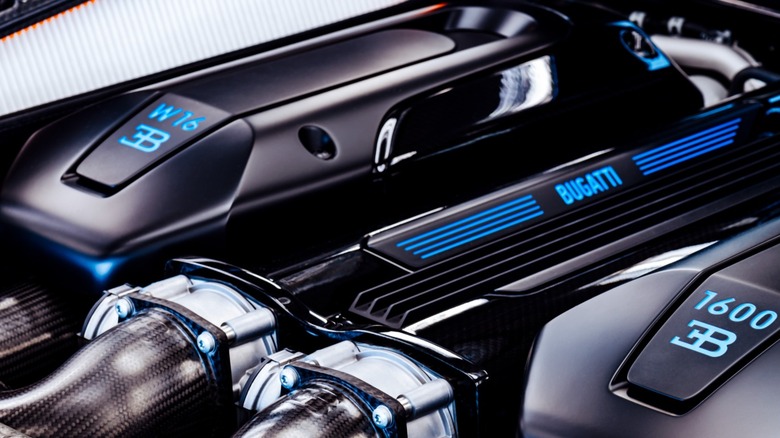
You know about inline engines like I-4s and even I-6s. Then there are V6 and V8 engines. And, if you're familiar with exotic sports cars, you know about V12s and V16s. What you don't hear about very often is the "W" formation of engines. While inline engines line all the cylinders in a row, and "V" engine lines them up into two banks, "W" engines line cylinders up into three or four banks. These go back to the beginning of the 20th century. A man named Alessandro Ambrogio Anzani built the Anzani W3 and put it in the motorcycles he manufactured in the first decade of the 1900s. In 1909, such an engine would be installed in an airplane called the Blériot XI, which would go on to become the first plane to fly across the English Channel.
Today, "W" engines are primarily attributed to Volkswagen AG , having evolved from the automaker's VR6 engines. Its "VR" engines would take the two rows of cylinders you would typically find in a "V" engine and place them together so compactly that they would fit under one cylinder head. Two of these "VR" arrangements are placed on one crankshaft to form a "W" engine. A W8 uses two VR4 blocks, a W12 uses two VR6 blocks, and a W16 uses two VR8s. Since the early 2000s, "W" engines have shown up in Audis, VWs, Bentleys, and Bugattis – and a W10 was recently put in the BMW M5. W18 engines have been built, as well, but it only found use in concept cars.
There were even bigger engines out there, like the Duesenberg W24 used to race boats. But official details on these engines are scarce, so this article will only focus on the W engines used in cars.
For the Passat: W8
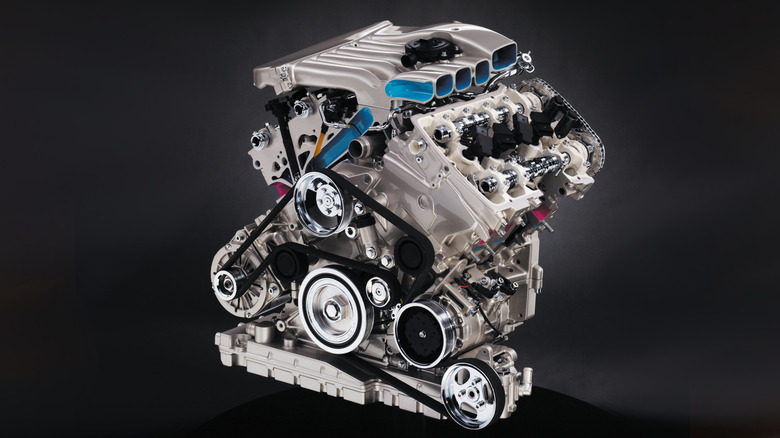
A major advantage of W8 engines comes from how they fit more cylinders in a tighter space. These engines might be a little wider than their "V" equivalents, but they are much shorter, too. You can see how compact the W8 looks in the picture above; it puts two VR4 blocks together but uses just one crankshaft. This design allowed Volkswagen to fit the W8 into its Passat, which had an engine bay that would normally only fit a V6.
This engine had a top speed of 155 miles per hour thanks to 271 horsepower and 272 pound-feet of torque. Those weren't incredibly impressive numbers compared to V8 engines of the time, and it had a combined fuel economy rating of just 18 mpg. Granted, it got good reviews for ride quality, but the W8 version of the Passat also started at about $38,000 — which is over $71,000 in today's money – making it a hard sell for most.
Volkswagen built the W8 for the Passat staring in 2001, but it abandoned the engine in 2005. The next generation of the Passat had a different orientation for its engine mounts that replaced the W block with a VR6. Still, the W8 found in that Passat has received a lot of love from enthusiasts today, allowing its legacy to last.
Widespread use: W12
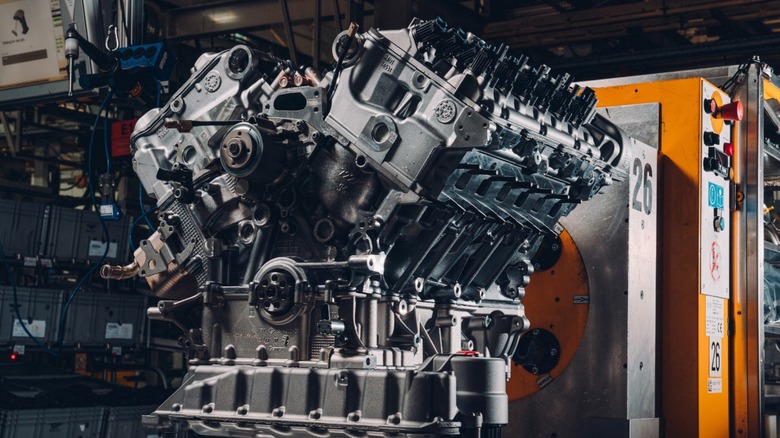
Maybe the most historically-significant W12 was the Napier Lion, which inhabited several kinds of British bombers and other military aircraft from the 1910s through the 1930s. It could put out 450 horsepower, making it the most powerful engine at the time. A car powered by a pair of them even broke a land speed record in 1939 at the Bonneville Salt Flats, achieving the blistering speed of 369.7 miles per hour. This particular W12 had three banks of four cylinders arranged in a broad arrow configuration, unlike the modern W12 by VW that uses four banks of three cylinders from two VR6s.
The Audi A8, Volkswagen's Phaeton and Touareg, Bentley's Continental GT, Flying Spur, Batur, and Bentayga, and Spyker's C12 La Turbie and Zagato all had W12 engines like this. Bentley would be the last brand to boast this configuration, only discontinuing its use in 2024. Instead, the automaker wanted to focus on its hybrid V8 with the goal of making something even more powerful than the W12.
Built for Bugatti: W16
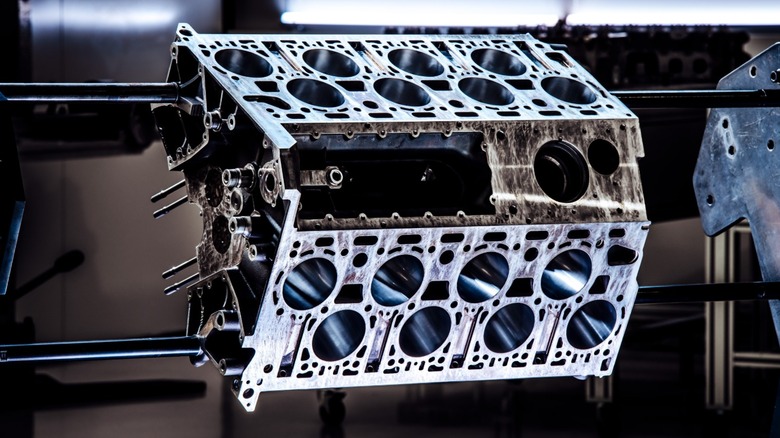
The modern W16 was built much like the other modern "W" engines. It was just bigger and more complex — and it was really only built for Bugatti. The automaker first started planning it in 1997, then tested it in 2001. It attached two eight-cylinder blocks at a 90-degree angle, meaning it had four rows of four cylinders. That allowed the engine to just be at the size of a typical V12 (which is still pretty big).
This thing had 64 valves and four turbochargers, and it could crank out nearly 1,500 horsepower when it came out. And that wasn't even its most powerful iteration, as the same engine in the Centodieci climbed to nearly 1,600 horsepower. Not many people need that much horsepower on the street, but these cars were made more for luxury than practicality. Speaking of which, the W16 engine in the Chiron needed 10 radiators, as well as the ability to move 60,000 liters of air and 800 liters of coolant per minute. Without all of that, it wouldn't be able to reach such massive levels of performance.
You won't find many traces of W16 engines beyond Volkswagen's umbrella, and you aren't likely to see it in any newer vehicles, either. Bugatti recently discontinued the Chiron's W16 in favor of a hybrid V16. As a result, the 2024 Chiron Super Sport L'Ultime and 2025 Mistral are currently the last Bugatti models to be mass-produced with W16 engines.
Concept-only: W18
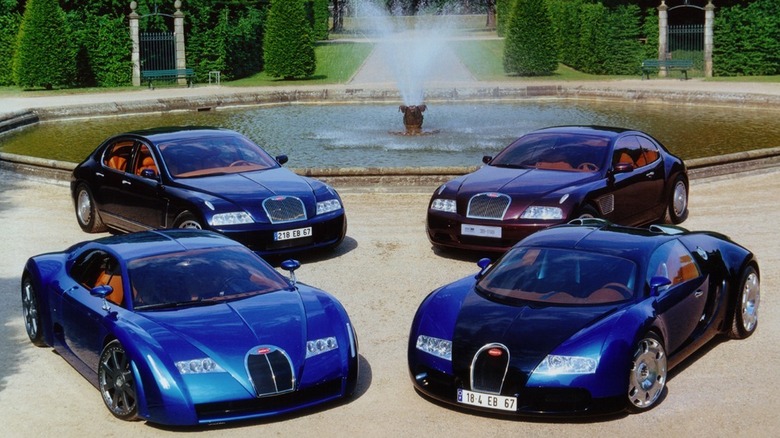
The history of the W18 goes at least as far back as the 1930s, when the Japanese Navy conceptualized three-bank W18s known as the Model 94 and YE2A. At least one version of the engine was fully built and tested, but it was made for aircraft, not cars. Regardless, after the war, Japan turned its attention to turbine engines — as did the rest of the world.
Volkswagen would experiment with the W18, as well. In 1997, VW CEO Ferdinand K. Piëch had apparently doodled a plan for a W18 engine on an envelope, combining three VR6 blocks as a concept for the Bugatti Veyron. But before that would come to fruition, there would be W18 engines built with three conventional inline banks of six cylinders each. They were all in concept cars, though, never making it to production.
The first concept car to boast a W18 engine was the Bugatti EB118, introduced in 1998. One year later, it was followed up by a concept of the Chiron at the Frankfurt Motor Show. The concept model was given the name of "18/3," indicating the engine's 18 cylinders and three banks. Another W18 would later show up in the Bugatti Veyron 18/4 concept car, though actual production Chirons and Veyrons would instead be powered by W16s.