

Trying To Find Parking In North Korea Is A Chore These Days
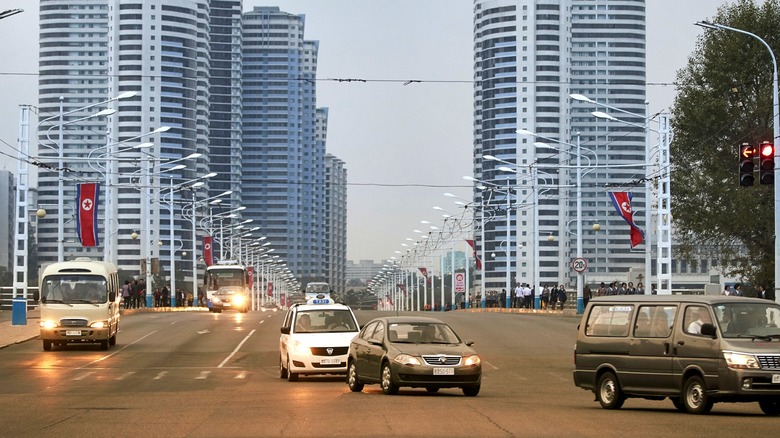
For a country that was reportedly banned from importing luxury goods, including cars for nearly two decades, it's surprising to see that North Korea's people are experiencing a phenomenon drivers in other countries know too well — trouble finding a parking spot. The car culture in the authoritarian state is alive and thriving, Reuters reports, when in reality it shouldn't be. Now there's just not enough spaces to accommodate all of these (potentially illegal) imported cars.
See, North Korea managed to ruffle some feathers back in 2003 when it decidedly removed itself from the Nuclear Non-Proliferation Treaty (NPT), and just two years later began testing its own nuclear weapons. The result was several resolutions passed over the next decade by the UN Security Council, placing further restrictive measures on North Korea's trade to prevent the growth of its weapons and nuclear programs, and also ensure the welfare of North Korea's people.
The first resolution banned the "direct or indirect supply, sale, or transfer" of luxury goods to North Korea, in which some took luxury goods to mean "cars." In 2017, two more resolutions were passed (2375 and 2379) which basically kneecapped crude oil and petroleum imports, the latter limited crude oil imports to just 4 million barrels per year. For comparison, the US on its own produces 16 million barrels a day. With an inability to bring cars into the country, or the oil to fuel them, how can private car ownership be spreading like wildfire and cause a parking headache?
Smuggling cars illegally is as easy as 1-2-3
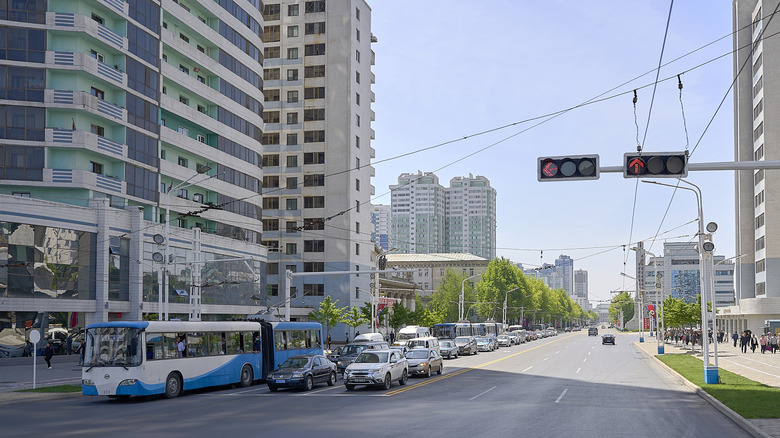
It would be naive to say sanctions are holding. Investigative reports — like one conducted in 2019 by the New York Times and Center for Advanced Defense Studies — revealed the expert ways and lengths in which controversial cargo can be imported into North Korea, while tracking what ended up being a delivery of Kim Jong Un's new armored cars.
Reuters revealed a preferred method of getting cars into North Korea relies on "informal channels" along the Chinese border. A used-car dealer in China's northeastern Jilin province told the outlet that vehicles change hands multiple times before crossing the North Korean border. Only a few experienced smugglers handle final deliveries. He confirmed cars that he had sold had ended up across the border, but insisted he didn't trade with the importers and "has no control over its resale or the end user."
Over the last three years, Reuters scanned social media posts by residents and visitors of Pyongyang to find several foreign-brand vehicles including Changan, Chery, and Geely — all Chinese brands — and European brands like BMW and Audi. When asked, Audi and BMW were insistent they have no involvement or business with North Korea. But Chinese manufacturers didn't comment on how their vehicles are making it to the forbidden territory.
Perhaps their mum approach on China's behalf might be due to the skyrocketing exports of things like lubricating oils and grease, new tires, and oddly, rear-view mirrors to North Korea.
Mo' cars, mo' parking problems
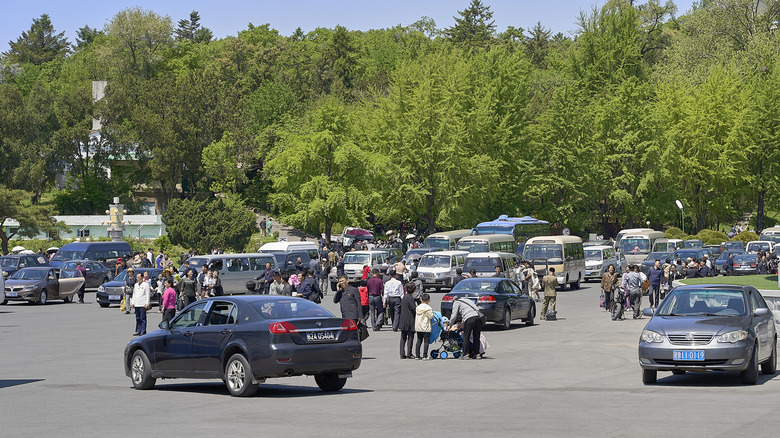
Chinese export records don't list the number of cars exported to North Korea, likely because it's prohibited by sanctions, and possibly because the cars are not "officially" exported either. While there are no specific numbers listed on how many cars are actually in the country, Reuters reports that the yellow private-owned license plates in images they have investigated have begun to show five-digit numbers, with one showing a number plate in the 10,000s, indicating a number close to that. Jung Change-Hyun, a North Korea analyst and director of the Korean Peace and Economy Institute think tank in Seoul, said that the number of cars could reach closer to 20,000 in the next year.
That doubling of cars in the country, especially in the capital, will just further exacerbate the traffic woes the lacking infrastructure is struggling to contain. A foreign businessman who regularly visits the country told Reuters that parking in the city has become difficult, and that many of the available spaces in Pyongyang are managed informally with attendants charging fees (sounding much like overflow parking for an event). State media released a video in October of North Korean dictator Kim Jong Un touring an underground parking garage, which is not commonly found in the capital.
It honestly sounds like trying to find parking in downtown Detroit during a game or event. In that case, it'll take a lot more than just a couple of ramped garages to fix its parking problems.