

Michelin Pioneered The Asymmetric Tire Tread, Here's Why It Was Revolutionary
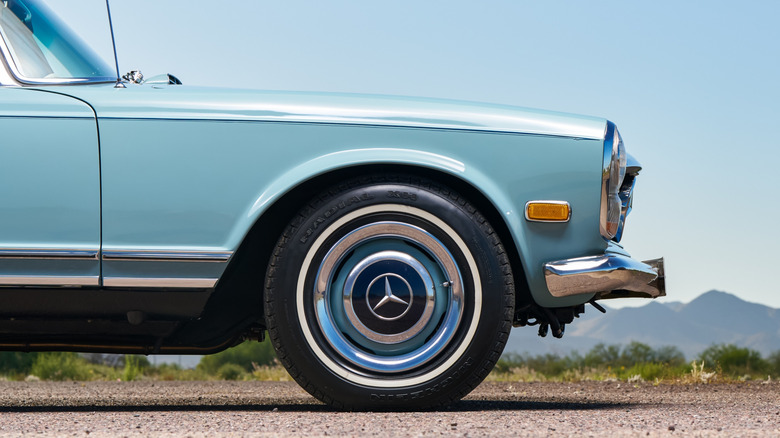
Not many companies have shaped the car tire in the same way Michelin has. Founded in 1889 by brothers Édouard and André Michelin in Clermont-Ferrand, France, the company has been responsible for some of the most consequential leaps in tire history. That includes the removable pneumatic tire in 1891 and the first radial tire in 1946 — innovations that eventually became global industry standards.
By the mid-1960s, sports cars were pushing harder into corners and were less stable at highway speeds than a symmetric tire could effectively handle. Michelin responded with another major innovation: the asymmetric tread design, introduced on the XAS tire in 1965. So what exactly is an asymmetric tire? The name says it all. Unlike a conventional symmetric tire, which looks the same on both sides and can be mounted in any orientation, an asymmetric tire has two distinct halves and an inside and an outside.
Each half is engineered for a different job, and because of that, the tire must be mounted in the specific orientation indicated on the sidewall. Outside of the tire goes out, inside goes in. Although there are many differences between symmetric, asymmetric, and directional tread patterns, the Michelin XAS was the first production tire to divide those responsibilities between the tread's halves. A breakthrough that still influences performance tire design to this day.
Split down the middle, built for everything

Before asymmetrical patterns, the uniformity of a single tread pattern kept things simple, but it also meant the tire couldn't be optimized for any one condition. Wet grip, dry cornering, straight-line stability — it all had to come from the same piece of rubber doing the same thing everywhere. For everyday driving, that was fine. For a sports cars, it simply wasn't good enough.
What Michelin figured out with the XAS was that the inner and outer halves of a tire don't face the same conditions — so why should they have the same tread? Nowadays, we understand that the inside of the tire deals mostly with displacing water, while the outer tread features stiffer blocks that matter most when it comes to dry cornering and less road noise. It follows a similar logic to how a person's foot is different on each side.
According to TireRack's explanation of the XAS asymmetric tread patterns, "the lower void outer shoulder allows for more tread in continuous surface contact and greater available grip during cornering. Greater void along the inner shoulder aids the four circumferential grooves in displacing water from the contact patch to increase hydroplaning resistance."
For a sports car driver in 1965, that was a genuine leap forward. Some of the best performance and ultra-high-performance tires sold today use the very principle Michelin's R&D department pioneered six decades ago, and which is why it was so revolutionary.
The cars that ran the Michelin XAS
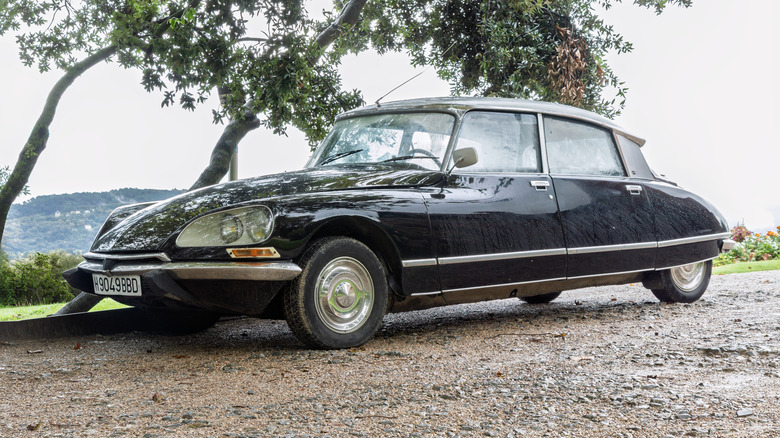
Although the XAS itself is the reason why asymmetric tires are so common today, the cars that required them played an equally important role. Back in the 1960s, the Porsche 911, 912, and 914 models all came with Michelin XAS tires from the factory. In a similar fashion, the iconic 1960s Citroen DS — the car that made it cool to be weird — also relied on the Michelin XAS. Many major European carmakers from the 1960s era (think Lancia, Austin Healey, Lotus, Aston Martin, Peugeot, Alfa Romeo, and Renault) dipped their toe into the world of Michelin XAS tires.
Some of these cars were able to reach serious speed, which is also why the XAS tire received a V speed rating, that's up to 149 mph (240 km/h). Nowadays, the tire market is much more competitive, and choosing the very best ultra-high-performance rubber is more difficult than ever. For OE fitments, some car brands go with Michelin and its Pilot Sport Cup range, others opt for the Pirelli Trofeos, and others the Goodyear Eagle F1S or Bridgestone Potenzas. Back in the 1960s when the Michelin XAS came to be, it was the only choice for what it offered.