

What's The Difference Between A Throttle Body And A Carburetor?
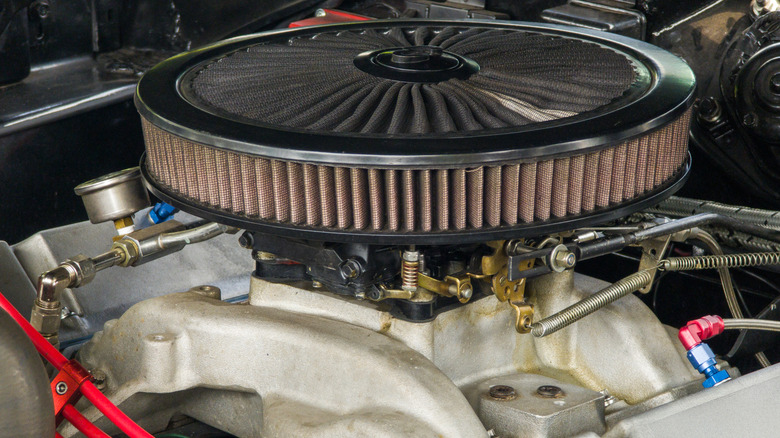
The throttle body and carburetor are alike in that they both feed an internal combustion engine with air, but carburetors are also responsible for adding fuel into the mix. Moreover, a carburetor has a throttle body that functions similarly to the throttle body of a fuel-injected engine, which could add to the confusion between the two.
Almost all vehicles manufactured in the late '80s and early '90s feature fuel injection and a separate throttle body, while older cars have carburetors that predate onboard diagnostics, sensors, and intricate electronics. Carburetors are the old-school approach to feeding an engine with atomized fuel and air, since their job is to provide the right ratio of air and fuel for optimal combustion and power. A carburetor typically sits on top of the engine and doesn't need electricity or sensors to run, since everything works mechanically. Owners can even fiddle with the air-to-fuel ratio by manually adjusting the throttle and air valves.
The pros and cons of electronic throttle bodies and carburetors
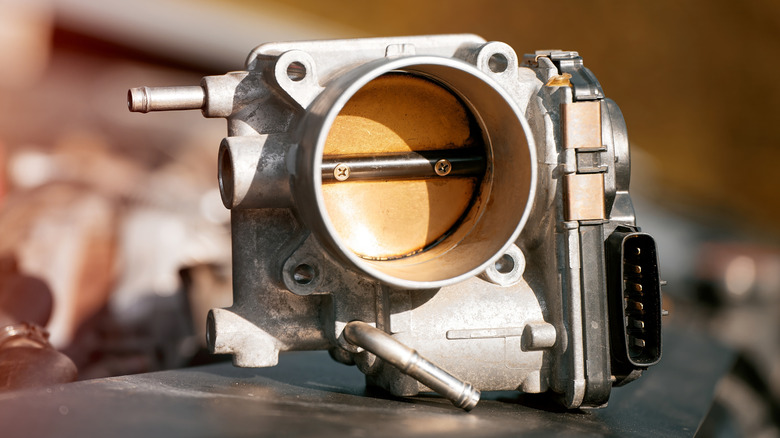
On the other hand, an electronic throttle body is different in that it only inhales air and not gasoline. Similar to the throttle body under a carburetor, the electronic version utilizes a butterfly valve to regulate the airflow into the manifold. It works with the throttle position sensor (TPS) and mass air flow sensor (MAF) to tell the engine control unit (ECU) how much fuel the injectors need to supply to match the amount of airflow. Since it mainly deals with airflow management, the throttle body of a fuel-injected engine is usually found between the main air hose (after the air filter) and the intake manifold.
Electronic throttle bodies lord over carburetors in the efficiency department. The fancy electronics and fuel injection enable modern engines to have a more precise air-fuel ratio for any load, driving situation, or throttle pedal application. The result is a more fuel-efficient engine. The biggest drawback of throttle bodies and fuel injection, however, is the cost. In some applications, a carburetor would cost half as much as electronic injection for a high-performance engine. Another downside to fuel injection and throttle bodies is the complex array of sensors, electronics, and vacuum lines that could make it tricky to diagnose, repair, or maintain the system without using dedicated OBD-II scanners and other gizmos.
Meanwhile, carburetors are cheap, simple, and offer straightforward upkeep. It still takes skill and know-how to fix or clean a carburetor with or without removing it, but they don't need scanners to tell you what's wrong. So while the analog nature of carburetors can help an engine produce more power, it loses in efficiency, emissions, and performance at extreme temperatures or high altitudes compared to electronic fuel injection.
Throttle bodies and carburetors require frequent maintenance
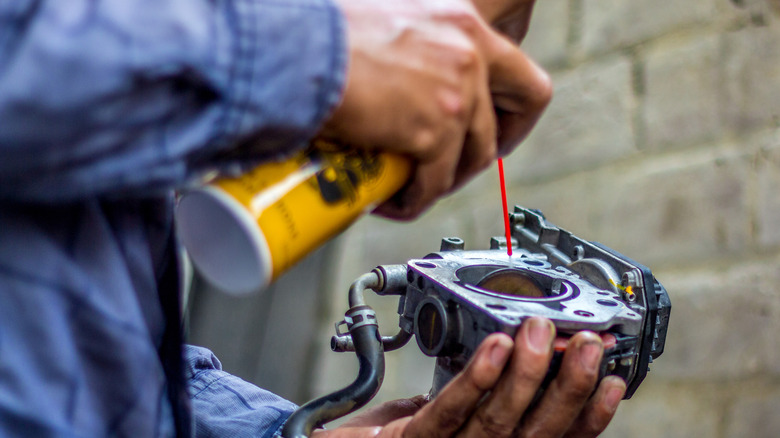
One of the similarities between throttle bodies and carburetors is that they both share a need for regular maintenance. Carburetors need cleaning if the engine is difficult to start, idles roughly, stalls, has a noticeable loss of power and acceleration, or drinks too much gas. Experts recommend cleaning your car or motorcycle's carburetor at least once a year before symptoms crop up.
Throttle bodies need cleaning, too, but not as often as carburetors. Hard starting (especially when the engine is cold), rough idling, and a sticky gas pedal are among the telltale signs of a dirty or clogged throttle body. The general rule is to clean it every 25,000 to 50,000 miles (depending on the manufacturer), but it is a good idea to do that when replacing the air filter, which makes a lot of sense. With that in mind, replacing your car's engine air filter once a year or every 12,000 to 15,000 miles is recommended for those who use ordinary paper air filters. Synthetic or washable air filters can last longer.