

Will Trump Suspend The Federal Gas Tax? Will The Sun Rise In The West? Are Any Of Us Forgiven?
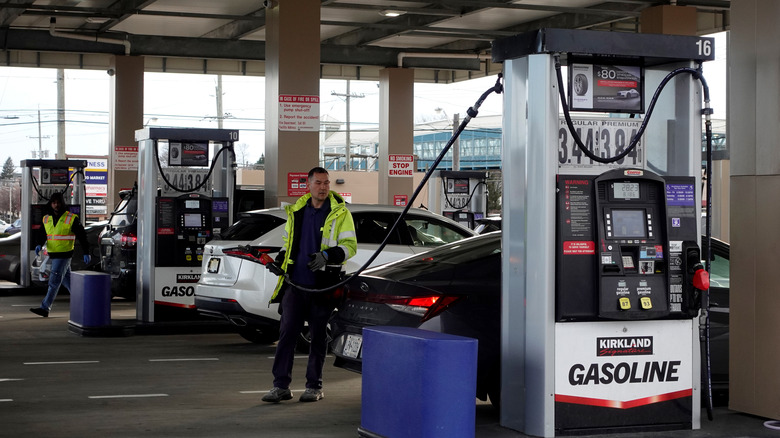
Currently, the average gas price in the U.S. is $4.50 a gallon, while diesel averages $5.64. That's not quite as expensive as fuel got in the U.S. when Russia first invaded Ukraine back in 2022, but it's still way higher than it was before Trump started his war with Iran and could soon look cheap in comparison if Gas Buddy's least optimistic predictions prove accurate. But while Trump's in a pickle trying to end a disastrous war he can't quite get out of, he has a solution to the high cost of fuel — just suspend the federal gas tax. But will he actually do it?
On a certain level, it's Trump, so there's a good chance he doesn't know which room he's in, much less what his plans are for the federal gas tax. But unless the Supreme Court decides to ignore the law that legal experts agree plainly states Congress has control over the federal gas tax, it isn't up to Trump. As President, he is the head of the executive branch of the federal government, and he's allowed to do his best to convince Congress to do what he wants, but he doesn't and shouldn't have any authority over the federal gas tax.
The legal side of things is certainly one part of the issue, but the other problem Trump has is that the federal gas tax only adds $0.183 to the cost of gasoline and $0.243 to a gallon of diesel. Suspending the federal gas tax would save drivers a little bit of money, but the price they'd pay would still be far higher than it was before Trump started his war with Iran. Maybe he could talk Congress into doing it for him, and we don't know that he couldn't convince the Supreme Court to let him circumvent both the law and Congress, but would the juice be worth the squeeze? Probably not when most voters won't love paying $4.30 or more either.
But should Trump suspend the national gas tax?
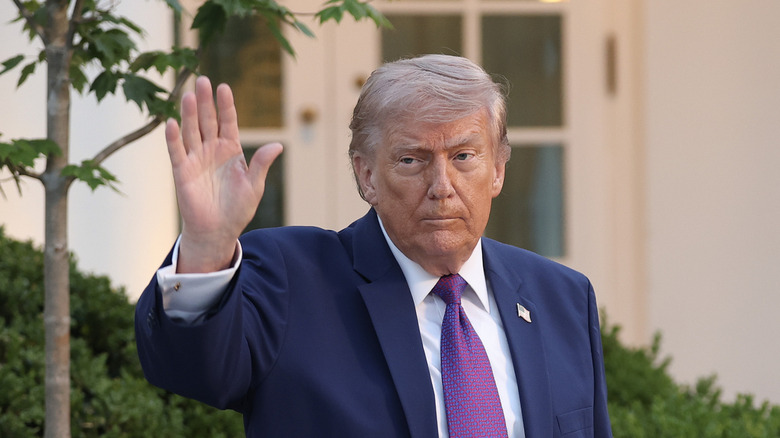
While cutting $0.18 off the price of a gallon of gas wouldn't bring the cost back below $3.00, it would still add up over time. As Trump told reporters in the White House on Monday, "It's a small percentage, but it's, you know, it's still money." That's right 10,000 Tariff Grandpa, it is still money. So should Trump find a way to do it anyway? Since it's Trump, answers could easily be biased, but conveniently, Biden also suggested suspending the federal gas tax back in 2022, and we can still see what the experts said when Trump wasn't president.
Back when Biden was the one desperate to lower gas prices, the Washington Post certainly wasn't sold on the idea:
But the idea was met with skepticism from lawmakers in both parties. Economists are also lukewarm on the idea. Many are unconvinced that putting the federal gas tax on hold would bring prices down. They worry it would be a costly giveaway to the oil industry that ultimately aggravates the energy shortage.
Part of the reason economists cautioned against suspending the federal gas tax in 2022 had to do with our old friend supply and demand. Suspending the federal gas tax would have made gas cheaper, but it wouldn't have increased the supply of gasoline, and according to the graph in this Intro to Economics textbook, when demand goes up and supply stays constant, bad things happen to gas prices. So the oil companies would get richer, but regular Americans probably wouldn't see prices drop for long.
The other issue is that the federal gas tax goes directly into what's known as the Highway Trust Fund, and suspending it would take billions of dollars away from important infrastructure projects. Or, as the Washington Post put it at the time, "That is money badly needed to invest in roads, bridges and other public works at a time America's infrastructure is suffering neglect." In fact, it was considered such a bad idea that Nancy Pelosi and Senator Marsha Blackburn somehow ended up on the same side of the issue.
Aside from the part where Marsha blamed Biden for Putin's invasion of Ukraine, all the old arguments from 2022 still make plenty of sense in 2026, so should Trump suspend the federal gas tax? Absolutely not, and Congress should refuse to allow it.