

Why Mercedes' U.S. Diesel Sales In The 80s Went From 4-Out-Of-5 To Footnote
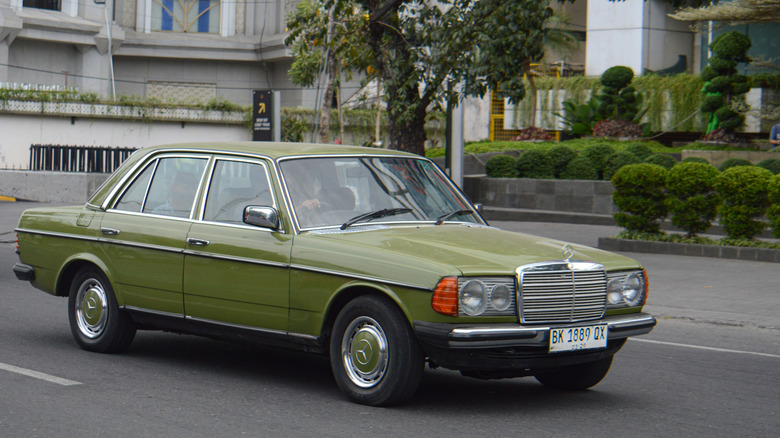
Certain automakers' cache is formed in their powerplants. We can't think of Porsche without hearing their ravenous flat-six engines, nor can we imagine GM, Ford, and AMC muscle cars of the late '60s and early '70s without ground-pounding V8s.
Nowadays, Mercedes-Benz and its performance arm, Mercedes-AMG, have more than a few powertrains that have caught the attention of enthusiasts, like the twin-turbo 4.0-liter V8 found in the G63 and hybridized, turbocharged 2.0-liter under the latest C63's hood. Even if the latter is not exactly universally adored. But back in the '80s, MB was most known for its selection of sturdy turbodiesel inline-fours and sixes; they accounted for nearly 80% of the brand's sales.
In case you didn't notice, Mercedes hasn't sold any diesel-equipped passenger vehicles (i.e. nothing above an SUV) since 2016. Why did Mercedes' U.S. diesel sales in the '80s go from four-out-of-five to footnote? There are some significant reasons, so let's discuss them, but first riff on why those rackety iron-block wonders from the Decade of Decadence were so good.
The legendary W123
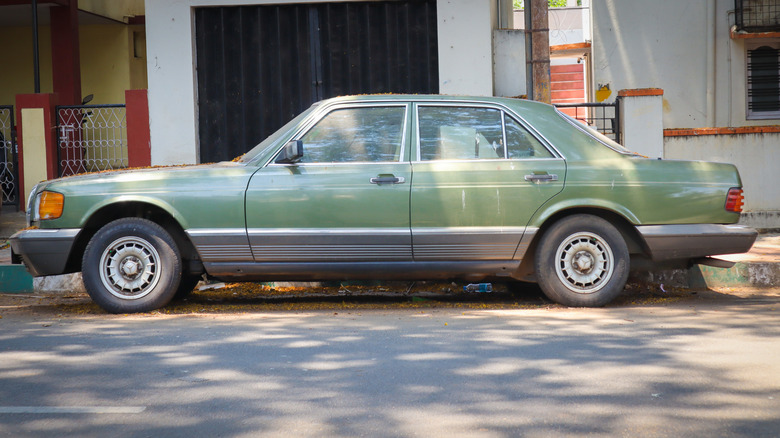
Back in 1976, MB debuted the W123 chassis that's widely regarded as over-engineered. Its various models may possess timeless iconic styling, but what's more important is how they were put together. Offering good corrosion resistance, suspension lasting 300,000 miles, and engines that were designed not to need a major service until the odometer hits at least 600,000, they were bulletproof. It was a time when built-to-last mattered, and some high-mileage Mercedes models certainly prove this. Later, the W126 and W201 followed the same formula in '78 and '84, respectively.
A plethora of engines came in '70s and '80s Benzes, but those running on diesel were the most popular. The gasoline crisis of the '70s certainly spurred this on, since automakers were looking for ways to bolster fuel economy and diesel could do the job.
The W123 300D featured an OM617 3.0-liter inline-five that produced 80 horsepower and 127 pound-feet of torque when it hit dealers in 1977. Once turbocharged in 1982, those figures increased to 121 and 170, respectively. The former got around 22-25 mpg combined, whereas the turbo variant dropped to 20-23 mpg. These figures aren't much by today's standards, but meant a lot back then.
Another highlight of the era was the W126 300SDL of 1986. Under its hood was the turbocharged OM603 3.0-liter inline-six which put out 148 hp and 201 lb. ft of torque, and was good for 20-22 mpg.
No matter the model, overall solidity is a common theme. "Everything just seems to grow naturally from the car's basic mass," Csaba Csere of Car And Driver wrote of the '82 300CD in 1982. "The general impression is that you could go through anything with the 300CD and it would just turn around and ask for more."
Falling out of favor
Fast forward to more modern times, and passenger vehicle diesels have become a very niche market. Back in 2016, Mercedes made the decision to give diesels the kibosh in the US. Between diesels becoming increasingly harder to pass 50-state emissions regulations, which includes injecting DEF (diesel exhaust fluid, which is mostly Urea) into the exhaust, and the fallout of Dieselgate, this makes sense.
Emissions regulations have tightened quite a bit over the past decade, and with hybridization becoming so commonplace so quickly, it seems like a more fruitful area of investment. And no automaker (or consumer) wants to relive the infamous Dieselgate scandal. Because Volkswagen was cheating in emissions tests, the ripple effect was massive, leading twenty-five billion dollars down the drain, and consumers having to deal with fixes and buybacks.
MB/Daimler actually was investigated by the California Air Resources Board (CARB) in 2016 and found guilty of unscrupulous activity surrounding its diesels. But it only got a slap on the wrist; it had to fix/upgrade consumers' emissions controls for free. OK, $1.5 billion isn't exactly a slap on the wrist, but it's way less than what VW had to cough up. As recently as last year, five automakers were put on trial for their diesel-cheating ways, too.
In terms of why Mercedes' US diesel sales in the 80s went from four-out-of-five to footnote, well, it's all due to increasingly strict emissions regulations and the prevalence of hybridization. But at least those old '80s models are still cruising around, holding up traffic in cities' trendy neighborhoods across the nation, and still deeply admired by enthusiasts. It's a good thing they were built so well.