

Which Car Was The First To Have A 6-Speed Transmission?
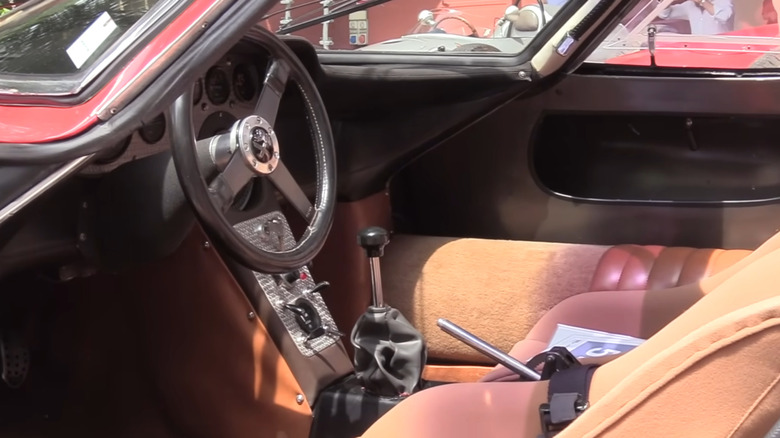
Ever since French inventors Louis-René Panhard and Émile Levassor demonstrated their three-speed manual transmission in 1894 — the first manual ever — the automotive realm has been fascinated by shifting one's own gears. Whether it's to make the most of an engine's powerband, a better sense of control, or simply the engagement factor, there's something special about them that keeps enthusiasts hell-bent on preferring them. Even as conventional and dual-clutch automatics become faster and more exciting, they often stack as many as eight gears within their cases.
Nothing beats a slick-shifting six-speed manual transmission. As we found in our reviews, the unit that Ford throws in the current Mustang Dark Horse is great to operate, as is the six-speed manual that's exclusive to the Acura Integra Type S and its Honda Civic Type R sibling.
Before these, however, the increasing prevalence of six forward gears in enthusiast rides really popped off (or, rather, slotted in) in the 1980s and 1990s. But which car was the first to have a six-speed transmission? The timeline goes back further than you may think. Let's get one thing out of the way, though: We're talking six forward speeds; reverse doesn't count.
The first manufacturer to offer six ratios for moving forward wasn't a sporty name from Europe, but rather Indiana's own Auburn with its dual-ratio rear axle in 1932. The transmission was actually a three-speed, but it functioned like a six-speed by adding a selectable high and low range using a vacuum-actuated clutch to engage or disengage a planetary gear set inside the rear differential. The driver could switch between the two ranges by moving a lever on the steering wheel at speeds under 40 mph.
The first production 6-speed manual transmission came from a race car
But the story of six forward speeds doesn't end there. The first street-going automobile to feature six individual forward gears is believed to be the 1967 Alfa Romeo 33 Stradale. Well, barely street-going, as it was homologated from the Tipo 33 race car, and production was capped at 18 units. Housed within its beautiful handmade clamshell body was a 2.0-liter V-8 making 220 horsepower – we can only imagine that revving this thing out while rowing through six gears must be heavenly.
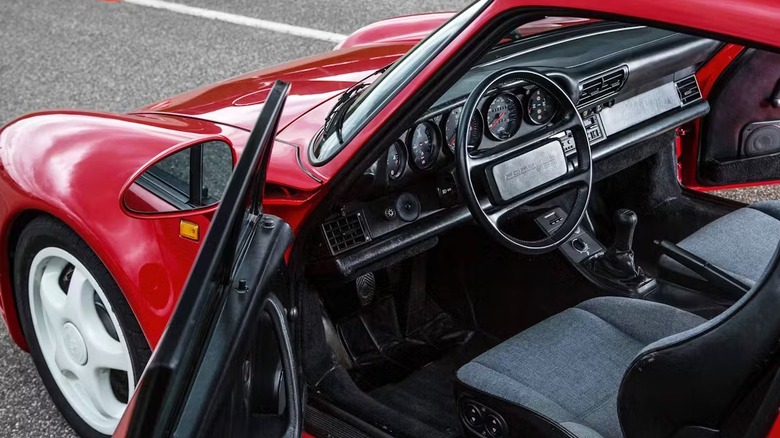
When it comes to the first supercar to have six cogs behind (or in this case, in front of) its crankshaft, the 1983 Porsche 959 claims that title, but it has a slightly odd way of going about it. The first forward gear is the G gear, which stands for Gëlande — off-road, as English speakers know it — a carryover from the 959's Group B rally engineering. Its very short ratio was meant for maximum low-speed torque, as one often needs in off-road scenarios, and Porsche dubbed the second gear "first" to pass some countries' noise regulations. Only 292 road-going 959s were built.
In terms of which car was the first to have a six-speed transmission, it's cool that Auburn claims the title, even if it technically was six ratios and not six individual gears. Thirty years after that, Alfa Romeo made it six gears. Then, 20 years after that, Porsche's first supercar was renowned for having six of its own — even if it wasn't technically marketed as such.