

How Complaints From The British Led To Harley-Davidson Creating The XR-750
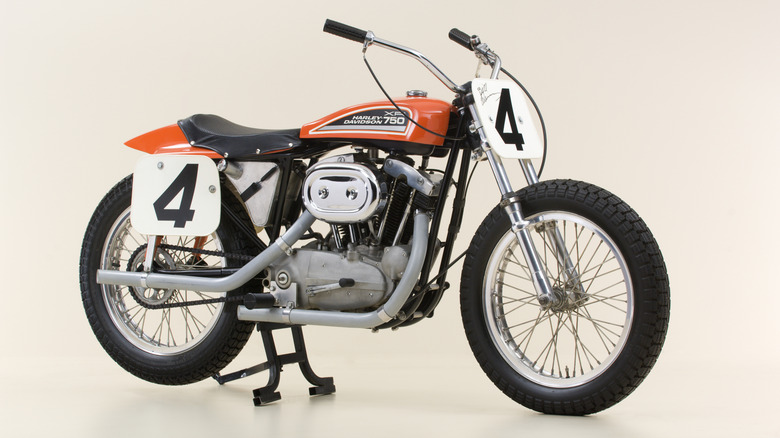
Cue the bald eagles and ridiculous fireworks display. Evel Knievel, the legendary stunt motorcyclist and storied death defier, had a way of taking patriotically themed displays of his disregard for his own safety and turning them into crowd-enthralling spectacles. And what was he riding when he lined up to launch himself through the air at 100 mph? Often, his mount of choice was a Harley-Davidson XR-750. If the bike wasn't American enough by itself, Knievel's XR-750 was adorned in the good ol' Stars and Stripes. Subtlety wasn't part of the formula.
Well, as it turns out, the XR-750 might be as British as teatime and not going into crushing debt paying for health care. That's right; one of Evel Knievel's most beloved mounts owes its existence to British motorcycle marques' complaints of unfair advantages favoring Harley-Davidson's bikes in the American Motorcyclist Association (AMA) Grand National Championship. Frankly, we're grateful they complained. The result of the griping was none other than the most successful motorcycle in AMA Pro Racing history. See? Complaining can work. Especially if its from a storied brand like Norton.
The Brits forced Harley-Davidson's hand by complaining to the AMA
The year was 1969. Hundreds of millions of viewers tuned in to watch the moon landing. Woodstock blew attendees' minds. And in motorcycle racing, the AMA Grand National Championship's rules regarding engine displacement bowed to pressure from British motorcycle makers.
Before 1969, displacement regulations mandated that side-valve engines, like the kind of stuff Harley-Davidson was fielding, could be up to 750 cubic centimeters (45.8 cubic inches). Overhead-valve (OHV) engines, on the other hand, were limited to 500cc (about 30.5 cubic inches). That put British brands in the Grand National Championship, like Triumph, Norton, and the once-iconic BSA, at a distinct disadvantage. At first, the British motorcycle brands just put up with it. Sort of. But by the later part of the decade, the Brits were pushing to change the rules. After some pressure, the AMA agreed to allow OHV-engined bikes to have up to 750cc of displacement.
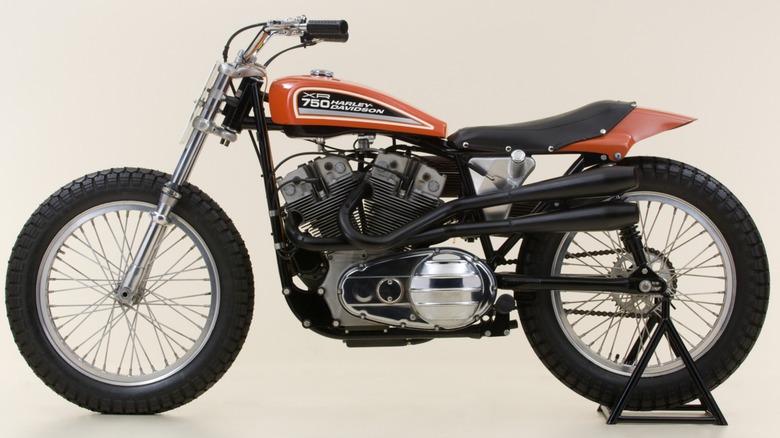
With a newly leveled playing field, Harley-Davidson Race Team Manager Dick O'Brian and his team set to work adapting the design of its 900cc (55 cubic-inch) Sportster XLR Ironhead engine for use in the AMA Grand National Championship. The bike would have to replace the KR750 and its air-cooled, side-valve 45-cubic-inch flathead. To make things work with the new rules, the team had to set up the design of the Sportster's twin to handle flat track racing. They improved the oiling of the original design, added special cast-iron cylinder heads, ditched the generator for a magneto, and met the 750cc displacement limit. Just like that, the Motor Company's racing team had created something special.
A Harley-Davidson racing record that stands today
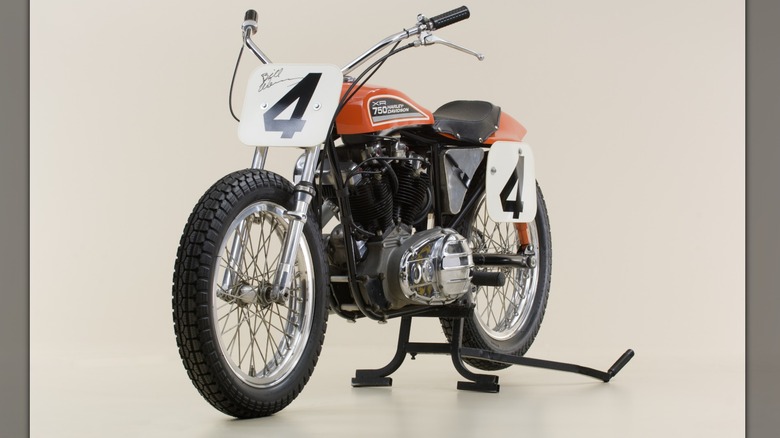
By 1972, the XR-750 had a further-improved, more powerful aluminum version of the Ironhead OHV engine. As if born to it, the bike dominated the gnarly sport of flat track racing. Just how dominating was the little V-Twin flat tracker? The XR-750 won 28 of 37 Grand National Championships between 1972 and 2008.
That's kind of a big deal. The 2020 season marked the 50th anniversary of the the XR-750's racing debut. To commemorate the milestone, Harley-Davidson fielded an updated version of the old flat track winner with the XG750R. And though it bears a resemblance to the XR-750, the newer bike packs a much more modern liquid-cooled and fuel-injected V-Twin.
The XR-750's AMA racing successes should be reason enough for the flat tracker to enjoy some reverence among motorcycle fans. But the born-of-British-complaining bike didn't just stick to flat track racing. Or stick to the ground, for that matter. The aforementioned daredevil, Evel Knievel, jumped the XR-750 time and time again from 1970 to 1976. Why the XR-750? Knievel chose the little flat tracker for the same reason that Harley-Davidson enjoyed so much success with it: it was light, sturdy, full of character, and refused to lose.