

What's The Difference Between An Idler Pulley And A Tensioner Pulley?
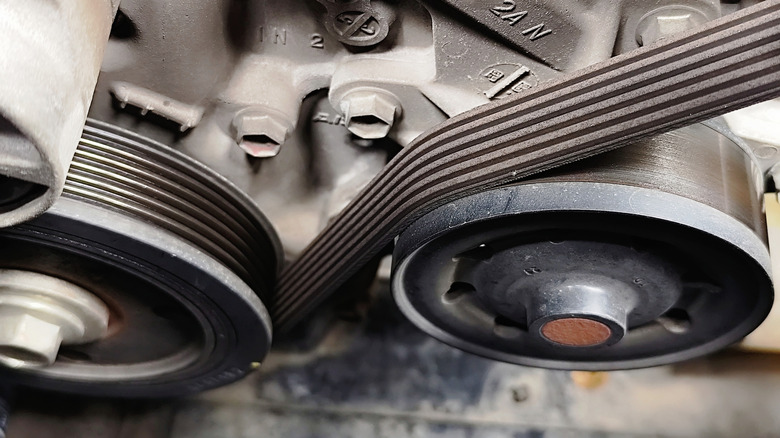
If you've ever popped the hood of a running car, you probably noticed all the activity going on. Up top, you may hear the rhythmic ticking of the fuel injectors, then, if the engine was just fired up after sitting a while, the secondary air injection system may be pumping away, ensuring the catalytic converter heats up as quickly as possible.
Visually, depending upon how much paneling is in the way, you might see the accessory belt system doing its thing, spinning the alternator, air conditioning compressor, water pump, and power steering pump (if its power steering system utilizes hydraulic fluid). It might even be connected to a supercharger if it's a spicier ride.
Zeroing in on this particular system, they all utilize what are known as idler pulleys and tensioner pulleys. But what's the difference between the two? They both play crucial roles in an engine's healthy operation, and may appear very similar upon first glance. But again, we draw your attention to the word "roles" — they might share the same belt, but their functions can be quite different from one another. Let's turn the key and fire up some knowledge on what exactly the idler pulley and tensioner pulley do.
An idler pulley does exactly what you might expect
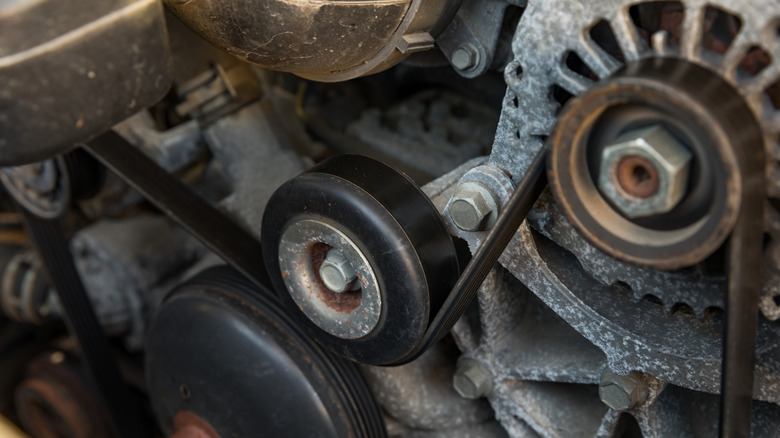
Let's get one important point out of the way, first: the idler pulley has nothing to do with '80s punk band, The Teen Idles. No, instead, it rather just sits there, well, idle.
It's spinning, but its job is to guide the drive belt (particularly in a serpentine belt setup) through the manufacturer's designated path, ensuring all components it contacts — like the water pump, alternator, etc — get the right amount of belt surface area, at the right angle, and as true as possible. By the latter, we mean, it keeps the belt running straight. This ensures everything spins smoothly and prevents it from slipping off or getting shredded.
Then, there's the tensioner pulley. This keeps tension on the belt so everything spins as it should, preventing belt slippage. Typically, a tensioner pulley has a provision for a socket to grab hold of. When turned a certain direction, it de-tensions the belt to allow its removal. De-tensioning it to install a belt can be tricky on some vehicles, as it may require finessing the belt to ensure its routed correctly before tightening it up.
More crucially, tensioner pulleys play an important role in engines that utilize belts for their timing system. An engine's valve timing is precisely in sync with the crankshaft — if it's not, it could lead to catastrophic engine damage. A timing belt with either a worn out or poorly installed tensioner pulley could allow the belt to skip a tooth, which could make it jump out of time, or snap if it's adjusted too tightly. This author's done both the timing belt and accessory belt on their B5-generation Audi S4; if the former's tensioner pulley isn't replaced or properly installed, it could spell disaster.
Types of tensioner pulleys and what to look out for
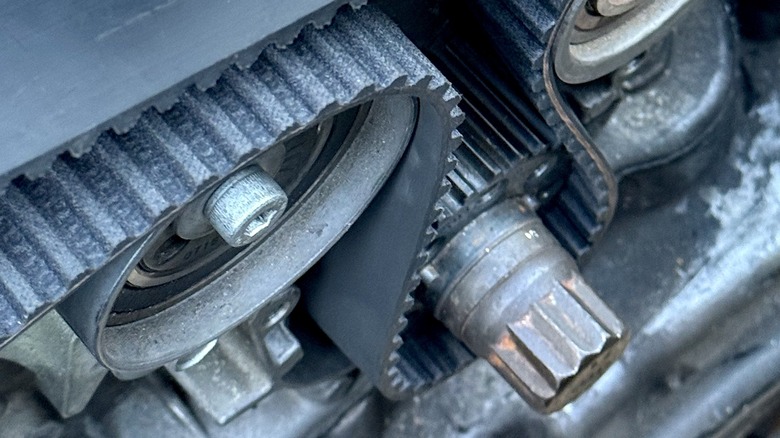
The two common types of tensioner pulleys are either spring- or hydraulically actuated. The latter can be a ram that pops out and pushes on an arm to push a roller — like the B5 Audi S4's timing belt tensioner. That push is what puts tension on the belt. When a spring is involved, it's the force that's maintaining tension. Some accessory drive systems may have a manual tensioner, meaning you set the tension yourself and tighten the bolt to the manufacturer's specific guidelines.
It's easy to ensure tensioner and idler pulleys are in good condition and doing their jobs as efficiently and effectively as possible. A tensioner pulley shouldn't have any movement or play, with or without load. Then, any chirping, squealing, or grinding coming from the belt could be a shot bearing in either type of pulley. Removing the belt and spinning each individual pulley will narrow down what's making a racket. This could also point to a belt misalignment — make sure all components are bolted on straight and to the proper torque spec outlined in a shop manual. The pulley may spin more than one or two revolutions, which indicates its bearings are shot. If the pulley doesn't move at all, it's seized and putting a lot of undue stress on the system.
In short, then, what's the difference between an idler pulley and a tensioner pulley? Well, is it simply sitting there keeping the belt aligned in the right routing, or providing tension to ensure the belt is taut enough for optimal component and engine operation? The former is an idler pulley, and the latter is a tensioner pulley.