

How Different Countries Tackled Hand Signals Before Mechanical Turn Signals Were Invented

Turn signals are one of the earliest automotive safety features. In the early 1900s, some cars came with mechanical arm "trafficators" that would pop out of either side of the car to indicate a turn. In 1908, Italian inventor Alfredo Barachini was granted a patent for illuminated traffictors, and French automaker Talbot began putting modern-style illuminated arrows on its cars in the 1930s. However, despite turn signals existing for over a century, there wasn't a uniform method of mechanical turn signal implementation, and they weren't even required by law in the United States until 1953.
Since turn signals weren't uniform for the first half-century or so of the automobile, many drivers were still required to learn hand signals. But it became tricky when traveling internationally, as different countries tackled hand signals differently. While they didn't vary wildly between countries, there were enough differences to cause confusion, and standards haven't really improved since then. Some countries still have confusing hand signals, some use the same gestures for entirely different purposes, and some even lack basic ones. So how did the world handle this before blinkers?
How are hand signals used while driving in the U.S.?
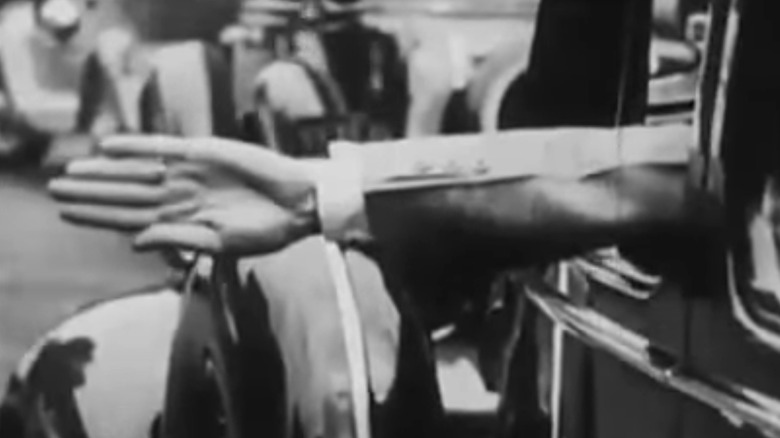
There are three main hand signals for U.S. drivers, but they're a bit different than the original three from before mechanical turn signals. The original hand signals were as follows: A left arm straight out of the driver's window, with the back of the hand facing backwards, indicated a left turn. A left arm out with the palm facing backwards meant the car was slowing to a stop. Lastly, an arm making clockwise circles (from the driver's perspective) indicated a right turn.
The only one of those signals that remains is the left turn. Signaling a right turn is now far easier to see that someone vaguely moving their arm around, as it's an arm bent upwards at a 90-degree angle. Stopping is even clearer than having to notice weather someone's palm is facing forwards or backwards. Instead, a stop signal is an arm bent down at a 90-degree angle.
The need for hand signals died out pretty quickly into the automobile's existence, especially once Buick became the first American car company to use blinkers in 1939. But if one one or both of your blinkers stop working, it's good to know how to alert other drivers of your upcoming turn. These are also the same hand signals used by cyclists; sharing the road with cars can be dangerous for them, so it's important for drivers to know what their hand signals are. Of course, while cyclists can still signal a right turn with an upward 90-degree bent arm, they can also just stick their right arm straight out. There's nothing blocking the view of them doing so, after all.
What are the hand signal similarities and differences in other countries?
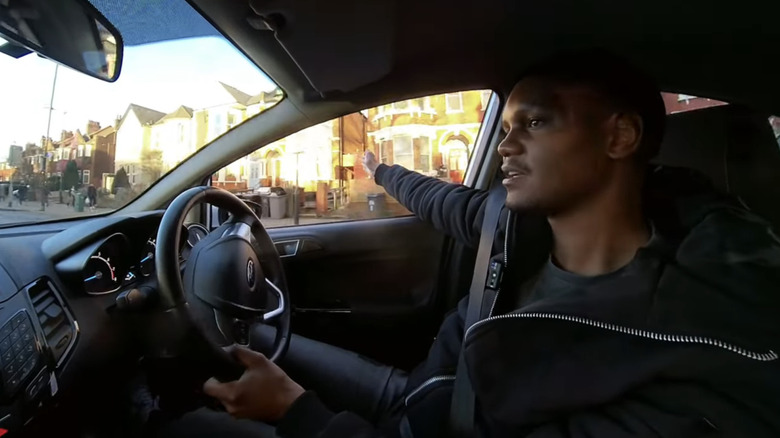
Hand signals have always varied in other countries, but information about such variations is sparse, so it's hard to pin down if the ones used today are the originals. Since they evolved in America, it stands to reason they may have changed throughout the years in other areas, too. In fact, the 1931 U.K. highway code sheds some light on how the country's hand signals were first used.
Since U.K. cars are right-hand-drive, drivers would stick their right hand out with their palm facing forward to signal a right turn. It gets trickier from there, though. To signal slowing down, the driver would stick their right arm out, palm down, and wave it up and down with a limp wrist. To let traffic behind them know it's safe to pass, they'd extend their arm below the window line and move it in a back and forth motion. Interestingly, gestures for signaling a stop and turning left are depicted, but only while driving a horse-drawn carriage and holding a whip.
In the U.K. today, the right turn gesture is the same. The up and down motion is now to indicate that the driver's about to street park. A left turn signal does exist now, at least; for that, they stick their right arm straight out, but they then make counter-clockwise circles with it. Australia is similar, but the stop gesture is an upward 90-degree arm bend and left-turn hand signals are still seemingly nonexistent. Spanish hand signals are similar to the U.S., but slowing down uses the old U.K. up-and-down motion. Thankfully, illuminated turn signals exist, helping to bring some uniformity. That doesn't mean some automakers don't make dumb blinkers, but at least they all mostly work the same.